Page loaded successfully. Showing biography for Lawrence Kupferman.
Lawrence Kupferman BIOGRAPHY
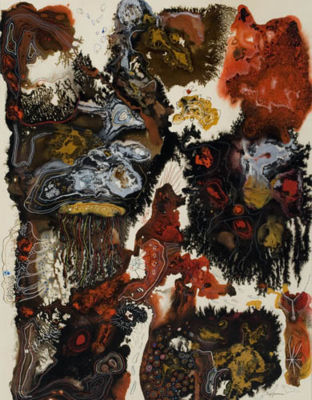
1909 Dorchester, Massachusetts - 1982 Boston, Massachusetts. Known for: Abstract, surreal painting, teaching.
During the 1930s, Lawrence Edward Kupferman was employed by the Works Progress Administration, making a series of etchings and dry points, mostly of the facades of houses. His style changed... Read full biography
During the 1930s, Lawrence Edward Kupferman was employed by the Works Progress Administration, making a series of etchings and dry points, mostly of the facades of houses. His style changed completely in the 1940s, becoming first political and expressionist, and later abstract expressionist. In... Read full biography
During the 1930s, Lawrence Edward Kupferman was employed by the Works Progress Administration, making a series of etchings and dry points, mostly of the facades of houses. His style changed completely in the 1940s, becoming first political and expressionist, and later abstract expressionist. In very recent years he had returned to making prints of buildings in his first manner. As an educator, he served as chairman of the department of painting at the Massachusetts College of Arts. Source:.... Read full biography
During the 1930s, Lawrence Edward Kupferman was employed by the Works Progress Administration, making a series of etchings and dry points, mostly of the facades of houses. His style changed completely in the 1940s, becoming first political and expressionist, and later abstract expressionist. In very recent years he had returned to making prints of buildings in his first manner. As an educator, he served as chairman of the department of painting at the Massachusetts College of Arts. Source:. Marilyn Pink Fine Arts... Read full biography
During the 1930s, Lawrence Edward Kupferman was employed by the Works Progress Administration, making a series of etchings and dry points, mostly of the facades of houses. His style changed completely in the 1940s, becoming first political and expressionist, and later abstract expressionist. In very recent years he had returned to making prints of buildings in his first manner. As an educator, he served as chairman of the department of painting at the Massachusetts College of Arts. Source:. Marilyn Pink Fine Arts... Read full biography
Artist Biography
Biography page for Lawrence Kupferman ((1909 - 1982)), known for Abstract, surreal painting, teaching. Showing 2 biographical entries and 0 sample artworks.
Lawrence Kupferman - Artist Info
About Lawrence Kupferman
Biography from the Archives of askART
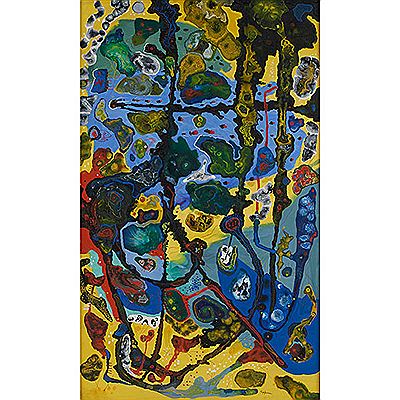 During the 1930s, Lawrence Edward Kupferman was employed by the Works Progress Administration, making a series of etchings and dry points, mostly of the facades of houses. His style changed completely in the 1940s, becoming first political and expressionist, and later abstract expressionist. In very recent years he had returned to making prints of buildings in his first manner.
As an educator, he served as chairman of the department of painting at the Massachusetts College of Arts.
Source:
Marilyn Pink Fine ArtsBiography from Pierce Galleries
Unconventional Modernist Lawrence Kupferman (1909-1982) innovated many of the technical achievements used by more famous artists, but few critics recognized his unique genius.
Art was the chronicler of and the archive for Kupferman's mind wanderings. As concepts evolved and were redefined, the artist's brush represented being in past, present, and future time. His pigments ooze, lines oscillate, and avenues of flowing, jelly-like paint river through or fade into and out of space.
Kupferman took motifs from tangible and sensed realities. His atmospheres symbolize cosmic space. Existence is spiritualized as a connected covenant with all of creation. Veil-like, mysterious lines move like vapors over washes of opaque translucent colors that blend, erupt or fade into seas of time-like space and souls become one with an ever-moving, deepening milieu.
He admitted, "My figures journey to greet an eternal fellowship with nature's every particle. . . .
"Around 1941, I started to pour paint onto canvases in Provincetown. Jackson Pollock came into my studio to observe how I let paint take on a liquid life or path of its own. Those ethereal poured paintings may have stimulated Pollock's more frantic splashed-on techniques," Kupferman said thoughtfully. "I want paint to find its own way on canvas, just as if it were a person discovering his or her way in life…. My personal background has a lot to do with why I have that goal."
Kupferman was born on March 25, 1909, in Dorchester, MA, the son of an impoverished Austrian Jew Samuel Kupferman (cigar maker) and his wife Rose. In 1914, he was not told his mother had died and was sent to live with grandparents. He waited and expected his mother to return and filled hours by drawing. Two years later, he was devastated to hear his mother was dead. During that period, classmates discriminated against Jews. He began to formulate that reality is not what it seems and that in the hidden, illusive, unseen elements of the abstract, authenticity and certainty can be found.
"Being a short, homely Jewish kid in a predominantly Irish-Catholic, snobby town, I admit, I was a lonely, misunderstood, introverted boy. I vowed when I was eight, that I'd never be narrow-sighted, deceitful, or mean like the children and adults with whom I grew up."
In the late 1920s, Kupferman attended Boston's Museum School to study with Philip L. Hale and lamented, "Hale was rigid, straight-laced, unfriendly and too restrictive. He didn't allow any freedom of expression and I craved to find that in art. Beyond that, I considered the Boston school passé."
In 1932, Kupferman studied with Ernest L. Major at MASS College of Art, and met and married fellow artist Ruth Cobb (1937). During the 1930s, his painted hard lines began to dissolve, bleach and cave-in during the Great Depression, and desolation and anguish crept into his work. He worked as an etcher for the WPA and began to question the isolation of individuals within crowded cities.
Jack Levine (b. 1915), Hyman Bloom (b. 1913) and David Aronson (b. 1923) founded the "The Boston Urban Jewish School," whose roots ran deep into traditional Hebraic scholarship. Their work depicted graphically and without restriction the social problems and moral issues of their era.
Hitler's WWII atrocities against the Jews enraged Kupferman. His broad humanity surfaced in infernos of melting color in Holocaust Figures. Pregnant, illusive female figures and haunting male heads dissolve into vanishing realities that are kept present in paint. The lyrical figures in Archaic Drama glorify and rejoice over life.
His painting, Evening Tides, 1948 abstracts biological reality to show that being is a continuous, evolving river or journey into the unknown. "This might be at the deepest bottom of an ocean, where light comes only from microscopic life forms…or it could be out…far beyond Venus, where things collect and begin again," Kupferman mused. "Life is mysterious. I find relevance in the abstract, for in it is the womb of existence." He called his wiggly sperm-like lines "mind submarines. They thrust deep into the murkiness of the subconscious…so the complexities of truth can be analyzed." Kupferman's courageous series of paintings that probed inside the human brain examined the thought process.
Kupferman was an Associate of the National Academy, taught Painting at MA College of Art and was Chairman of its Painting Department. Some critics gave him credit for having been one of the pioneering fathers of the poured painting technique. As early as 1943, the Museum of Modern Art, the Whitney Museum of American Art and various publications acknowledged him as a humanistic innovator whose work bluntly exposes humans to themselves.
After 1945, the series Truth Tunnels was devised to explore the eternal womb of the cosmos. Then, Kupferman painted various series that probed the human psyche and were meant to shock and challenge people to think: Conversations, Landscapes of the Mind and Cinemas. In All Are Artists on the High Wire, June, 1952, spirit-like entities dance, walk, fall, balance and are fragmented in fragile time and their souls mesh in oneness (as an abstract form) with infinite matter.
"Throughout my career," Kupferman admitted, "Boston was a mental and physical prison in which genuineness and spontaneity in art was absent. I summered in Provincetown for artistic sanity. Mark Rothko, Hans Hofmann, Adolph Gottlieb, William Baziotes, Leo Manzu, Byron Brown and I hung out together in an invigorating atmosphere of rediscovery. We started our own renaissance! Together with Robert Motherwell, Richard Pousette-Dart, Weldon Kees and Karl Knath, we exhibited at Forum 49, and if I had gone to New York with all of them…I probably would have been just as famous as they are. They told me to leave Boston. My career and art have suffered because I made a mistake about where to live. No one…looks at art for art's sake. It's all about where you live…. Isn't that pathetic?"
Kupferman's art hears the echoes, sees the flows and rides the tides of motion and space. He strayed from traditional, antiquated thought into unsafe, unknown realms. In The Bottom of the Sea, 1954, microscopic marine life is scientifically examined. Kupferman theorized that life began in the sea and that within its depths the answers to mysteries about life are held. Minimal oscillating lines show micro-organic life forms moving in The Bottom of the Sea. Fluid within matter grows, oozes and regroups. Marine minutiae symbolize the continuum of productive growth. Lifelines are started, defused and enveloped in vibrations of watery color currents. The artist identifies life as sinuous hope that can come out of voids and turmoil. Believing that human life might have begun as a tiny microscopic organism that originally fell from outer space into one of earth's seas, Kupferman envisioned afterlives to be when souls (energies) lift from or escape bodies to rise into the cosmos to continue an everlasting journey through pantheistic space; see his painting, The Voyageur, 1971.
Transcendental Meditation as taught by Maharishi Mahest Yogi and the poetry of Pablo Neruda and Jorge Guillen influenced Kupferman to pour acrylics onto canvas to symbolize the inner flows of the universe and inestimable space. His ocean views (1970s) saluted the constancy of motion in life. Kupferman believed each particle of existence is part of a huge moving sea of space, and that all things are one. The Voyager, 1971 was Kupferman's ode to man's victory in space. In Mystic Rites, 1974 figures float, ease from earth and transcend into cosmos rebirth. By 1980, the artist resurrected his mother in paint and she floats through his theories to give birth, carry a child, contemplate and fade away. It comforted him to realize at the end of his life that she had always been with him.
In 1978, the artist said somberly, "I'll be remembered, I hope, as someone who was authentic… as someone who felt and tired to understand experiences…as an artist who was as truthful as he could be. Of course, being human has its limitations, but I've tried to be a meaningful contributor…a responsible voice….I am a political animal who is interested in the big picture of justice and humanity….If I'm wrong about an afterlife, I hope to live in my work. If I had it all to do over again, I'd want to be me and do what I've done…. My goal was to show that every living creature has an invaluable, eminent covenant with creation."
The artist died on October 2, 1982, from Parkinson's Disease in Boston, content thinking his soul would enter an abstracted eternal womb and join all of those who went before him.
References:
Art Digest, "Kupferman Abstracts," vol. 22, no. 14, April 15, 1948 and "Kupferman's Dynamic Compositions," vol. 24, no. 4, Nov. 15, 1949
Art News, "Lawrence Kupferman," vol. XLVII, no. 2, April 1949
Barr, Alfred H., Jr., & D.C. Miler, American Realists and Magic Realists, Museum of Modern Art, 1943
Baur, John I.H., Revolution & Tradition in Modern American Art (Harvard College 1951)
Boston Sunday Globe, "Lawrence Kupferman and His Strange Sea of Thought," May 29, 1953
New York Times, "Print Show at Museum of Modern Art," 7/10/49
NY Sunday Times, "Provincetown Season," Sam Hunter, Aug. 29, 1948
Pagno, Grace, "Contemporary American Painting", Encyclopedia Brittanica, 1945
Schwarz, Karl, Jewish Artists of the 19th and 20th Centuries (Philosophical Library, NY, 1949)
Taylor, Robert, "Lawrence Kupferman and his strange sea of thought," Boston Sunday Herald, 3/29/53
Time, "Wet and Dry," 4/19/48, p. 71
"The State of Painting," 12/11/50, p. 72
"Art," 4/17/1950
-----------
Lawrence Edward Kupferman was born March 25, 1900 in Dorchester, MA, the son of cigar maker, Samuel Kupferman and Rose. He studied at the Boston Museum School with Philip Leslie Hale and H. Alden Ripley (1929-1931); Massachusetts School of Art with Ernest L. Majors and Otis Philbrick (1931-1935).
He was a member of the Society of American Etchers; Associate at the National Academy; and Philadelphia Watercolor Club. Award recognition came from American Artists for Victory (1942); San Francisco Art Association (1938); and Society of American Etchers (1939).
One-man shows include Mortimer Brandt Gallery (1946); Boris Mirski Gallery, Boston (1944-1946); Mortimer Leavitt Gallery, NY (1948, 1949, 1951, 1953); Martha Jackson Gallery (1955); Swetzoff Gallery, Boston (1956); Ruth White Gallery, NY (1958); Gropper Gallery, NY (1958); Pace Gallery, Boston (1950,1961,1963); DeCordova Museum, Lincoln, MA (1961); Galerie Irla Kert, Montreal (1962); Art Unlimited, Prov., RI (1963); Tragos Gallery, Boston (1965); Horizon Gallery, Rockport (1968); Greenfield Gallery, NY (1970); Horizon West, L.A., CA (1971); Harold Ernst Gallery, Boston (1973);retrospective, Brockton Art Museum, Brockton, MA (1976).
Kupferman was an instructor at the Massachusetts School of Art (1941-1970).
He died at University Hospital in Boston of Parkinson's disease and complications of pneumonia on October 2, 1982. He married artist, Ruth Cobb on April 29, 1937 and they had two children, both artists, Nancy and David.
Critic Howard Devree wrote in The New York Times: "A gentle lyric spirit is manifest in the watercolors of Lawrence Kupferman. Suggestion through rich evanescent color is Kupferman's approach of wind-blown foliage or tide-moved water weeds, the sense of sunlight on a May morning or the mysterious mantle of an August night and of stars seen through pine trees, and of the feel of the sea through shapes and colors calling up marine images. These paintings are poetic visions of the inner eye."
By Patricia Jobe Pierce