Page loaded successfully. Showing biography for Leo Putz.
Leo Putz BIOGRAPHY
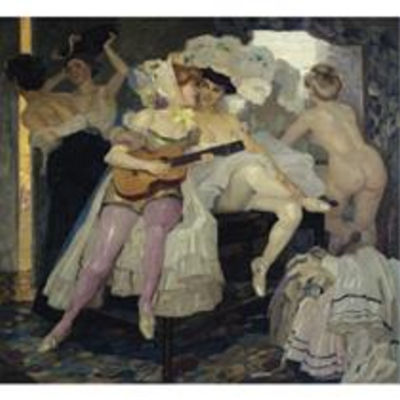
1869 Meran, South Tyrol, Italy - 1940 Meran, South Tyrol, Italy. Known for: Impressionist and Expressionist painting.
Leo Putz (1869, Meran-1940, Meran). Leo Putz was born in South Tyrol, Italy. His oeuvre of over 2700 works reflects a life that was dedicated to artistic freedom. He is recognized today as an... Read full biography
Leo Putz (1869, Meran-1940, Meran). Leo Putz was born in South Tyrol, Italy. His oeuvre of over 2700 works reflects a life that was dedicated to artistic freedom. He is recognized today as an important German Impressionist* painter and one of the pioneers of Expressionism*. In 1866 at the age of... Read full biography
Leo Putz (1869, Meran-1940, Meran). Leo Putz was born in South Tyrol, Italy. His oeuvre of over 2700 works reflects a life that was dedicated to artistic freedom. He is recognized today as an important German Impressionist* painter and one of the pioneers of Expressionism*. In 1866 at the age of 16, Putz moved to Munich to take his first drawing lessons under his stepbrother, Prof. Robert Poetzelberger. He then studied fine art at the Academy in Munich and from 1891 to 1892 at the Académie... Read full biography
Leo Putz (1869, Meran-1940, Meran). Leo Putz was born in South Tyrol, Italy. His oeuvre of over 2700 works reflects a life that was dedicated to artistic freedom. He is recognized today as an important German Impressionist* painter and one of the pioneers of Expressionism*. In 1866 at the age of 16, Putz moved to Munich to take his first drawing lessons under his stepbrother, Prof. Robert Poetzelberger. He then studied fine art at the Academy in Munich and from 1891 to 1892 at the Académie Julian* in Paris under Adolphe Bouguereau and Benjamin Constant. *The Munich Secession was founded in 1892 and Putz frequently exhibited at their annual show. After returning from Paris, Putz attended the studio classroom of the genre* painter Paul... Read full biography
Leo Putz (1869, Meran-1940, Meran). Leo Putz was born in South Tyrol, Italy. His oeuvre of over 2700 works reflects a life that was dedicated to artistic freedom. He is recognized today as an important German Impressionist* painter and one of the pioneers of Expressionism*. In 1866 at the age of 16, Putz moved to Munich to take his first drawing lessons under his stepbrother, Prof. Robert Poetzelberger. He then studied fine art at the Academy in Munich and from 1891 to 1892 at the Académie Julian* in Paris under Adolphe Bouguereau and Benjamin Constant. *The Munich Secession was founded in 1892 and Putz frequently exhibited at their annual show. After returning from Paris, Putz attended the studio classroom of the genre* painter Paul Höcker. In 1899, Hocker's class founded the artist group "Die Scholle" ('the soil'). P... Read full biography
Artist Biography
Biography page for Leo Putz ((1869 - 1940)), known for Impressionist and Expressionist painting. Showing 1 biographical entries and 0 sample artworks.
Leo Putz - Artist Info
About Leo Putz
Biography from Richard Rhoda Fine Art
Leo Putz (1869, Meran-1940, Meran)
Leo Putz was born in South Tyrol, Italy. His oeuvre of over 2700 works reflects a life that was dedicated to artistic freedom. He is recognized today as an important German Impressionist* painter and one of the pioneers of Expressionism*.
In 1866 at the age of 16, Putz moved to Munich to take his first drawing lessons under his stepbrother, Prof. Robert Poetzelberger. He then studied fine art at the Academy in Munich and from 1891 to 1892 at the Académie Julian* in Paris under Adolphe Bouguereau and Benjamin Constant. *The Munich Secession was founded in 1892 and Putz frequently exhibited at their annual show.
After returning from Paris, Putz attended the studio classroom of the genre* painter Paul Höcker. In 1899, Hocker's class founded the artist group "Die Scholle" ('the soil'). Putz and his classmates, who included Walter Georgi, Fritz and Erich Erler and Adolf Muenzer, confronted traditional Academic and Historical method with a new temperamental painting style that was influenced by Wilhelm Trubner. The membership had in common their links with Jugendstil* ("youth-style") painting, their fondness for symbol-laden content and closeness to nature. Putz was an active contributor to their weekly paper Jugend, and many of his works were published on the front page.
Leo Putz defined 1901 as the year he began his Impressionistic period. He began teaching at the Munich Women's Academy and in the same year joined the Vienna Secession, remaining a member until 1939. In 1905, Putz was awarded several medals and his work was added to the permanent collections at the Dresden State Gallery and the New Royal Pinakothek Museum of Munich.
In 1909 Putz was awarded a professorship at the Academy, and his first monograph was published. From 1909 through 1914, Putz spent the summer months at the Hartmannsberg Castle in the Bavarian Chiemgau region. He was accompanied by German painter Hans Roth and American Edward Cucuel, who were both his students. Some of his best late Impressionist work was produced during this period including The Rowboat and The Bathers.
Putz had to leave Germany in 1915 after being declared a public enemy by the 'Räterepublik' (The Independent Social Democratic Party), and he spent the following years in exile in The Hague. Putz and his family returned to Gauting in Bavaria in 1923 when he was awarded an honorary membership of the Bayerische Akademie der Schönen Künste (Bavarian Academy of Fine Arts).
In 1928, Putz made his first trip overseas, traveling to São Paulo, Brazil. He and his family spent the following 5 years in South America, traveling to Buenos Aires and the jungle in Bahia. His work was recognized in Brazil with an honorary professorship at the Escola Nacional de Bellas Artes. He taught at the local academy in Rio de Janeiro and was later rewarded the honorary title of "Extraordinary Professor". The time spent in South America had a significant influence on Putz' painting style, which changed from Impressionism to an "exotic Expressionism" with southern landscapes, a bright and colorful palette and people populating his works.
In 1933, Leo Putz' and his family returned to Germany, and in 1935 his South American paintings were displayed in a large exhibition at the Munich Künstlerverein (Artist's Society). Putz' work was soon classified as Degenerate Art* by the Nazi's, and he was interrogated several times by the secret police and finally forced to flee or risk imprisonment.
In 1937 he sought refuge in his birth town of Meran, but upon arrival was denounced for anti-National Socialist comments and was banned from his profession and confined to his immediate surroundings. Putz spent his time focused on painting castles, manor-houses and the local scenery. The National Socialists dissolved the Secession and all artist groups in Munich by 1938.
Leo Putz died on 21 July 1940 while in exile in Meran and was buried in nearby Gauting.
GERMAN MUSEUMS
Dachau - Gemälde Galerie
Dresden - Staatliche Kunstsammlungen
Düsseldorf - Kunstmuseum
Essen - Museum Folkwang
Frankfurt - Städelsches Kunstinstitut
Hannover - Landesgalerie
Köln - Wallraf-Richartz Museum
Landsberg a. Lech - Neues Stadtmuseum
Leipzig - Museum der bildenden Künste
Mainz - Gemäldegalerie der Stadt Mainz
München - Bayerische Staatsgemäldesammlungen, Städtische Galerie im Lenbachhaus, Stadtmuseum
Nürnberg - Städtische Galerie
Stuttgart - Staatsgalerie
Schweinfurt - Sammlung Georg Schäfer Stiftung
INTERNATIONAL MUSEUMS
Bozen - Museum für moderne Kunst
Budapest - Szépmüvésti Múzeum (Museum der bildenden Künste)
Buenos Aires - Museo Nacional de Bellas Artes
Bukarest - Muzeul de Arta
Innsbruck - Tiroler Landesmuseum Ferdinandeum
Meran - Stadtmuseum
Dorf Tirol -Südtiroler Museum für Kultur, Landesgeschichte, Schloss Tirol
Sources:
Benezit's Art Dictionary
kettererkunst.com, leo-putz.de
German Wikipedia
galerie-albertina.at
sammlung-unterberger.com
* For more in-depth information about these terms and others, see AskART.com Glossary http://www.askart.com/AskART/lists/Art_Definition.aspx