Page loaded successfully. Showing biography for Leon Weissberg.
Leon Weissberg BIOGRAPHY
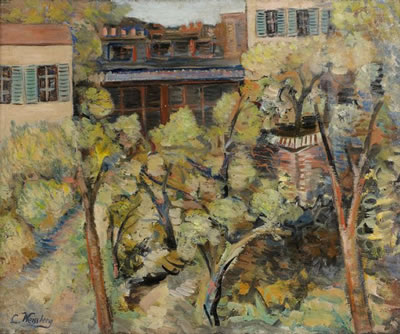
1893 - 1943. Known for: Impressionist, expressionist cityscape, landscape, still life, female nude figure painting.
Leon Weissberg is an artist who has dominated almost all the styles he has learned during European travels. He was introduced to a great variety of painting and to the Group of Four who had... Read full biography
Leon Weissberg is an artist who has dominated almost all the styles he has learned during European travels. He was introduced to a great variety of painting and to the Group of Four who had post-Impressionist tendencies that he could observe as soon as he arrived in Paris. This dogmatic... Read full biography
Leon Weissberg is an artist who has dominated almost all the styles he has learned during European travels. He was introduced to a great variety of painting and to the Group of Four who had post-Impressionist tendencies that he could observe as soon as he arrived in Paris. This dogmatic expressionism for the quartet Weissberg absorbed while still studying in Vienna, Munich and Berlin. In Austria the artist was taught by Oscar Kokoschka, a well-known expressionist. Weissberg was born into a... Read full biography
Leon Weissberg is an artist who has dominated almost all the styles he has learned during European travels. He was introduced to a great variety of painting and to the Group of Four who had post-Impressionist tendencies that he could observe as soon as he arrived in Paris. This dogmatic expressionism for the quartet Weissberg absorbed while still studying in Vienna, Munich and Berlin. In Austria the artist was taught by Oscar Kokoschka, a well-known expressionist. Weissberg was born into a wealthy Orthodox Jewish family. His father was an entrepreneur and councillor of Przeworska Poland City Council. In 1910 he graduated from the Classical Gymnasium in Vienna and then studied at the Vienna Academy of Fine Arts. After completing his... Read full biography
Leon Weissberg is an artist who has dominated almost all the styles he has learned during European travels. He was introduced to a great variety of painting and to the Group of Four who had post-Impressionist tendencies that he could observe as soon as he arrived in Paris. This dogmatic expressionism for the quartet Weissberg absorbed while still studying in Vienna, Munich and Berlin. In Austria the artist was taught by Oscar Kokoschka, a well-known expressionist. Weissberg was born into a wealthy Orthodox Jewish family. His father was an entrepreneur and councillor of Przeworska Poland City Council. In 1910 he graduated from the Classical Gymnasium in Vienna and then studied at the Vienna Academy of Fine Arts. After completing his military service on the front lines during World War I, Weissberg went to Berlin, where he became drawn into the gypsy atmosphere of the ci... Read full biography
Artist Biography
Biography page for Leon Weissberg ((1893 - 1943)), known for Impressionist, expressionist cityscape, landscape, still life, female nude figure painting. Showing 1 biographical entries and 0 sample artworks.
Leon Weissberg - Artist Info
About Leon Weissberg
Biography from Desa Unicum
Leon Weissberg is an artist who has dominated almost all the styles he has learned during European travels. He was introduced to a great variety of painting and to the Group of Four who had post-Impressionist tendencies that he could observe as soon as he arrived in Paris.
This dogmatic expressionism for the quartet Weissberg absorbed while still studying in Vienna, Munich and Berlin. In Austria the artist was taught by Oscar Kokoschka, a well-known expressionist.
Weissberg was born into a wealthy Orthodox Jewish family. His father was an entrepreneur and councillor of Przeworska Poland City Council. In 1910 he graduated from the Classical Gymnasium in Vienna and then studied at the Vienna Academy of Fine Arts. After completing his military service on the front lines during World War I, Weissberg went to Berlin, where he became drawn into the gypsy atmosphere of the city.
He met and befriended the then-beginning actress Marlene Dietrich in Berlin; he volunteered to participate in café nightlife, made numerous friendships with other painters, listened to discussions about art, learned about the work of Cubists, Supremacists and German expressionists.
It was then that Weissberg made a strong determination that at all costs he wanted to devote himself to painting and continue his studies in this direction. However, this decision weighed on family relations, as the disappointed father eventually broke off contact with his son.
In 1922 Leon moved to Munich, where he continued his studies at the Academy of Fine Arts. He kept himself out of painting, playing the violin in cabarets and episodic film roles. After numerous European trips, the artist moved permanently to Paris in 1923 and settled in an art colony on Montparnasse.
Leon Weissberg is a classic example of an artist-newcomer to Montparnasse: he came to Paris without luggage and at night came to La Rotonde – the most important bohemian café, where he immediately befriended Sigismund Menkes. The artist lived at rue Campagne Première and became a frequent visitor to La Rotonde and Café du Dôme.
Unlike most artists coming to Paris to study painting at the Academy of Fine Arts or in the private studios of renowned masters, Weissberg did not study further. He decided that he was already an educated and mature painter, and it was time to present his painting at exhibitions. There was a period of great creative and exhibition activity of the creator. He made his debut in 1924 at the Autumn Salon and by the end of the decade took part in further exhibitions.
It was at the Automne Salon in 1925 that the idea of establishing the so-called The Group of Four, formed by Alfred Aberdam, Zygmunt Menkes and Joachim Weingart, in addition to Weissberg. The group did not have a program, nor did it announce any artistic manifesto. However, the artists of this group showed very strong tendencies towards practicing and interpreting expressionism.
Their paintings were characterized by contrasting colors, contrasting qualities, color stain gained primacy over the logical drawing structure and perspective. Painting forms were built only with a color spot, applying paint quickly and spontaneously.
For the first time, the group took part in an exhibition at the Au Sacre du Printemps Gallery run by Polish marszand Jan Sliwinski as part of a collective exhibition organized at the turn of 1925/26. The participation of artists in the exhibition was considered "very successful", as reported by the Lviv press. The Group of Four received invitations to exhibitions in Bordeaux and Tokyo, and had a permanent exhibition at galerie du Chapitre on the Champs-Elysees. Leon Weissberg studied at the Academy of Fine Arts in Vienna and Munich.
In 1922 he made an artistic trip to Italy and the Netherlands, and also stayed in Berlin. In 1923 he settled permanently in Paris, where a year later he exhibited his work at the Automne Salon and the Tuileries Salon. He also exhibited his paintings in Galerie Zak and Galerie Manteau.
After the outbreak of World War II, he left Paris; In 1941, he was imprisoned in the Gurs and Drancy camps, and later transferred to Majdanek camp, where he was killed.
Jerzy Malinowski counts Leon Weissberg among the so-called 'Group of Four' alongside Sigmund Menkes, Alfred Aberdam and Joachim Weingart. These were artists from Lviv, who at the turn of 1925/26 organized an exhibition in the Paris gallery Jan Sliwinski.
Weissberg painted expressive landscapes, portraits, circus and genre scenes with Jewish themes, city views.