Page loaded successfully. Showing biography for Leonardo Drew.
Leonardo Drew BIOGRAPHY
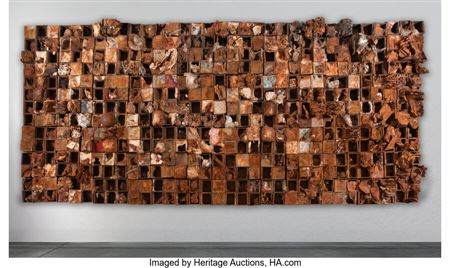
Born 1961 Tallahassee, Florida. Known for: Large-scale sculpture installations, abstract painting, assemblage.
Following is text from an exhibition review published in Art in America online magazine, January 18, 2013. "Leonard Drew" by Mary Proenza. Number 161, a floor-to-ceiling installation winding through... Read full biography
Following is text from an exhibition review published in Art in America online magazine, January 18, 2013. "Leonard Drew" by Mary Proenza. Number 161, a floor-to-ceiling installation winding through the gallery, was the dynamic centerpiece of this exhibition, which also included a dozen elegant... Read full biography
Following is text from an exhibition review published in Art in America online magazine, January 18, 2013. "Leonard Drew" by Mary Proenza. Number 161, a floor-to-ceiling installation winding through the gallery, was the dynamic centerpiece of this exhibition, which also included a dozen elegant wall sculptures (all works 2012). Made primarily of wood, some of it burned and much apparently found, the pieces at their best display Leonardo Drew's virtuosic ability to create forms as quietly,... Read full biography
Following is text from an exhibition review published in Art in America online magazine, January 18, 2013. "Leonard Drew" by Mary Proenza. Number 161, a floor-to-ceiling installation winding through the gallery, was the dynamic centerpiece of this exhibition, which also included a dozen elegant wall sculptures (all works 2012). Made primarily of wood, some of it burned and much apparently found, the pieces at their best display Leonardo Drew's virtuosic ability to create forms as quietly, incontestably credible as those in nature. Drew, an African-American artist born in Tallahassee in 1961 and raised in housing projects in Connecticut, has often alluded to sociopolitical issues in his work. His past use of such symbolically charged... Read full biography
Following is text from an exhibition review published in Art in America online magazine, January 18, 2013. "Leonard Drew" by Mary Proenza. Number 161, a floor-to-ceiling installation winding through the gallery, was the dynamic centerpiece of this exhibition, which also included a dozen elegant wall sculptures (all works 2012). Made primarily of wood, some of it burned and much apparently found, the pieces at their best display Leonardo Drew's virtuosic ability to create forms as quietly, incontestably credible as those in nature. Drew, an African-American artist born in Tallahassee in 1961 and raised in housing projects in Connecticut, has often alluded to sociopolitical issues in his work. His past use of such symbolically charged materials as cotton, rope, rags and rust has been cited as referring to the antebellum South, Civil Rights struggles and mo... Read full biography
Artist Biography
Biography page for Leonardo Drew ((Born 1961)), known for Large-scale sculpture installations, abstract painting, assemblage. Showing 2 biographical entries and 0 sample artworks.
Leonardo Drew - Artist Info
About Leonardo Drew
Biography from the Archives of askART
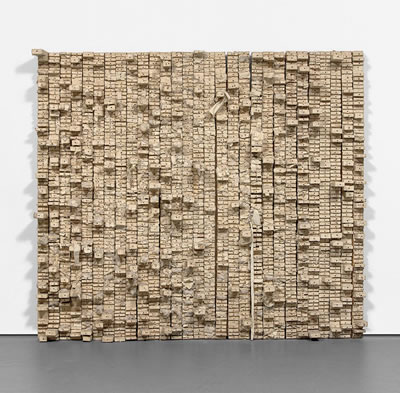 Following is text from an exhibition review published in Art in America online magazine, January 18, 2013.
"Leonard Drew" by Mary Proenza
Number 161, a floor-to-ceiling installation winding through the gallery, was the dynamic centerpiece of this exhibition, which also included a dozen elegant wall sculptures (all works 2012). Made primarily of wood, some of it burned and much apparently found, the pieces at their best display Leonardo Drew's virtuosic ability to create forms as quietly, incontestably credible as those in nature.
Drew, an African-American artist born in Tallahassee in 1961 and raised in housing projects in Connecticut, has often alluded to sociopolitical issues in his work. His past use of such symbolically charged materials as cotton, rope, rags and rust has been cited as referring to the antebellum South, Civil Rights struggles and modern industrial America. The charred timbers of this installation suggested some such references, but the work ultimately conveyed the forces and forms of the natural world more broadly.
Visitors walked under and around the blackened assembly of beams, two-by-fours, plywood scraps, dry branches and sticks, which looked both random, like detritus after a disaster, and intricately constructed, like latticework. In its tall, attenuated structure with openings that let in light, the piece evokes fire-devastated neighborhoods or forests. Meanwhile, in its scale and snaking shape, it resembles a dinosaur skeleton. In terms of the show, the installation was rather defused by proximity to the highly realized, neighboring wall sculptures, which in turn felt crowded.
The sculptures have a more organic bent than is typical of Drew's work. The 5½-foot-wide Number 160 looks like a giant starfish. It's surprising to realize that the visually soft, carpetlike texture of the "arms" is created by the aggregated ends of many small, unpainted wooden spikes. The center of the work—a grouping of white-painted branches and small geometric constructions that appear sun-bleached—suggests the mouth of an anemone; some of the shapes curve outward, evoking sensitive tentacles designed to trap and digest prey. This kind of energetic core is typical of many of Drew's sculptures, as is the blurring of distinctions between what's swallowing or bursting from what, and what's natural or constructed.
Like much of his previous work, Number 162, a mural-size assemblage on paper, spans the gap between drawing and sculpture. It reads as an enormous sketchbook in which some of the notations have taken on physical dimension. On the sides are small drawn and painted diagrams and three-dimensional models. His usual palette of black and earth tones is accented with one little stroke of sky-blue gouache. A large, burned, rootlike system fills the middle, with elements at the top and bottom pushing forward in tendrils. The area in between breaks down into small wooden modules-a hallmark of the artist's work that recalls Louise Nevelson, as has often been noted. In its quotidian aspect and combination of painted, drawn and projecting elements, the work is akin to Robert Rauschenberg's Combines.
Overall, this piece, which so effectively juxtaposes wild and tame, can be read as a takeover by nature. The root-like elements, although burned, seem to embody the life force of the diagrams and models. In this, as in much of Drew's work, even when nature is in a stage of decline, it's irrepressibly generative.
Online Source:
http://www.artinamericamagazine.com/reviews/leonardo-drew-1/Biography from the Archives of askART
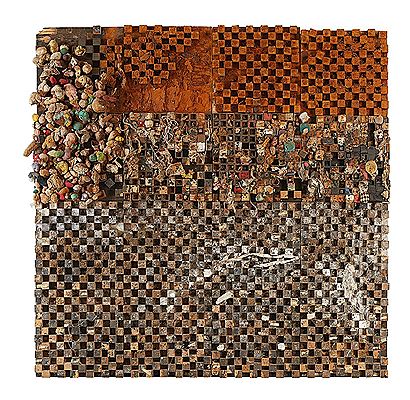 Leonardo Drew is known for his dynamic large-scale sculptural installations. On the one hand, Drew's sculptures can be seen as exercises in formalism rooted in the very experience of looking. On the other hand, these works explore memory by employing a wide range of material to evoke common elements of the human experience and of our diverse histories.
Drew has been making artwork since childhood, and first exhibited his work at the age of 13. He went on to attend the Parsons School of Design and received his BFA from the Cooper Union for the Advancement of Science and art in 1985. Since then he has shown in a variety of institutions such as The Hirschhorn Museum and Sculpture Garden at the Smithsonian Institution in Washington DC, the Royal Hibernian Academy in Dublin, Ireland, The Art Institute of Chicago, The Miami Art Museum, and the St. Louis Art Museum. He has also collaborated with the Merce Cunningham Dance Company, and has participated in artist residencies at ArtPace, San Antonio and The Studio Museum of Harlem in New York City, among others.
Drew's mid-career survey exhibition, "Existed: Leonardo Drew," debuted in 2009 at the Blaffer Gallery, the Art Museum of the University of Houston and traveled to the Weatherspoon Art Museum in Greensboro, NC and the DeCordova Museum and Sculpture Park in Lincoln, MA. A monograph of his work was published in conjunction with the survey by Giles, Ltd., London.
Drew lives and works in Brooklyn, New York.
Source:
"Leonard Drew", Sikkema Jenkins Co., www.sikkemajenkinsco.com/index.php?v=artist&artist=4eecdee08526f