Page loaded successfully. Showing biography for Lester Frederick Johnson.
Lester Frederick Johnson BIOGRAPHY

1919 Minneapolis, Minnesota - 2010 Westhampton, New York. Known for: Modernist street people figure and genre painting, teaching.
Following is The New York Times obituary of Lester Johnson. "Lester Johnson, Expressionist Painter, Dies at 91" . By William Grimes. June 8, 2010. Lester Johnson, an admired artist whose... Read full biography
Following is The New York Times obituary of Lester Johnson. "Lester Johnson, Expressionist Painter, Dies at 91" . By William Grimes. June 8, 2010. Lester Johnson, an admired artist whose expressionist brushwork lent vigor and force to the human figure — isolated and embattled, or alive with the joy... Read full biography
Following is The New York Times obituary of Lester Johnson. "Lester Johnson, Expressionist Painter, Dies at 91" . By William Grimes. June 8, 2010. Lester Johnson, an admired artist whose expressionist brushwork lent vigor and force to the human figure — isolated and embattled, or alive with the joy of movement in crowds — died on May 30. He was 91 and lived in Southampton on Long Island. His death, at a nursing home in Westhampton, N.Y., was confirmed by his son, Anthony. Mr. Johnson, a... Read full biography
Following is The New York Times obituary of Lester Johnson. "Lester Johnson, Expressionist Painter, Dies at 91" . By William Grimes. June 8, 2010. Lester Johnson, an admired artist whose expressionist brushwork lent vigor and force to the human figure — isolated and embattled, or alive with the joy of movement in crowds — died on May 30. He was 91 and lived in Southampton on Long Island. His death, at a nursing home in Westhampton, N.Y., was confirmed by his son, Anthony. Mr. Johnson, a maverick associate of the Abstract Expressionists in New York, found his subject matter in the joys and sorrows of ordinary people on the street. His boxy figures of the 1960s, somberly painted in thick impasto their features often scratched into the... Read full biography
Following is The New York Times obituary of Lester Johnson. "Lester Johnson, Expressionist Painter, Dies at 91" . By William Grimes. June 8, 2010. Lester Johnson, an admired artist whose expressionist brushwork lent vigor and force to the human figure — isolated and embattled, or alive with the joy of movement in crowds — died on May 30. He was 91 and lived in Southampton on Long Island. His death, at a nursing home in Westhampton, N.Y., was confirmed by his son, Anthony. Mr. Johnson, a maverick associate of the Abstract Expressionists in New York, found his subject matter in the joys and sorrows of ordinary people on the street. His boxy figures of the 1960s, somberly painted in thick impasto their features often scratched into the surface, faced the viewer squarely with an air of stoicism or grim defiance. Some were self-portrait... Read full biography
Artist Biography
Biography page for Lester Frederick Johnson ((1919 - 2010)), known for Modernist street people figure and genre painting, teaching. Showing 3 biographical entries and 0 sample artworks.
Lester Frederick Johnson - Artist Info
About Lester Frederick Johnson
Name variants
Lester Johnson
Biography from the Archives of askART
 Following is The New York Times obituary of Lester Johnson.
"Lester Johnson, Expressionist Painter, Dies at 91"
By William Grimes
June 8, 2010
Lester Johnson, an admired artist whose expressionist brushwork lent vigor and force to the human figure — isolated and embattled, or alive with the joy of movement in crowds — died on May 30. He was 91 and lived in Southampton on Long Island.
His death, at a nursing home in Westhampton, N.Y., was confirmed by his son, Anthony.
Mr. Johnson, a maverick associate of the Abstract Expressionists in New York, found his subject matter in the joys and sorrows of ordinary people on the street. His boxy figures of the 1960s, somberly painted in thick impasto their features often scratched into the surface, faced the viewer squarely with an air of stoicism or grim defiance.
Some were self-portraits. Others, such as Bowery Patriarch (1963) and Three Men Sitting (1969), enlisted the stumbling, broken men he saw on the Bowery from his second-floor studio window.
Pulsing with a dark energy and compressed into taut masses by brutal external forces, Mr. Johnson's subjects, presented singly or in groups, seemed like hostages to fate. The art critic Harold Rosenberg called them "golem-like," a reference to the manlike creature of Jewish folklore created from inanimate matter. "Johnson's grim dolls seem to push forward out of a background darkness which they bring with them to the painting surface," he wrote in Art News in 1966.
In the 1970s, Mr. Johnson shifted gears. "I get into a theme, and I get into it until I don't like it," he told The Hartford Courant in 2005. He began painting women in colorful print dresses and men wearing bowler hats, crowding the canvas and moving ebulliently through the city's streets. Their flattened, stylized forms, and the often frieze-like arrangement of the figures, suggested Greek vase art set to a jazz soundtrack. "It was a real pleasure to use color," he told The Courant. "From then on, I had another world."
"If there is such as thing as the poetry of congestion, Mr. Johnson invented it," John Russell wrote in The New York Times in 1977. "The people in his painting just love company. They can't get enough of it. No matter how he packs them in we feel that both he and they would gladly find room for someone else."
Lester Frederick Johnson was born on Jan. 27, 1919, in Minneapolis. After graduating from high school he began an apprenticeship at the Cosmopolitan Art Company, where he learned to make frames and copy calendar landscapes.
Determined to become a fine artist, he enrolled at the Minneapolis School of Art, where he studied with Alexander Masley, a former student of Hans Hofmann in Munich.
When Mr. Masley was dismissed because of political infighting at the school, Mr. Johnson moved to the St. Paul School of Art to study with another Hofmann protégé, Cameron Booth. He later studied at the School of the Art Institute of Chicago.
In 1947 he moved to New York, where he shared a studio, at different times, with Larry Rivers and Philip Pearlstein. Two years later he married Josephine Valenti, who survives him. In addition to his son, an architect who lives in Manhattan, he is survived by his daughter, Leslie Lowery, of Greenwich, Conn., and four grandchildren.
Mr. Johnson started out painting small urban landscapes and abstract paintings but gradually moved toward the human figure, developing a style heavily influenced by the painterly techniques of the Abstract Expressionists and the existential atmosphere in the Giacometti paintings he saw in a show at the Pierre Matisse Gallery in 1948.
What he took from Giacometti, the critic Hilton Kramer noted in a 2004 review of Mr. Johnson's work in The New York Observer was not a style but "an attitude of interrogation and anxiety in dealing with the figure."
He became one of the figurative artists voted into the Eighth Street Club, the famous weekly gathering of the Abstract Expressionists. They regarded him as talented but misguided. He regarded drips and gestural brushstrokes as an avant-garde signature that could easily descend into empty cliché.
"I was into human content and I used it, and I found it a very, very exciting thing to do," Mr. Johnson said in an interview in 1988. "I did a lot of paintings at the time where you can hardly see the figure, but it's there."
He had his first solo show at the Artists Gallery in 1951.
In 1964, Jack Tworkov, the chairman of the graduate art department at Yale, recommended Mr. Johnson for a job. He taught figure drawing at Yale until his retirement in 1989, and from 1969 to 1974 was the director of studies for the graduate painting program.
The James Goodman Gallery in Manhattan surveyed his work in 2004 in the exhibition "Lester Johnson: Four Decades of Painting." In 2005, the University of Connecticut in Storrs mounted a 50-year retrospective of his work, "People Passing By: Paintings, Drawings and Prints by Lester Johnson," at the William Benton Museum of Art.
Correction:
An obituary on June 9 about the painter Lester Johnson erroneously credited him with a distinction. Several figurative artists — not just Mr. Johnson — were members of the salon known as the Eighth Street Club. (Among them were Larry Rivers and Edwin Dickinson.)Biography from the Archives of askART
 A New York artist, known as a second-generation abstract expressionist, Lester Johnson was born to a large Lutheran family in Minneapolis. He studied at the Minneapolis School of Art and the St. Paul Art School. There he was introduced to Hans Hofmann's teaching approach, particularly the "push and pull" effects of form and color by St. Paul teachers Alexander Masley and Cameron Booth, both of whom had studied with Hofmann in Munich.
After further study at the Chicago Art Institute, Johnson moved to New York City in 1947 and became one of the first downtown loft-dwellers. He shared a lower East Side studio with Larry Rivers and attended some of Hofmann's New York classes. Rents were cheap but Johnson was broke much of the time as he tried to support his painting through a variety of part-time jobs, including teaching art.
In 1950, he and realist figurative painter Philip Pearlstein shared a studio space. Lester's wife, Jo, had introduced the two artists at a time when she and Pearlstein were studying art history at New York University. Johnson's various studios, on the Bowery and elsewhere, were always one flight up with a view of Manhattan's active street life. No wonder, for over fifty years, street scenes have been a dominant part of his art.
Johnson adopted the working techniques of action painting, which meant he used a great deal of paint. A tube of oil paint might be expended in seconds as he, like Pollock, physically projected himself into the work. The images that Johnson produced were not decorative, but stubbornly confrontational: oversize, brooding, thickly encrusted, scarred surfaces that were alive with recognizable objects and figures.
Even today, few realize how radical it was for Johnson to depict a recognizable subject in an adamantly pro-abstract-expressionist climate. Sculptor George Segal recalled: "The Abstract Expressionists were legislating any reference to the physical world totally out of art. This was outrageous to us".
Rebellion came naturally to Lester Johnson, and he remained tenaciously outside the mainstream. Nonetheless, he produced a body of work that influenced several generations of younger painters and confounded an art establishment in need of neat categorization. He remains one of the few painters whose work holds significance for both abstract and figurative artists.
Lester Johnson's animated men and women, with all their nervous energy, yield themselves only gradually to analysis and will no doubt be reinterpreted for many years to come. His largest achievement is perhaps the degree to which each of his works is still able to convince us that the act of painting is relevant and vital.
Source: Based on information from article in "Provincetown Arts Magazine," by Burt ChernowBiography from ACME Fine Art
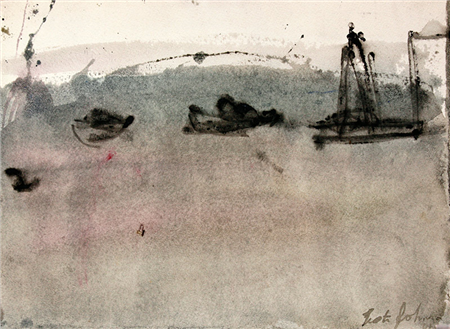 Lester Johnson
1919-
Education:
Minneapolis School of Art, The President's Scholarship, 1940-41
St. Paul Art School
The School of the Art Institute of Chicago
Member:
American Academy of Arts and Letters
Exhibitions:
Pennsylvania Academy of the Fine Arts, 1949, 1951, 1957, 1964
The Jewish Museum, New York, 1956
Stable Gallery, New York, 1957
Minneapolis Institute of Art, 1957
Whitney Museum of American Art, 1958, 1967, 1968, 1973
The Baltimore Museum of Art, 1958, 1970
Salzburg Festival, Germany, 1959
Nebraska Art Association, 1959
University of Colorado, 1959
Institute of Contemporary Art, Boston, 1959, 1960
American Federation of Arts, 1960, 1965
The Museum of Contemporary Art, Houston, 1961
The Carnegie Institute, Pittsburgh, 1961, 1964, 1967,1970
The Art Institute of Chicago, 1962, 1972, 1979
The Museum of Modern Art, 1962, 1967, 1968, 1986
Musee Cantonal des Beaux-Arts, Lausanne, Switzerland, 1963
The Aldrich Museum of Contemporary Art, Connecticut, 1964, 1967, 1977, 1987 (Solo)
Museum voor Schone Kunsten, Chent, Belgium, 1964
New School Art Center, New York, 1964
The Solomon R. Guggenheim Museum, New York, 1964, 1972, 1979
Cincinnati Art Museum, Ohio, 1968
Center of Visual Arts Institute Torcuato Di Tella, Buenos Aires, 1968
Smithsonian Institution, Washington DC, 1969
Philadelphia Art Alliance, 1969
Fondation Marguerite et Aime Maeght L'Art Vivant aux etats Unis, St. Paul-de-Vence, France, 1969, 1970
Il Bienal Internacional del Deporte en las Bellas Artes, Madrid, 1969
Brooklyn Museum of Art, New York, 1972, 1974
Palazzo dell'Academia, Palazzo Reale, Genoa, Italy, 1972
Exhibitions Continued:
La Bibliotheque Nationale, Paris, France, 1973
New Britain Museum of American Art, 1978
Provincetown Art Association and Museum, 1980, 1981, 2001
Wadsworth Atheneum, Hartford, 1983
Art Museum Association of America, San Francisco, 1984
The Metropolitan Museum of Art, New York, 1985
Westmoreland Museum of Art, Greensburg, PA, 1987 (Solo)
Augustana College, Rock Island, IL, 1988 (Solo)
Norwalk Community Technical College, Norwalk, CT, 1996 (Solo)
Provincetown Art Association and Museum, Provincetown, MA: "Figurative Expressionism:" Paintings 1963-2000", 2001 (Solo)
Museum of Fine Arts, Boston, 2003
Collections:
The Albright-Knox Art Gallery, Buffalo, NY
The Aldrich Museum of Contemporary Art, Ridgefield, CT
The Baltimore Museum of Art, Baltimore, MD
Boca Raton Museum, Boca Raton, FL
The Bruce Museum, Greenwich, CT
The Carnegie Museum of Art, Pittsburgh, PA
The Chrysler Museum, Norfolk, VA
Dayton Art institute, Dayton, OH
The Detroit Institute of Art, Detroit, MI
Fogg Art Museum, Harvard University Museums, Cambridge, MA
Fort Lauderdale Museum, Fort Lauderdale, FL
Fort Worth Art Museum, Fort Worth, TX
The Solomon R. Guggenheim Museum, New York, NY
Guild Hall, East Hampton, NY
Hirshhorn Museum and Sculpture Garden, Washington DC
Honolulu Academy of Arts, Honolulu, HI
Housatonic Museum of Art, Bridgeport, CT
Kalamazoo Institute of Arts, Kalamazoo, MI
Madison Art Center, Madison, WI
The Metropolitan Museum of Art, New York, NY
Minneapolis Institute of Art, Minneapolis, MN
The Museum of Modern Art, New York, NY
The Museum of Fine Arts, Boston, MA
National Museum of American Art, Washington DC
Neuberger Museum SUNY, Purchase, NY
The New Jersey State Museum, Trenton, NJ
The New School for Social Research, New York, NY
The New York Public Library, New York, NY
Orton Museum, Ohio State University, Dayton, OH
Phoenix Art Museum, Phoenix, AZ
Sheldon Memorial Art Gallery, University of Nebraska Art Galleries, Lincoln, NE