Page loaded successfully. Showing biography for Lew Davis.
Lew Davis BIOGRAPHY
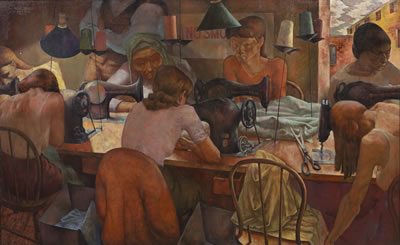
1910 Jerome, Arizona - 1979 Pinnacle Peak, Arizona. Known for: Landscape-figure, genre, and still life painting.
Born in Jerome, territory of Arizona, Lew Davis has a name associated with the copper mining landscapes of his hometown, and he is referred to as the Dean of Arizona Artists. As a youngster, he was a... Read full biography
Born in Jerome, territory of Arizona, Lew Davis has a name associated with the copper mining landscapes of his hometown, and he is referred to as the Dean of Arizona Artists. As a youngster, he was a frustration to his teachers because he continually drew in notebooks and paid little attention to... Read full biography
Born in Jerome, territory of Arizona, Lew Davis has a name associated with the copper mining landscapes of his hometown, and he is referred to as the Dean of Arizona Artists. As a youngster, he was a frustration to his teachers because he continually drew in notebooks and paid little attention to lessons. He saw illustrations of Norman Rockwell and decided he wanted to do work like him. At age 17, Davis traveled to New York and worked as a sign painter and messenger boy for The New York Sun... Read full biography
Born in Jerome, territory of Arizona, Lew Davis has a name associated with the copper mining landscapes of his hometown, and he is referred to as the Dean of Arizona Artists. As a youngster, he was a frustration to his teachers because he continually drew in notebooks and paid little attention to lessons. He saw illustrations of Norman Rockwell and decided he wanted to do work like him. At age 17, Davis traveled to New York and worked as a sign painter and messenger boy for The New York Sun while studying at the Academy of Design with Leon Kroll. He taught for three years at a private school in New Jersey, and returned in 1935 to Jerome on a United States Treasury Department Art Project. This assignment required him to send six paintings a... Read full biography
Born in Jerome, territory of Arizona, Lew Davis has a name associated with the copper mining landscapes of his hometown, and he is referred to as the Dean of Arizona Artists. As a youngster, he was a frustration to his teachers because he continually drew in notebooks and paid little attention to lessons. He saw illustrations of Norman Rockwell and decided he wanted to do work like him. At age 17, Davis traveled to New York and worked as a sign painter and messenger boy for The New York Sun while studying at the Academy of Design with Leon Kroll. He taught for three years at a private school in New Jersey, and returned in 1935 to Jerome on a United States Treasury Department Art Project. This assignment required him to send six paintings a year of his region back to Washington D.C., an obligation he fulfilled by painting his "Jerome Ser... Read full biography
Artist Biography
Biography page for Lew Davis ((1910 - 1979)), known for Landscape-figure, genre, and still life painting. Showing 3 biographical entries and 0 sample artworks.
Lew Davis - Artist Info
About Lew Davis
Name variants
Lewis Davis
Biography from the Archives of askART
 Born in Jerome, territory of Arizona, Lew Davis has a name associated with the copper mining landscapes of his hometown, and he is referred to as the Dean of Arizona Artists.
As a youngster, he was a frustration to his teachers because he continually drew in notebooks and paid little attention to lessons. He saw illustrations of Norman Rockwell and decided he wanted to do work like him. At age 17, Davis traveled to New York and worked as a sign painter and messenger boy for The New York Sun while studying at the Academy of Design with Leon Kroll.
He taught for three years at a private school in New Jersey, and returned in 1935 to Jerome on a United States Treasury Department Art Project. This assignment required him to send six paintings a year of his region back to Washington D.C., an obligation he fulfilled by painting his "Jerome Series" of copper mining scenes, which brought him his first national recognition.
In 1937, he married Mathilde Schaefer, a sculptor, and they settled in Scottsdale, and he became the assistant director of the Art Center School and helped organize the Arizona Society of Painters and Sculptors. He recalled that at that time there were few artists in Arizona and access to supplies and galleries was difficult.
During World War II, he was stationed at Fort Huachuca, and supervised silk-screen poster making to recruit black soldiers. He was put in charge of building morale among those soldiers and also painted murals and edited the post newspaper. He won the Legion of Merit medal for these efforts but was left emotionally exhausted and had a long, difficult period of recovery.
In 1951, he undertook a campaign to make the art exhibition at the Arizona State Fair more professional. He founded the Arizona Art Foundation, composed of people who pooled their funds to bring in outside exhibitions about which Davis gave lectures.
In 1957, he and his wife moved north of Scottsdale to Pinnacle Peak where the landscape inspired him to use a brighter palette. In 1973, his wife of thirty-six years died; a year later, he lost a leg in surgery, but he continued to work for five more years. March 6, 1977 was proclaimed "Lew Davis Day" in Arizona by Governor Raul Castro.
Sources:
Peter Bermingham, The New Deal in the Southwest
Edan Hughes, Artists in California, 1786-1940
Biography from the Archives of askART
 Born in Jerome, Arizona on November 2, 1910, Lew Davis was a lifelong resident of his native state except for a period in the 1920s when he studied art in New York City at the National Academy of Design under Leon Kroll and trips to California.
During the 1930s and 1940s he worked for the U.S. Treasury Department Art Project and was active in southern California. A Social Realist, his early works are scenes of mining communities and the desert; whereas, works done following WWII are abstract to some degree.
March 6, 1977 was proclaimed by Governor Raul Castro as "Lew Davis Day." He is called "The Dean of Arizona Artists." His final years were spent in a mountain home and studio at Pinnacle Peak.
Exhibitions:
National Academy of Design, 1931 (prizes)
Painters & Sculptors of LA, 1938
Los Angeles County Museum of Art, 1938, 1942
San Francisco Museum of Art, 1938-40
Golden Gate International Exposition, 1940
California Water Color Society, 1941 (prize)
Santa Barbara Museum, 1942
Pasadena Art Institute, 1946
California Palace of the Legion of Honor 1953
Scottsdale Center, 1979 (solo).
Collections:
Pasadena Museum; Los Banos (CA) Post Office (mural); Howard University.Biography from Southwest Graphics Collection
Lew Davis was born in Jerome, Arizona, in 1910, and lived near Scottsdale for more than 40 years. He held the title of "The Dean of Arizona Artists."
His paintings have been exhibited in the nation's leading museums including the Whitney, Corcoran, Los Angeles County, and San Francisco Museum.
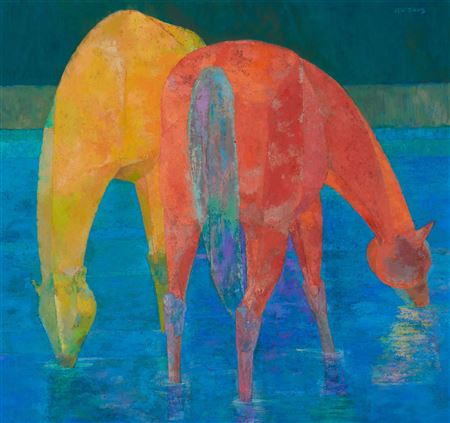
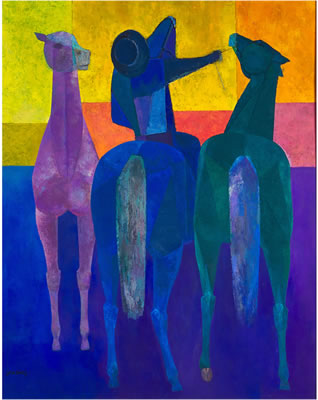
Lew Davis was an Arizona painter who, in a highly personal and contemporary manner, retained as his main objective the depicting of Arizona and the West. Davis' art went through a variety of different phases in his prolific career. During the 50's and 60's a severe abstract phase emerged, which drew casual resemblences to the work of Paolo Uccello, Diego Rivera, and Piero Delia Francesca. At the time of his great desert paintings, Davis seemed to possess Cezanne's feeling for the cubistic trend in art.
Contrasted to his later work, his early pieces done in Jerome consisted of streets, shacks, horses, and men of the once inhabited ghost town. His later work was characterized by his increased interest in the desert plants, mountains, and the moon. Davis saw universal truths in desert rocks and lichen.
A retrospective of his life's work was on display at the Phoenix Art Museum soon after his death in 1979.