Page loaded successfully. Showing biography for Louis Lang.
Louis Lang BIOGRAPHY
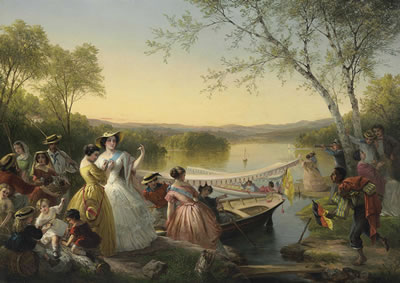
1814 Waltsee, Wurttemberg, Germany - 1893 New York City. Known for: Genre, portrait and history painting, plaster ornament sculpture.
The following information is excerpted from The New York Times, October 16, 2011. "When Applying the Paint Was Spreading the News" by Robin Pogrebin. Early on the morning of July 27, 1861, the Irish... Read full biography
The following information is excerpted from The New York Times, October 16, 2011. "When Applying the Paint Was Spreading the News" by Robin Pogrebin. Early on the morning of July 27, 1861, the Irish brigade of New York's 69th Regiment returned From the First Battle of Bull Run, landing by steamboat... Read full biography
The following information is excerpted from The New York Times, October 16, 2011. "When Applying the Paint Was Spreading the News" by Robin Pogrebin. Early on the morning of July 27, 1861, the Irish brigade of New York's 69th Regiment returned From the First Battle of Bull Run, landing by steamboat at what is now Battery Park. The crowd that massed along the bay to welcome the weary soldiers included all manner of society: flower sellers, fruit vendors, dignitaries, newsboys, grieving widows,... Read full biography
The following information is excerpted from The New York Times, October 16, 2011. "When Applying the Paint Was Spreading the News" by Robin Pogrebin. Early on the morning of July 27, 1861, the Irish brigade of New York's 69th Regiment returned From the First Battle of Bull Run, landing by steamboat at what is now Battery Park. The crowd that massed along the bay to welcome the weary soldiers included all manner of society: flower sellers, fruit vendors, dignitaries, newsboys, grieving widows, well wishers and families of the wounded. The mood was triumphant — New York's immigrant boys had returned — but also melancholy; their Civil War battle had ended in defeat. And the artist Louis Lang captured it all on a sprawling canvas in oil paint.... Read full biography
The following information is excerpted from The New York Times, October 16, 2011. "When Applying the Paint Was Spreading the News" by Robin Pogrebin. Early on the morning of July 27, 1861, the Irish brigade of New York's 69th Regiment returned From the First Battle of Bull Run, landing by steamboat at what is now Battery Park. The crowd that massed along the bay to welcome the weary soldiers included all manner of society: flower sellers, fruit vendors, dignitaries, newsboys, grieving widows, well wishers and families of the wounded. The mood was triumphant — New York's immigrant boys had returned — but also melancholy; their Civil War battle had ended in defeat. And the artist Louis Lang captured it all on a sprawling canvas in oil paint. Now Return of the 69th (Irish) Regiment, N.Y.S.M. From the Seat of War, restored and re-framed, is to b... Read full biography
Artist Biography
Biography page for Louis Lang ((1814 - 1893)), known for Genre, portrait and history painting, plaster ornament sculpture. Showing 3 biographical entries and 0 sample artworks.
Louis Lang - Artist Info
About Louis Lang
Biography from the Archives of askART
 The following information is excerpted from The New York Times, October 16, 2011
"When Applying the Paint Was Spreading the News" by Robin Pogrebin
Early on the morning of July 27, 1861, the Irish brigade of New York's 69th Regiment returned From the First Battle of Bull Run, landing by steamboat at what is now Battery Park.
The crowd that massed along the bay to welcome the weary soldiers included all manner of society: flower sellers, fruit vendors, dignitaries, newsboys, grieving widows, well wishers and families of the wounded.
The mood was triumphant — New York's immigrant boys had returned — but also melancholy; their Civil War battle had ended in defeat. And the artist Louis Lang captured it all on a sprawling canvas in oil paint.
Now Return of the 69th (Irish) Regiment, N.Y.S.M. From the Seat of War, restored and re-framed, is to become a permanent, prominent fixture in the New-York Historical Society's renovated building, which reopens, fittingly, on Nov. 11 — Veterans' Day.
Huge, detailed and colorful, it comes from an era when paintings were expressive and descriptive, tools not only to evoke emotions, but also to do the very real work of simply documenting and recounting history.
"The whole human comedy is played out across the stage of the painting," said Linda S. Ferber, the society's vice president and senior art historian. "It's a combination of the sentimental — of the personal stories — and the collective narrative of this heroic group of men."
The painting will be the centerpiece of the society's opening exhibition, "Making American Taste: Narrative Art for a New Democracy," which looks at taste in art as it was defined from the 1830s to the late 1860s.
The return of Lang's panorama, which is about 11 feet wide by 7 feet tall and weighs in at 700 pounds with the frame, required its own renovation. Donated by Lang in 1886, the painting was on display until sometime after World War II, after which the society has difficulty tracking it. Unearthed from storage in 1977, it was in pieces.
So when the society decided to revive the painting in 2006, it meant essentially tackling a jumbo jigsaw puzzle.
"Can we put the painting back together again?" Ms. Ferber said the society asked. "Are the pieces all here?"
The daunting prospect seemed worth the time and $220,000 expense. The painting captures a moment in Civil War history, when the Irish rose to defend the Union and were lauded as heroes. Their joyful homecoming, however, was followed by the 1863 Draft Riots, blamed largely on the Irish.
"It seemed perfect for our project — a real knockout, given its scale and the amount of incredible reportorial detail," Ms. Ferber said. "The excitement of the painting was entirely evident."
The society spread the fragments out on a tarp and looked down from above. "We had the painting," Ms. Ferber said. "It was all there."
For guidance the society had a black-and-white photograph of the painting from the 1940s that showed it hanging at the society, and a brochure that was given out when the painting was first displayed in 1862 at Goupil's Gallery. The brochure gave details of various elements, like "Private White meeting his family, embracing his young babe; his oldest son explaining to a boy why the bayonet of his father's gun is broken and shattered."
The society sent the Lang to the Williamstown Art Conservation Center in Massachusetts, where it was painstakingly restored. "It was probably one of the most challenging efforts we've ever undertaken," said Thomas Branchick, the center's director.
The dark mahogany frame (with a gilded inner liner) was reconstructed in Manhattan by Eli Wilner & Company. It will be united with the painting at the society on Nov. 3, before the renovated building reopens.
The society has also created a new museum within the museum: the 4,000-square-foot DiMenna Children's History Museum, designed by Lee H. Skolnick Architecture & Design Partnership and named for a $5 million donation from Joseph and Diana DiMenna. The museum aims to make American history more relevant for children through the lives of young people from the past. With historical artifacts and interactive installations, it encourages visitors to become history detectives, by exploring different periods.
The Lang will be the first work that visitors see as they enter the "American Taste" exhibition. When the show goes on the road (the painting will not travel because of its size), the painting will be installed at the entrance to the Henry Luce III Center for the Study of American Culture on the society's fourth floor.
The Lang, which depicts New York Bay as seen from Bowling Green, is in a way many paintings in one, with a chaotic array of vignettes and characters. The newsboy is hawking portrait prints that feature the image of Col. Michael Corcoran, who led the regiment. The man on horseback is Thomas Francis Meagher, an Irish nationalist and recent immigrant whose death sentence had been commuted by Queen Victoria and who became a captain in the regiment.
Lang painted it in record time; the regiment returned in July 1861 and the painting went on display in October 1862. "As someone said, it was like CNN," Ms. Ferber said. "It really was reportage."
Known as "The Fighting 69th" and famous for its marching tune, "Garryowen," the 69th Regiment of the New York State Militia continues to operate in a landmark armory on Lexington Avenue.
The "American Taste" show will feature other narrative paintings from the society's collection, including works by Benjamin West, Asher B. Durand, William Sidney Mount and Eastman Johnson. But the Lang is the jewel in the crown. "You always want a benchmark painting in any exhibition," Ms. Ferber said. "I think this will do the trick."
At the time engravings were made of paintings like this — Albert Bierstadt's Rocky Mountains and Frederic Edwin Church's Heart of the Andes — so that they could be reproduced and distributed. But not Lang's.
Were there originally plans to circulate the painting more widely? Did they get derailed by the Draft Riots, which made people less interested in honoring Irish Americans?
"There are still a lot of questions to be answered," Ms. Ferber said. "The fact that the painting is now back as part of the conversation is really the beginning."
Source:
http://www.nytimes.com/2011/10/17/arts/making-american-taste-at-the-new-york-historical-society.html?pagewanted=2&_r=1&ref=artsBiography from the Archives of askART
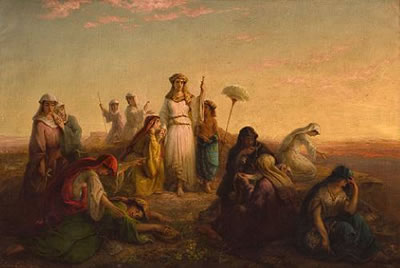
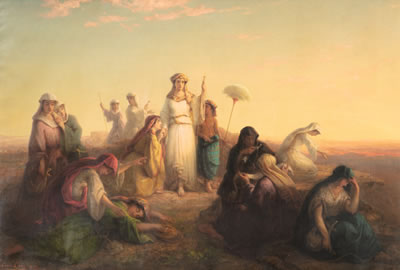 Louis Lang, a painter of historical, biblical, literary and anecdotal subjects, was born in Waldsee, Wurtemberg, Germany, on March 29, 1814. Paintings include Mary Stuart Distributing Gifts, Jephtha's Daughter, Neapolitan Fisher Family and Romeo and Juliet.
He came from an artistic family, his father being a history painter. Combining this heritage with his own native talents, he was producing successful pastels at age sixteen. Lang studied in Stuttgart, Germany and Paris, France, before coming to the United States in 1838. He first settled in Philadelphia, then lived in Italy from 1841-1845, before returning to America (1847) and living the majority of his life in New York City, with frequent visits to Europe.
During the Civil War, Lang was working in the well-known artistic landmark, the Tenth Street Studio Building, in New York City. John F. Kensett and Emanuel Leutze were other artists there at the time.
Lang was a member of the Artists' Fund Society, and the National Academy of Design, New York City, one of his exhibition venues. He was elected an Associate there in 1850, and an Academician in 1852.
Louis Lang died on May 6, 1893.
Sources include:
Groce and Wallace, The New York Historical Society's Dictionary of Artists in America
http://www.famousamericans.net/louislang/Biography from Metropolitan Museum of Art
Renowned American painter of historical, literary and portrait subjects, Louis Lang was born in Wurtemberg, Germany into an artistic family. At the age of 16, he was already producing accomplished pastels.
He began his art studies in Stuttgart and later worked in Paris before he immigrated to the United States in 1838. He settled in Philadelphia and from 1841 to 1845 he resided in Italy. In 1847 he moved to New York City where he lived for the remainder of his career with frequent visits to Europe.
During the Civil War, Lang held a studio in the Tenth Street Studio Building and exhibited at the National Academy of Design where he was elected an Associate in 1850 and Academician in 1852.
Submitted October 2005 by James Halperin, Co-Chairman Heritage Galleries and Auctioneers, Dallas, Texas