Page loaded successfully. Showing biography for Louisa Lizbeth Chase.
Louisa Lizbeth Chase BIOGRAPHY
1951 Panama City, Panama - 2016 East Hampton, New York. Known for: Abstract painting and printmaking, caligraphy scribbles.
Following is The New York Times obituary:. "Louisa Chase, Painter of Geometric Shapes and Body Parts, Dies at 65". by William Grimes, May 16,2016. Louisa Chase, whose turbulent canvases, with their... Read full biography
Following is The New York Times obituary:. "Louisa Chase, Painter of Geometric Shapes and Body Parts, Dies at 65". by William Grimes, May 16,2016. Louisa Chase, whose turbulent canvases, with their landscape-derived images and ghostly torsos and hands, made her one of the brightest young stars in... Read full biography
Following is The New York Times obituary:. "Louisa Chase, Painter of Geometric Shapes and Body Parts, Dies at 65". by William Grimes, May 16,2016. Louisa Chase, whose turbulent canvases, with their landscape-derived images and ghostly torsos and hands, made her one of the brightest young stars in the much-heralded resurgence of painting in the 1980s, died on May 8 at her home in East Hampton, N.Y. She was 65. The cause was cancer, her brother, Ben, said. Ms. Chase arrived in New York in the... Read full biography
Following is The New York Times obituary:. "Louisa Chase, Painter of Geometric Shapes and Body Parts, Dies at 65". by William Grimes, May 16,2016. Louisa Chase, whose turbulent canvases, with their landscape-derived images and ghostly torsos and hands, made her one of the brightest young stars in the much-heralded resurgence of painting in the 1980s, died on May 8 at her home in East Hampton, N.Y. She was 65. The cause was cancer, her brother, Ben, said. Ms. Chase arrived in New York in the mid-1970s, a pregnant moment when minimalism and conceptual art were loosening their grip, allowing a new generation of painters to come to the fore, many of them grouped in the mini-movement known as New Image Painting. Her work was distinctive:... Read full biography
Following is The New York Times obituary:. "Louisa Chase, Painter of Geometric Shapes and Body Parts, Dies at 65". by William Grimes, May 16,2016. Louisa Chase, whose turbulent canvases, with their landscape-derived images and ghostly torsos and hands, made her one of the brightest young stars in the much-heralded resurgence of painting in the 1980s, died on May 8 at her home in East Hampton, N.Y. She was 65. The cause was cancer, her brother, Ben, said. Ms. Chase arrived in New York in the mid-1970s, a pregnant moment when minimalism and conceptual art were loosening their grip, allowing a new generation of painters to come to the fore, many of them grouped in the mini-movement known as New Image Painting. Her work was distinctive: cartoonishly rendered hands and torsos, floating on expanses of candy colors. In one series, she cast Christian saints, re... Read full biography
Artist Biography
Biography page for Louisa Lizbeth Chase ((1951 - 2016)), known for Abstract painting and printmaking, caligraphy scribbles. Showing 2 biographical entries and 0 sample artworks.
Louisa Lizbeth Chase - Artist Info
About Louisa Lizbeth Chase
Biography from the Archives of askART
 Following is The New York Times obituary:
"Louisa Chase, Painter of Geometric Shapes and Body Parts, Dies at 65"
by William Grimes, May 16,2016
Louisa Chase, whose turbulent canvases, with their landscape-derived images and ghostly torsos and hands, made her one of the brightest young stars in the much-heralded resurgence of painting in the 1980s, died on May 8 at her home in East Hampton, N.Y. She was 65.
The cause was cancer, her brother, Ben, said.
Ms. Chase arrived in New York in the mid-1970s, a pregnant moment when minimalism and conceptual art were loosening their grip, allowing a new generation of painters to come to the fore, many of them grouped in the mini-movement known as New Image Painting.
Her work was distinctive: cartoonishly rendered hands and torsos, floating on expanses of candy colors. In one series, she cast Christian saints, represented as headless figures, adrift on a sea of scattered geometric forms.
Critics and curators took note, recognizing affinities with the New Image style of visually arresting emblems superimposed on abstract, brushy grounds. Ms. Chase was given a solo show at Artists Space in 1975, and in 1979 her painting “Tears, Ocean II” was included in the manifesto-like exhibition “American Painting: The Eighties” at New York University, organized by the critic Barbara Rose.
Her approach to landscape soon took on apocalyptic overtones. In her 1982 painting “Crevice,” slabs of upthrust rock tumbled against one another, with a pair of disembodied feet and ankles adding a ghostly human presence. The ragged archway of “Pink Cave,” weirdly repeated in smaller, mutated versions across the canvas, expressed sex as both promise and threat.
“The forces closest to landscape are the closest to the internal forces that I am trying to understand,” Ms. Chase wrote in the catalog for “The American Landscape: Recent Developments,” a 1981 show at the Whitney Museum’s branch in Stamford, Conn. “The location is inside.”
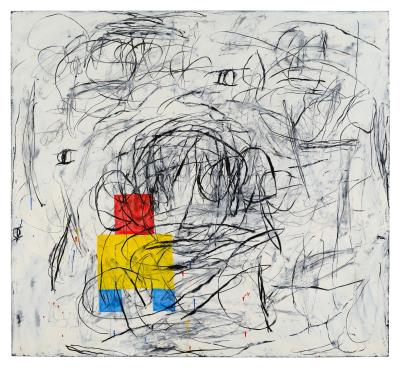
In the mid-1980s Ms. Chase began producing charged, gestural abstract work in which the landscape elements and body parts of earlier paintings became enmeshed in thickets of color and skeins of calligraphic lines. In a catalog interview for her 1991 show at Brooke Alexander, she called this “a ball of yarn sense of narration that went in and out of space.”
The work, which showed affinities with the forceful, swaggering style of Neo-Expressionism, won her new admirers. In 1984 the Institute of Contemporary Art in Boston organized a traveling exhibition, “New Currents: Louisa Chase.” The same year, two of her paintings, “Woods” and “Fire,” were included in the Venice Biennale.
Louisa Lizbeth Chase was born on March 18, 1951, in Panama City, Panama, where her father, Benjamin, a West Point graduate and Army major, was stationed. Her mother, the former Wilda Stengel, was a homemaker.
Louisa grew up in Mount Gretna, Pa., and attended George School, a Quaker institution in Bucks County, before enrolling in Syracuse University with the intention of studying classics. Instead, she found her way to art and earned a degree in printmaking in 1973.
After attending Yale’s summer program in Norfolk, Conn., in her senior year at Syracuse, she was accepted into the university’s graduate painting program, where she received a master’s degree in fine art in 1975.
On graduating, she moved to New York, where she began exhibiting frequently. She also taught at the Rhode Island School of Design from 1975 to 1979 and at the School of Visual Arts in Manhattan from 1980 to 1982.
She continued to push her work in an abstract direction into the 1990s, giving free rein to her tangled marks and lines. “The angry-child scratches have exploded into an allover web of messy Twombleyesque crosshatching; the individual lines gouge the built-up surfaces cruelly,” Holland Cotter wrote in Art in America, reviewing her show at the Robert Miller Gallery in 1986. The appeal of the work, he wrote, lay in its “scaled-down gestural poetry combined with Abstract Expressionist fervor.”
Ms. Chase later introduced geometric shapes in primary colors, some of them suggesting the human form, like the figure with outstretched arms, made up of yellow rectangles, in “Sleepwalker” (1991).
“I’m working with the most simple elements that I can,” she told the reference work World Artists. “The drawing’s just completely what it is: black, white, gray, and then the red, yellow and blue.
“It’s a really different head,” she added. “I don’t think I could come up with an image now to save my life.”
In her later years, Ms. Chase exhibited at the Halsey McKay Gallery in East Hampton. In addition to her brother, a conceptual artist, she is survived by her mother and by a sister, Abigail Chase.Biography from the Archives of askART
 Abstraction painter and printmaker Louisa L. Chase was born in 1951 in Panama City, Panama and now (2002) lives in Sag Harbor, New York. Her paintings, primarily oil, feature sparse, dark, Expressionist calligraphic scribbles often overlaying and contrasting with the geometry of isolated rectangles in primary colors, as if to comment upon the opposing natures of these differing forms.
Chase earned a B.F.A. degree in 1973 from Syracuse University, New York, and an M.F.A. degree in 1975 from Yale University, New Haven, Connecticut. She taught painting from 1975 to 1979 at the Rhode Island School of Design, Providence, and in 1980 to 1982 in New York City at the School for Visual Arts.
She received grants in 1978-79 and 1982-83 from the National Endowment for the Arts, and in 1979-80 from the New York Council on the Arts Creative Artists Public Service
Chase has exhibited, in one-person and group shows, at the Robert Miller Gallery, New York City (1981-82, 1984, 1986); Galerie Inge Baker, Cologne, Germany (1983); Margo Leavin Gallery, Los Angeles, California (1985); Whitney Museum of American Art (1985); Metropolitan Museum of Art (1988); and Bard College, Annandale-on-Hudson, New York (1989).
Louisa Chase's work is in the collections of the Metropolitan Museum of Art, Museum of Modern Art, Whitney Museum of American Art, and New York Public Library in New York City; the Albright-Knox Art Gallery, Buffalo, New York; University of Massachusetts, Worcester; Corcoran Gallery of Art, and Library of Congress, Washington, D.C.; and Denver Art Museum, Colorado.
Source:
Jules and Nancy Heller, North American Women Artists of the 20th Century