Page loaded successfully. Showing biography for Louise Edith Fishman.
Louise Edith Fishman BIOGRAPHY
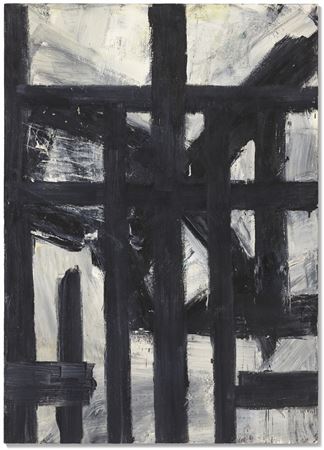
1939 Philadelphia, Pennsylvania - 2021 Manhattan, New York City. Known for: Gestural, abstract expresionist painting, calligraphy.
Following is a review of three exhibitions by Louise Fishman titled "A Restless Spirit", written by Carrie Moyer and published in Art in America, October 1, 2012. A legendary talker, Franz Kline is... Read full biography
Following is a review of three exhibitions by Louise Fishman titled "A Restless Spirit", written by Carrie Moyer and published in Art in America, October 1, 2012. A legendary talker, Franz Kline is famous for saying that "painting is like hands stuck in a mattress." Kline's remark vividly conjures... Read full biography
Following is a review of three exhibitions by Louise Fishman titled "A Restless Spirit", written by Carrie Moyer and published in Art in America, October 1, 2012. A legendary talker, Franz Kline is famous for saying that "painting is like hands stuck in a mattress." Kline's remark vividly conjures the image of a painter wrestling with the inert pigment in order to feel his image and bring it to life. Intensely tactile and athletic, the paintings of Louise Fishman seem to have been born of this... Read full biography
Following is a review of three exhibitions by Louise Fishman titled "A Restless Spirit", written by Carrie Moyer and published in Art in America, October 1, 2012. A legendary talker, Franz Kline is famous for saying that "painting is like hands stuck in a mattress." Kline's remark vividly conjures the image of a painter wrestling with the inert pigment in order to feel his image and bring it to life. Intensely tactile and athletic, the paintings of Louise Fishman seem to have been born of this impulse. At 73, she has spent more than 50 years pitching dynamic gestural painting up against the cool austerity of the grid. The result is an oeuvre that is resolutely idiosyncratic and canonical at the same time. In her work, the personal reveals... Read full biography
Following is a review of three exhibitions by Louise Fishman titled "A Restless Spirit", written by Carrie Moyer and published in Art in America, October 1, 2012. A legendary talker, Franz Kline is famous for saying that "painting is like hands stuck in a mattress." Kline's remark vividly conjures the image of a painter wrestling with the inert pigment in order to feel his image and bring it to life. Intensely tactile and athletic, the paintings of Louise Fishman seem to have been born of this impulse. At 73, she has spent more than 50 years pitching dynamic gestural painting up against the cool austerity of the grid. The result is an oeuvre that is resolutely idiosyncratic and canonical at the same time. In her work, the personal reveals itself incrementally through an ever-shifting abstract language invented to express the artist's compound identity as a woman, le... Read full biography
Artist Biography
Biography page for Louise Edith Fishman ((1939 - 2021)), known for Gestural, abstract expresionist painting, calligraphy. Showing 2 biographical entries and 0 sample artworks.
Louise Edith Fishman - Artist Info
About Louise Edith Fishman
Biography from the Archives of askART
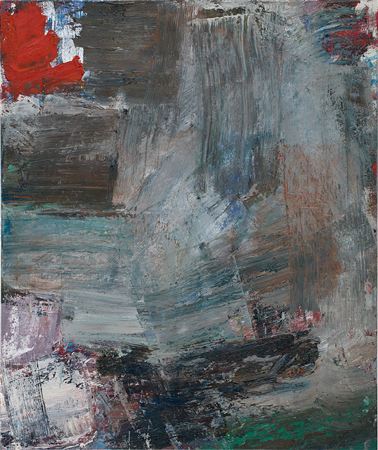 Following is a review of three exhibitions by Louise Fishman titled "A Restless Spirit", written by Carrie Moyer and published in Art in America, October 1, 2012.
A legendary talker, Franz Kline is famous for saying that "painting is like hands stuck in a mattress." Kline's remark vividly conjures the image of a painter wrestling with the inert pigment in order to feel his image and bring it to life. Intensely tactile and athletic, the paintings of Louise Fishman seem to have been born of this impulse.
At 73, she has spent more than 50 years pitching dynamic gestural painting up against the cool austerity of the grid. The result is an oeuvre that is resolutely idiosyncratic and canonical at the same time. In her work, the personal reveals itself incrementally through an ever-shifting abstract language invented to express the artist's compound identity as a woman, lesbian and Jew.
This desire to explore the empirical through nonobjective painting is what makes Fishman an important forerunner of much of the painting we see today.
This fall three diverse exhibitions offer an unprecedented opportunity to examine the progression of Fishman's formal and material experimentation over her long career. At New York's Tilton Gallery, "Louise Fishman: Five Decades" is a compact overview organized around the esthetic, personal and political touchstones of the artist's work. The full range of Fishman's interests is on view.
"Louise Fishman: New Work" at Cheim & Read, New York, presents some of her most virtuosic paintings to date, inspired by a recent stay in Venice, Italy.
Lastly, the Woodmere Art Museum in Philadelphia has organized "Generations: Louise Fishman, Gertrude Fisher-Fishman, and Razel Kapustin," an exhibition that positions Fishman in the context of her mother and aunt, both accomplished painters in their own rights.
Born in Philadelphia in 1939, Fishman grew up in a family of artists and avid art lovers. Her mother, Gertrude Fisher-Fishman, studied at the Barnes Foundation, and her sophisticated, light-filled abstractions reflect a long love affair with French modernist painting. At 95, she has only recently begun to slow her output.
Fishman's aunt, Razel Kapustin, worked with the Mexican muralist David Alfaro Siqueiros, and, like many of her peers, started out as a Social Realist painter and a communist. Later, Jewish themes became the primary subject of her artwork. Kapustin maintained a strong aversion to abstraction, a feeling that may have been exacerbated by the later career of her volatile classmate in Siqueiros's workshop, Jackson Pollock.
Growing up around two professionally active women artists during the 1940s and '50s had a powerful impact on Fishman. In the postwar era, when the popular role model Rosie the Riveter was refashioned into June Cleaver, Fishman was a basketball player intent on becoming an artist. Although sculpture was and continues to be a passion, it was the liberating physicality of the gesture that eventually drew Fishman toward painting.
She attended the Tyler School of Art, where she made her first abstract painting in 1961. After graduating with an MFA from the University of Illinois, Champaign, in 1965, she moved to New York City. By that time, hard-edge geometric abstraction had already supplanted the messiness of Abstract Expressionism. For a few years, Fishman dutifully worked with acrylic paint, taped her edges and thought about Kenneth Noland. While early works, such as a handsome untitled vertical stripe painting from 1970, lack Fishman's recognizably robust hand, her signature palette—graphic black, grays and earth tones—is already very much in evidence.
It was Fishman's involvement with the women's liberation movement in the early 1970s that propelled her to create her first cohesive body of work. She felt the full weight of the patriarchal construct of "art history," in particular painting's masculinity-driven legacy, prompting her "to figure out what part of me came from all the male stuff in my history and to eliminate it." (1) The impossibility and even absurdity of this effort caused Fishman to re-imagine every aspect of her studio practice, from scale, materials and supports to the very means of getting color to adhere to canvas.
For a series of intimate, somber untitled works from 1971-72, she dyed canvas in the kitchen sink, cut it into small squares and reassembled the grid by sewing it back together with thread. By approaching painting as a kind of quilt-making, Fishman gendered her materials, politicizing the given or "neutral" aspects of painting. One such piece, The Victory Garden of the Amazon Queen (1972), landed her in the 1973 Whitney Museum Biennial.
In the "Angry" series, from 1973, Fishman scrawled the righteous feelings of her female lovers, friends and comrades-in-arms across each painting, breaking yet another modernist taboo—the one against treating text as image. The works include Angry Louise, Angry Gertrude (Fishman's mother and Gertrude Stein) and Angry Marilyn (Monroe), all bristling with color. In the painting that names the writer Rita Mae Brown, the endlessly layered words "Angry Rita Mae" appear as receding waves of manic scribble.
Although Fishman had come out in the late 1950s, it wasn't until the early '70s that she found her community in a group of lesbian writers and academics. Envious of their journalistic skills, she used the idea of writing to generate a new body of work in which she integrated calligraphic mark-making into the painting process.
Thanks to the sense of personal liberation proffered by the women's movement, Fishman experienced a new-found freedom in the studio, even going so far as to return to oil painting, a rejection of the anti-heroic, craft-based agenda promulgated by some feminist colleagues. "I had spent my life avoiding sewing and anything else that had to do with 'women's tasks,'" Fishman said later. (2)
As a means of creating something authentic from the orthodoxy of painting, she intensified her investigation of materials and methods, substituting palette knives for brushes and a variety of surfaces for the standard stretched canvas. Works ranged from the seductive Caryatid (1974), an oil-and-wax monochrome on shaped wood, to Navigation (1981), an oil-on-linen composition with thick arabesques carved into the dense surface.
Looking to Bradley Walker Tomlin, Mark Tobey and Pierre Soulages, Fishman continued to investigate the idea of writing. She took up meditation, and Buddhist art became an important influence on her work. Chinese calligraphy, in particular, conflated gesture with writing. A collection of loose marks functions, contradictorily, as both a structure and a dis-integrative force. It is an inventive formal trope that Fishman has returned to repeatedly over the years.
The motif comes in many variations, including the primal Ecce Homo (1990), the graffiti-esque Blonde Ambition (1995) and the ravishing Longhand (2007). Most recently, in Blue for You (2010), she strips away any semblance of structure, allowing manic gestures to dominate from edge to edge.
In 1988 Fishman traveled to Eastern Europe and visited the former concentration camps at Auschwitz and Terezin, a heartrending experience that transformed her paintings once again. Over the years she had produced various works on the subject of Jewish identity, such as the wonderfully sarcastic Jewish Star Painting (1973-74), a small tondo with "Louise Edith Fishman" demurely inscribed in pink paint beneath the Star of David. Ashkenazi (1978), a striking red, white and black abstraction, employs a Hebrew name as a clue to her endeavor.
Unlike the formal and material signifiers of gender that she introduced into her work during the women's movement period (i.e., hand dyeing, sewing, patchwork, domestic scale), the ostensible markers of Jewish cultural identity are harder to identify in the arena of painting. After all, Abstract Expressionism, a movement long dominated by Jewish artists and critics, was ultimately naturalized as a triumphant American art form and represented by Jackson Pollock, a goy from Wyoming.
Fishman was deeply moved by her visit to the Pond of Ashes, a memorial built on the site of the Birkenau crematorium, and she collected a handful of silt while there. Back in the studio, she began working on paintings that would be part of a series called "Remembrance and Renewal." The ashes were mixed into oil paint, a theatrical act that rendered Jewish identity materially present yet still largely invisible.
Karpas (1988) is a group of four pale, muted compositions named for the Passover ritual of dipping bitter greens into salt water. Memorial Book (1988) depicts three skewed planes that modulate from an open book to an architectural fragment. The title refers to a kind of scrapbook published by shtetls and towns containing stories, photographs and a listing of residents who died in the Holocaust. Named for the restless, malevolent spirit from Jewish folklore, Dybbuk (1990) shows the artist playing out the mythic and macabre implications of painting with ashes. A spectral light seems to have entered the somber abstraction and shimmers from within its velvety black structure.
Fishman's studio in upstate New York was destroyed in a fire in 1990, and she lost everything. Devastated and unable to paint, she went to New Mexico with the hope of recovering from the shock. She began spending time with Agnes Martin in her studio, and the close contact with Martin's drawings rekindled her interest in the grid. Fishman saw that the grid could be employed as a form of meditation rather than simply a compositional device. Despite (or, perhaps, because of) the trauma of the fire, the mournful, anxious introspection that marked the "Remembrance and Renewal" paintings was replaced by a new confidence and depth of feeling.
In Valles Marineris and Sanctum Sanctorum (both 1992), Fishman seems to let go of her nagging mistrust of beauty, and uses a roller to help create a luminous grid made of thin layers of transparent color.
Fishman's paintings show the gravitas and clarity of an artist who has fully matured by the mid-1990s. The battling formal interests—calligraphy, gesture and the grid—start to hybridize into new means of structuring a picture. In recent works, it seems less and less important for her to show the labor required to "resolve" a painting. If struggle is apparent in the picture, it is now part of the content and not simply evidence of the painting process.
Fishman's worldview remains innately tough, unfazed by the pleasures of mastery. As luscious as they may be, paintings like Moon and Movies (2003) and Concealing and Revealing (2008) signal the presence of a rigorous mind. Slippery Slope (2006) and Splintering Gold (2009) demonstrate a hard-won physical intelligence that recognizes that beauty is just a heartbeat away from anarchy.
The exuberant new paintings at Cheim & Read are prime examples of Fishman's achievement. In 2011 she spent an idyllic three months with her soon-to-be wife, Ingrid Nyeboe, at the Emily Harvey Foundation Residency in Venice. The resulting pictures are both commanding and vigorous. Bracing flashes of light keep them in constant motion. Unlike Fishman's earlier, thickly painted images, these seem to have little gravity. Big swoops of phthalo blue, gray and mossy green dive and dance around the center of the canvases, creating pockets of air in their wake.
In Serenissima, The Salt-Wavy Tumult and Assunta (all 2012), Fishman's usual ratio of cardinal elements has been reversed—little clods of earthy pigment get caught up in a centrifuge of light, water and atmosphere.
Formal and chromatic traces of Venetian imagery—striped gondola posts, carved stone, grand pictures of sea battles, fleshy goddesses and Catholic pageantry—are embedded throughout Fishman's latest canvases. Powerful vertical strokes bisect Calle Maria Callas and Crossing the Rubicon (both 2012), generating a hushed center amid slashes of ocher, terra-cotta and raw sienna.
Using gessoed jute to create a highly textured support, Fishman playfully subjects the paint to scraping, dragging, raking, sponging and staining. The big squeegee even comes out in Lolland (2011), a luminous blue, black and gray painting named for the Danish island where Nyeboe was born.
Looking across a career spanning five decades, one is struck by Fishman's fierce single-mindedness. By the time she came of age as an artist, the romantic individualism of Abstract Expressionism was exhausted, and even regarded as suspect by some. Yet deeply attached to gestural painting, Fishman has persisted in using her own experience to re-frame its conventions and, in so doing, has produced a body of work that bristles with feeling and authenticity. The enduring value of the "long haul," as marked by the countless hours spent alone in the studio, is what perhaps most distinguishes painting practice from the more collaborative modes of contemporary art making. Fishman proves once again that the hard-won rewards of this solitude can be glorious.
Currently On View
"Louise Fishman: New Work" at Cheim & Read, through Oct. 27, and "Louise Fishman: Five Decades" at Tilton Gallery, through Oct 13, both in New York; "Generations: Louise Fishman, Gertrude Fisher-Fishman, and Razel Kapustin" at the Woodmere Art Museum, Philadelphia, Oct. 13, 2012-Jan. 6, 2013.
1 Interview with the author, April 23, 2011, to appear in Art Journal, Winter 2012, n.p.
2 Ibid., n.p. Recent and upcoming exhibitions include "Louise Fishman," John Davis Gallery, Hudson N.Y., July 1-Aug. 12, and a solo at Martha Max Kahn, Baltimore, Md., Mar. 13-Apr. 20, 2013.
Online Source:
http://www.artinamericamagazine.com/news-features/magazine/a-restless-spirit/Biography from the Archives of askART
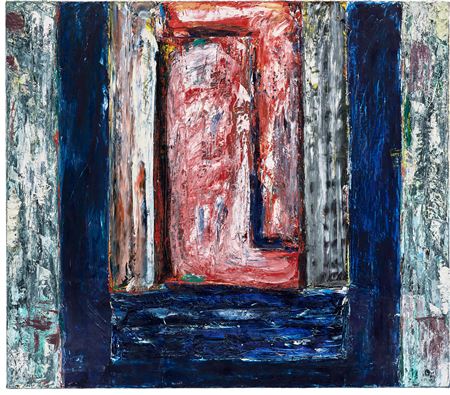 "Louise Fishman, Who Gave Abstract Expressionism a New Tone, Dies at 82, Obituary", The New York Times, by Neil Genzlinger, August 3, 2021
Her paintings infused a once-male-dominated genre with a feminist, lesbian sensibility.
Louise Fishman, a widely exhibited artist who imbued her Abstract Expressionist paintings and other works with elements of feminism and gay and Jewish identity, died on July 26 in Manhattan. She was 82.
Her spouse, Ingrid Nyeboe, said the cause was complications of an ablation, a heart procedure.
Ms. Fishman continually explored new themes and techniques, usually giving her own spin to the male-dominated genre of Abstract Expressionism.
She was influenced early in her career by the first-generation Abstract Expressionists, men from the Jackson Pollock era, but by the mid-1960s she began to immerse herself in the gay and feminist movements, joining protest organizations like WITCH — the Women’s International Terrorist Conspiracy From Hell — and sharing ideas and frustrations with other women in a consciousness-raising group. It led her to rethink her art
“I decided never to paint again unless it came out of my own experience,” she told The Brooklyn Rail in 2012. “Because, I’ve said this many times, being in my woman’s group and examining deeply where everything came from in my work, I realized that I hadn’t had a thought outside of the male tradition of art history and contemporary art history.”
Among the works she produced after that was her “Angry” series, begun in the early 1970s, each canvas a name amid a furious field of paint. It was intended to evoke the anger she imagined was felt by women in her group as well as various public figures. There was Angry Marilyn, for Marilyn Monroe, and Angry Paula, for the gallerist Paula Cooper. And, of course, Angry Louise.
After a trip to Central Europe in 1988 with a friend who was a Holocaust survivor, Ms. Fishman expanded on the Jewish and Holocaust themes that she had already begun to explore. For some of the works she made in that period, she mixed her paint with ash she had picked up in Auschwitz.
These types of paintings set her apart from the original Abstract Expressionists.
“Unlike Ab-Ex, which, despite its chest-thumping angst, was largely apolitical, Ms. Fishman hasn’t hesitated to introduce topical experience into her canvases,” John Goodrich wrote in The New York Sun in 2006
Ms. Fishman often ventured away from the brush, experimenting with different ways to apply paint and create works.
“It’s an impulsive process,” she told The Brooklyn Rail. “I’ll be on the street and just find stuff. I won’t even be sure why it interests me, but I’ll leave it in the studio, and sooner or later it’s either a tool or it gets used in some way in the paintings.”
But her interests went far beyond the technical aspects of what could be done with a brush or a palette knife.
“Fishman’s work may be process-driven,” Leah Ollman wrote in 2019 in reviewing an exhibition at the Vielmetter gallery in Los Angeles for The Los Angeles Times, “but her process encompasses questions about self, culture and history as much as materials, color and surface.
Exploration was a constant in her work.
“I think of myself as a perpetual student,” she told The New York Times in 2000.
Louise Edith Fishman was born on Jan. 14, 1939, in Philadelphia. She had art in her genes: Her mother, Gertrude Fisher-Fishman, was an artist, as was an aunt, Razel Kapustin. Her father, Edward, was an accountant.
She grew up in Philadelphia immersed in art thanks to her mother — she would sometimes accompany her mother to drawing classes. Years later she incorporated elements of two games she had played in her youth into grid paintings.
“One was the basketball court, basically a grid, and I knew where my foot was at all times in relation to the foul line and the half-court line,” she told The Philadelphia Inquirer in 2019, when she had an exhibition at Locks Gallery in Philadelphia. “Same thing when I would play bottle tops. You would make a court on the street with chalk, then get down on the street and shoot these bottle tops around these different boxes.
She studied at the Philadelphia College of Art and the Pennsylvania Academy of the Fine Arts as well as at the Tyler School of Art, part of Temple University. She earned bachelor’s degrees in painting and printmaking and in art education at Temple in 1963, then received a master’s degree in painting and printmaking at the University of Illinois at Champaign in 1965. She moved to New York that year, and was already well into Abstract Expressionism.
“I felt that Abstract Expressionist work was an appropriate language for me as a queer,” she said in an interview quoted in a catalog for a 2016 retrospective at the Neuberger Museum of Art in Purchase, N.Y. “It was a hidden language, on the radical fringe, a language appropriate to being separate.”
In her long career Ms. Fishman had dozens of solo shows and was featured in countless group shows. Her artistic forays included abandoning paint-on-canvas for a time in the 1970s and exploring aspects of traditional women’s crafts; in some works she stitched together strips of canvas in quiltlike fashion.
In addition to Ms. Nyeboe, whom she married in 2012, she is survived by a brother, S.J. Fishman.
Ms. Fishman bought a farmhouse in upstate New York in 1987 and used it as a studio and second home. When fire destroyed that studio in 1990, she spent time in New Mexico, recovering her equilibrium and working with the painter Agnes Martin. She began absorbing Chinese philosophies and traditions, and her works from this period show elements of Chinese calligraphy.
She continued to impress critics into the new century.
“Ms. Fishman’s works are not what you would call serene,” Ken Johnson wrote in The Times in 2000, reviewing a show at Cheim & Read in Chelsea. “Each heavily layered, extensively reworked picture feels like a hard-fought standoff between forces of order and chaos.”