Page loaded successfully. Showing biography for Luis Zarate.
Luis Zarate BIOGRAPHY
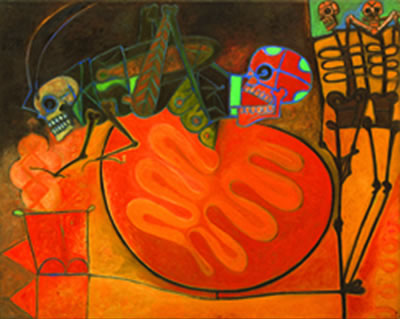
Born 1951 Santa Catarina de Cuanana, Oaxaca. Known for: Expressionist and abstract paintings.
. Luis Zárate was born in 1951 in Santa Catarina Cuanana, Oaxaca. Although he earned a degree in Industrial Engineering, Zárate remained dedicated to drawing and painting, ultimately developing his... Read full biography
. Luis Zárate was born in 1951 in Santa Catarina Cuanana, Oaxaca. Although he earned a degree in Industrial Engineering, Zárate remained dedicated to drawing and painting, ultimately developing his artistic practice as a self-taught painter. His visual language was shaped by the work of fellow... Read full biography
. Luis Zárate was born in 1951 in Santa Catarina Cuanana, Oaxaca. Although he earned a degree in Industrial Engineering, Zárate remained dedicated to drawing and painting, ultimately developing his artistic practice as a self-taught painter. His visual language was shaped by the work of fellow Oaxacan artists Rufino Tamayo, Francisco Toledo, and Rodolfo Nieto, whose expressive styles and cultural themes strongly influenced his approach. In 1970, Luis Zárate presented his first solo exhibition... Read full biography
. Luis Zárate was born in 1951 in Santa Catarina Cuanana, Oaxaca. Although he earned a degree in Industrial Engineering, Zárate remained dedicated to drawing and painting, ultimately developing his artistic practice as a self-taught painter. His visual language was shaped by the work of fellow Oaxacan artists Rufino Tamayo, Francisco Toledo, and Rodolfo Nieto, whose expressive styles and cultural themes strongly influenced his approach. In 1970, Luis Zárate presented his first solo exhibition at the former Convent of Santo Domingo in Oaxaca. Four years later, he won a scholarship through an industrial design competition, allowing him to study in Paris. During his 14-year stay in France, Zárate trained at the École nationale supérieure des... Read full biography
. Luis Zárate was born in 1951 in Santa Catarina Cuanana, Oaxaca. Although he earned a degree in Industrial Engineering, Zárate remained dedicated to drawing and painting, ultimately developing his artistic practice as a self-taught painter. His visual language was shaped by the work of fellow Oaxacan artists Rufino Tamayo, Francisco Toledo, and Rodolfo Nieto, whose expressive styles and cultural themes strongly influenced his approach. In 1970, Luis Zárate presented his first solo exhibition at the former Convent of Santo Domingo in Oaxaca. Four years later, he won a scholarship through an industrial design competition, allowing him to study in Paris. During his 14-year stay in France, Zárate trained at the École nationale supérieure des Arts Décoratifs and Atelier 17, and received guidance from Juan Soriano, whose mentorship helped him refine his painterly direction.... Read full biography
Artist Biography
Biography page for Luis Zarate ((Born 1951)), known for Expressionist and abstract paintings. Showing 2 biographical entries and 0 sample artworks.
Luis Zarate - Artist Info
About Luis Zarate
Biography from Morton Subastas
Luis Zárate was born in 1951 in Santa Catarina Cuanana, Oaxaca. Although he earned a degree in Industrial Engineering, Zárate remained dedicated to drawing and painting, ultimately developing his artistic practice as a self-taught painter. His visual language was shaped by the work of fellow Oaxacan artists Rufino Tamayo, Francisco Toledo, and Rodolfo Nieto, whose expressive styles and cultural themes strongly influenced his approach.
In 1970, Luis Zárate presented his first solo exhibition at the former Convent of Santo Domingo in Oaxaca. Four years later, he won a scholarship through an industrial design competition, allowing him to study in Paris. During his 14-year stay in France, Zárate trained at the École nationale supérieure des Arts Décoratifs and Atelier 17, and received guidance from Juan Soriano, whose mentorship helped him refine his painterly direction.
Zárate’s paintings fuse expressionism, abstraction, and regional symbolism, referencing Oaxacan mythology, local fauna, and spiritual archetypes. His compositions move fluidly between figuration and abstraction, incorporating techniques rooted in European avant-garde traditions while remaining grounded in Mexican cultural identity.
Since returning to Oaxaca in 1986, Luis Zárate has remained active in supporting social causes and cultural preservation. He has received multiple awards in France and Monaco, and his work has appeared in major exhibitions internationally.
Exhibitions:
Primera exposición individual, Ex-Convento de Santo Domingo, Oaxaca, Mexico (1970)
Salón de la Plástica Mexicana, Mexico City, Mexico (1973, 1987, 1995)
Galerie Suzanne Tarasiève, Paris, France (1982, 1984, 1986)
Arte Latinoamericano Contemporáneo, Museo de Arte Contemporáneo, Madrid, Spain (1990)
Latin American Art Today, Oslo Kunstforening, Oslo, Norway (1992)
Pintura Mexicana Contemporánea, Museo Nacional de Bellas Artes, Lima, Peru (1994)
Muestra Itinerante de Arte Latinoamericano, Berlin, Munich, Hamburg, Germany (1995–1996)
Sincretismos, Museo de las Américas, San Juan, Puerto Rico (1999)
Luis Zárate: Abstracción y Memoria, Museo de Arte Moderno, Mexico City, Mexico (2002)
El color de la nostalgia, Centro Cultural Santo Domingo, Oaxaca, Mexico (2008)
Retrospectiva, Museo Estatal de Arte Popular de Oaxaca, Mexico (2015)
Biography from Morton Subastas
Luis always knew that he wanted to dedicate himself to painting; however, upon finishing high school he studied a degree in Industrial Engineering, keeping drawing as a parallel activity. After finishing his degree he decided to dedicate himself to drawing and painting in a self-taught way. In this process of formation we can not leave aside the artistic references that he obtained from the works of Tamayo, Toledo and Nieto.
In 1970 he presented his first solo exhibition in the former convent of Santo Domingo, in Oaxaca. At that time he met the painter José Zúñiga, who supported his career and took him to Mexico City and began to exhibit his work in the Chapultepec Gallery. In 1974 he enrolled in an industrial design contest with which he obtained a scholarship to study in Paris. That year he devoted himself to visiting museums and galleries. He established contact with Juan Soriano, his wise advice helped him find his way in painting. His stay in Paris lasted for 14 years. He studied at the National School of Decorative Arts in Paris and at the Atelier 17. He has participated in exhibitions in Spain, Germany, Bulgaria, Norway, France, Italy, Monaco, Singapore, the United States, Mexico, Peru and Puerto Rico. In Europe he was awarded numerous prizes. In those years, the painting of Zárate presented rich figurative assemblages, which made reference to the legends, myths and fantasies of the Zapotec culture. In 1986 he decided to return to Oaxaca.
Consulted source:
LARA ELIZONDO, Lupina. Vision of Mexico and its artists. Volume III. Mexico. Promotion of Mexican Art, pp. 233-236.