Page loaded successfully. Showing biography for Manuel Mendive.
Manuel Mendive BIOGRAPHY

Born 1944 Havana, Cuba. Known for: Yoruba culture drawing, painting, wood carving and sculpture, mixed media.
Manuel Mendive is one of the leading Afro-Cuban artists to emerge from the Revolutionary Period. Mendive was born in Havana, Cuba, in 1944. His family practiced La Regla de Ocha, or Santería. A... Read full biography
Manuel Mendive is one of the leading Afro-Cuban artists to emerge from the Revolutionary Period. Mendive was born in Havana, Cuba, in 1944. His family practiced La Regla de Ocha, or Santería. A mulatto, he cherishes his Yoruba roots from the West Coast of Africa. In 1963, he graduated from the San... Read full biography
Manuel Mendive is one of the leading Afro-Cuban artists to emerge from the Revolutionary Period. Mendive was born in Havana, Cuba, in 1944. His family practiced La Regla de Ocha, or Santería. A mulatto, he cherishes his Yoruba roots from the West Coast of Africa. In 1963, he graduated from the San Alejandro Academy of Plastic Arts, Havana. He has received numerous awards for his art within exhibitions in Cuba and in Europe. Since the beginning of his artistic career, he has participated in many... Read full biography
Manuel Mendive is one of the leading Afro-Cuban artists to emerge from the Revolutionary Period. Mendive was born in Havana, Cuba, in 1944. His family practiced La Regla de Ocha, or Santería. A mulatto, he cherishes his Yoruba roots from the West Coast of Africa. In 1963, he graduated from the San Alejandro Academy of Plastic Arts, Havana. He has received numerous awards for his art within exhibitions in Cuba and in Europe. Since the beginning of his artistic career, he has participated in many group and solo art exhibits. His first one man show was held at the Center of Art in Havana, in 1964. In 1968, he was awarded the Adam Montparnasse prize for his painting exhibit at the Salon de Mai, in Paris, and third prize at the Salón Nacional... Read full biography
Manuel Mendive is one of the leading Afro-Cuban artists to emerge from the Revolutionary Period. Mendive was born in Havana, Cuba, in 1944. His family practiced La Regla de Ocha, or Santería. A mulatto, he cherishes his Yoruba roots from the West Coast of Africa. In 1963, he graduated from the San Alejandro Academy of Plastic Arts, Havana. He has received numerous awards for his art within exhibitions in Cuba and in Europe. Since the beginning of his artistic career, he has participated in many group and solo art exhibits. His first one man show was held at the Center of Art in Havana, in 1964. In 1968, he was awarded the Adam Montparnasse prize for his painting exhibit at the Salon de Mai, in Paris, and third prize at the Salón Nacional de Artes Plásticas, in Havana. Today, his art resides in museums and galleries all over the world which include Cuba, Russia, Somalia, Beni... Read full biography
Artist Biography
Biography page for Manuel Mendive ((Born 1944)), known for Yoruba culture drawing, painting, wood carving and sculpture, mixed media. Showing 4 biographical entries and 0 sample artworks.
Manuel Mendive - Artist Info
About Manuel Mendive
Name variants
Manuel Medive
Biography from the Archives of askART
 Manuel Mendive is one of the leading Afro-Cuban artists to emerge from the Revolutionary Period
Mendive was born in Havana, Cuba, in 1944. His family practiced La Regla de Ocha, or Santería. A mulatto, he cherishes his Yoruba roots from the West Coast of Africa. In 1963, he graduated from the San Alejandro Academy of Plastic Arts, Havana.
He has received numerous awards for his art within exhibitions in Cuba and in Europe. Since the beginning of his artistic career, he has participated in many group and solo art exhibits. His first one man show was held at the Center of Art in Havana, in 1964. In 1968, he was awarded the Adam Montparnasse prize for his painting exhibit at the Salon de Mai, in Paris, and third prize at the Salón Nacional de Artes Plásticas, in Havana. Today, his art resides in museums and galleries all over the world which include Cuba, Russia, Somalia, Benin, Congo, Norway, Denmark, Finland, Jamaica, and the United States.
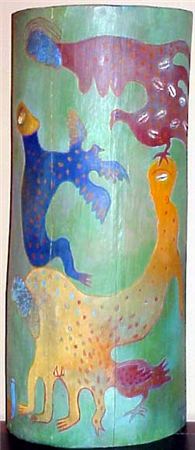
Mendive's work incorporates several art mediums and genres. His art consists of drawing, painting, body painting, wood carving, sculpture, and performance that integrates loosely choreographed dance with rhythmic music. At times, the availability of art materials was rather scarce due to the harsh economic climate of the island. As a result, he relied on his creativity and resourcefulness to obtain various mediums, commonly found in nature. Much of his work consists of paint and wood, which he combines with other interesting elements, such as, human hair, sand, feathers, and glass that convey a primitive quality. He not only paints with oils and pastels on canvases, but he paints on masks and posters. Mendive is also famous for his representation of saints and Lukumi gods through his use of carved, burned, and painted wood that he made during 1960s.
Mendive's art is strongly influenced by the Santería religion. In fact, Santería permeates every form of his art from body painting to events performed in public spaces.
In the 1960s and 1970s, his most significant works were created, and they depict a primitive display of Yoruba mythology with his use of raw materials that resemble altars. A prime example that his style is primitive and mythological is reflected in his art piece Voodoo Altar displayed at the Museo Nacional de Guanabacoa, in Cuba. Some of the materials Mendive's used to create Voodoo Altar include twigs, feathers, and hair. An example of his primitive, Afro-Cuban imagery is also seen in his 1976 painted wood carving, Slave Ship, which epitomizes the onset of the struggles in modern-day life. His art is minimalistic, yet it is thought provoking.
In the 1970s, he continued to promote Afro-Cuban culture through his colorful art by referencing the Middle Passage, colonialism, Cuban history, and Yoruba history. His art is a mixture of African and European styles.
From the mid-1960s to 2010, much of his work includes paintings and drawings that portray spirits and Orisha saints through the use of a wide array of colors and smooth, flowing shapes. The primary theme in his art is his recognition that African religion and African culture have shaped Cuban national identity and culture. Gerardo Mosquera praises him for his art because Mendive acknowledges the rich tapestry of African contributions to the Cuban culture.
In 1982, Mendive made his first trip to West Africa and traveled throughout the region for a year gaining new insight into his Yoruba roots. He drew energy from spending time in Africa and became inspired on a whole new level. After his return to Cuba, his art portrayed images connected with the natural environment, such as, his 1984 painting Viento a Fete.
References
• Ades, Dawn. Art in Latin America. Biographies by Rosemary O'Neill. New Haven and London: Yale University Press, 1989.
• Bettelheim, Judith. Afrocuba: Works on Paper, 1968-2003. San Francisco State University: University of Washington Press, 2005.
• Block, Holly. Art Cuba: The New Generation. New York: Harry N. Abrams, Inc. Publishers, 2001.
• Craven, David. Art and Revolution in Latin America 1910-1990. New Haven and London: Yale University Press, 2002.
• Poupeye, Veerle. Caribbean Art. New York: Thames and Hudson Inc., 1998.
• Sullivan, Edward J. Latin American Art in the Twentieth Century. New York: Phaidon Press Limited, 2004.
Source:
"Manuel Mendive", Wikipedia, en.wikipedia.org/wiki/Manuel_Mendive (Accessed 6/20/2013)Biography from GallArt.com
 Manuel Mendive is a significant Cuban 21st century artist. A major exponent of contemporary Afro-Cubanismo in the visual arts, he was born in 1944 into a Santería-practicing family. He graduated from the Academia de Artes Plásticas San Alejandro in Havana in 1962 with honors in sculpture and painting. He held his first one-man show at the Center of Art in Havana in 1964.
Since then he has exhibited at international venues. The Cuban booth at the XLII International Biennial Exhibition of Modern Art in Venice in 1988 was completely dedicated to his works.
His work can be found in Museums and galleries in many countries including the Museo Nacional de Bellas Artes in Havana, the Musee d'Art Moderne in Paris; as well as museums in Russia, Somalia, Congo, Norway, Denmark, Finland and the U.S and other countries.
Manuel Mendive Hoyo was born on December 15, 1944, in Luyanó, the same Havana neighborhood where Wifredo Lam went back to live for a few months on his "retours au pays natal" in 1942 and where Lam made his first "rediscoveries" of that visual universe André Breton would later describe as an un-trammelled union of real and magical worlds. It is mainly a dock and factory worker neighborhood.
The wooden house where Mendive was born was built in 1900 by his maternal grandfather Fermín Hoyo Espelusín, a construction worker. This grandfather is the most direct family antecedent for Mendive's artistic talent, for he was also a carver and engraver. He was sought for complicated architectural projects with decorative work and other nonfunctional aspects, such as the "Mudejar Palace" in the Plaza de las Ursulinas or the monument to General Antonio Maceo in the Havana park of the same name.
During the building of the latter Fermin was blinded in an accident. He was one of those anonymous master-builders who from colonial times spontaneously shaped "the style" of a city "without style" as it was aptly described by Carpentier in a memorable essay on the architecture of Havana; one of those eclectic "naifs" who were bold enough to invent scores of rare orders, with unusual, fancy columns and capitals whose design was hardly ever repeated throughout the kilometers of avenued porchways dating back to the turn of the century...
Writing about his work, the critic Edward Sullivan says, "I conceive of his work as daring, rebellious, unconventional and brave. He does not care about fashion or trends. His images, which so often incorporate and wildly transform the vestiges of African stimulus, do not appeal necessarily to those who seek the latest trend in the art world. Instead of intellectualized minimalism or hollow conceptualism, Mendive relies on the senses: thought, touch, color, breath, air, and fire".Biography from Gallery on Greene
The Art of Manuel Mendive's career spans 60 years. Unlike predecessors influenced by cubism and surrealism, Mendive draws on Lukumi/Yoruba traditions, weaving religion, nationalism, and memory throughout his paintings, drawings, sculptures, and performances from the 1960s to today.
Central to his practice are his seminal series Yoruba Mythology (1960s-70s), Middle Passage, and performances like La Vida (1980s), which testify to his devotion to Afro-Cuban culture and the visual language of religion.Biography from Setdart
Manuel Mendive is a Cuban artist known for his work as a painter, watercolorist, sculptor, and lithographer. His art is a reflection of the energy of the Orishas of the Yoruba pantheon, characterized by spontaneity, fluidity, and a timeless quality. Mendive studied at the San Alejandro Academy of Fine Arts in Havana, graduating in 1963. He has exhibited his work in Cuba and internationally, particularly in Europe. Mendive has received prestigious awards such as the Adam Montparnasse prize in Paris and the Alejo Carpentier Medal. His art is held in collections worldwide, including museums in Latin America, Russia, Africa, the United States, and Europe.