Page loaded successfully. Showing biography for Marie Barbera.
Marie Barbera BIOGRAPHY
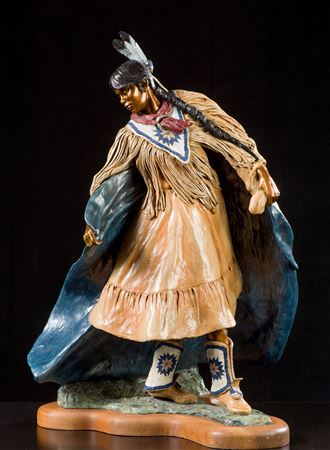
Born 1936. Known for: Indian figurative sculpture.
Lots Sold: 85%, High Price: Subscribe.
Marie Barbera is a first generation Italian-American known for figurative bronze sculptures of Native Americans. Her father, who emigrated from Italy to the United States in 1915, was a craftsman... Read full biography
Marie Barbera is a first generation Italian-American known for figurative bronze sculptures of Native Americans. Her father, who emigrated from Italy to the United States in 1915, was a craftsman restoring architectural details on federal and state buildings during the WPA programs of the 1930's.... Read full biography
Marie Barbera is a first generation Italian-American known for figurative bronze sculptures of Native Americans. Her father, who emigrated from Italy to the United States in 1915, was a craftsman restoring architectural details on federal and state buildings during the WPA programs of the 1930's. Both Marie and her brother chose to pursue an interest in art while growing up. Married to Frank Barbera in the 1950's, Marie and her husband raised two children and now have two grandchildren as well.... Read full biography
Marie Barbera is a first generation Italian-American known for figurative bronze sculptures of Native Americans. Her father, who emigrated from Italy to the United States in 1915, was a craftsman restoring architectural details on federal and state buildings during the WPA programs of the 1930's. Both Marie and her brother chose to pursue an interest in art while growing up. Married to Frank Barbera in the 1950's, Marie and her husband raised two children and now have two grandchildren as well. After many years as wife and mother, Marie returned to her work and developed the Barbera Studio. As of late, Marie Barbera has started working on and producing life size works that are well suited to public and private outdoor installations. Artist... Read full biography
Marie Barbera is a first generation Italian-American known for figurative bronze sculptures of Native Americans. Her father, who emigrated from Italy to the United States in 1915, was a craftsman restoring architectural details on federal and state buildings during the WPA programs of the 1930's. Both Marie and her brother chose to pursue an interest in art while growing up. Married to Frank Barbera in the 1950's, Marie and her husband raised two children and now have two grandchildren as well. After many years as wife and mother, Marie returned to her work and developed the Barbera Studio. As of late, Marie Barbera has started working on and producing life size works that are well suited to public and private outdoor installations. Artist Statement: Marie Barbera . I cannot identify why I felt so strongly about Nat... Read full biography
Artist Biography
Biography page for Marie Barbera ((Born 1936)), known for Indian figurative sculpture. Showing 1 biographical entries and 0 sample artworks.
Marie Barbera - Artist Info
About Marie Barbera
Biography from Kiva Fine Art (CLOSED)
Marie Barbera is a first generation Italian-American known for figurative bronze sculptures of Native Americans. Her father, who emigrated from Italy to the United States in 1915, was a craftsman restoring architectural details on federal and state buildings during the WPA programs of the 1930's. Both Marie and her brother chose to pursue an interest in art while growing up. Married to Frank Barbera in the 1950's, Marie and her husband raised two children and now have two grandchildren as well. After many years as wife and mother, Marie returned to her work and developed the Barbera Studio.
As of late, Marie Barbera has started working on and producing life size works that are well suited to public and private outdoor installations.
Artist Statement: Marie Barbera
I cannot identify why I felt so strongly about Native American culture but I did not create my art until discovering the world of the Native American Nations. At first I felt it was not my place to appropriate Native American subjects. This was not my own cultural heritage. At first I experimented with pastoral landscape but found this did not hold my interest. I relented to my fascination with the subject of native women and the influence of my appreciation for the work of Francisco Zuniga.
"I relented to my fascination with the subject of native women..."
Indiginous Americans are peoples of the earth and I feel I have developed a dialogue with them as I recreate their stories from their history into clay and into bronze. I develop my ideas from researching books. Something I read will intrigue me and I'll seek out additional information and become so involved in that story that I will integrate it to my own rememberence. These stories allow me to relate to you my works.
" ...stories allow me to relate to you my works."
In the 1960's I produced the first work of this Native thematic in the form of large scale watercolors reminiscent of Zuniga's sculptures of that same period. I love Zuniga's figures with large hands and feet, which suggest strength to me. I studied his drawings and sculptures in books and from examples of actual work from the San Diego Museum of Art Collection. I resisted the transition to a three dimensional medium for nearly twenty years and am sorry I waited so long. Clay is a wonderful medium that facilitates the full expression of my ideas.
I learned about the symbolism of the shield in Thomas E. Mails' book Mystic Warriors of the Plains.
In my The Shield of the Crow, I portrayed the Crow tradition of telling their history and acknowledging their honors by adding feathers to shields and headdresses that signified those events.
They Dance the Dance, They Chant the Chant is a work close to my heart. Before the tragedy of Wounded Knee in 1890, the Arapahos believed that if they danced the Ghost Dance and wore their protective shirts, they would be saved from the white man's bullets and their fallen ancestors would return to earth. Rather than depicting the final outcome of the massacre, the frozen bodies in the snow, I commemorated Wounded Knee with a trio of warriors dancing and chanting as they envisioned the return of the Old World that had been lost.
"Women are seminal in my work as they were in my own life ..."
Women are seminal in my work as they were in my own life experience of raising two daughters. The Plains depicts a mother and her children during the 1870's when the Cheyenne were herded into reservations and forced to adopt the ways of the white people. We could not take away their love of the family. In many cases it was the family pride that made survival possible. I used my own grandson's face as the model for the sleeping child on her shoulder.
Changing Woman portrays the Apache rite of passage from child to woman. The Sunrise Ceremony is similar to the Christian concept of Conformation. The exhausting weeklong ritual requires the girl to dance from morning until night around the cane of life, which was moved farther and farther from her.
"The Sunrise Ceremony is similar to the Christian concept of Conformation."
In my work I choose to represent moments that leads up to or follows the ritual act rather than the sacred moment. Native Americans frown upon divulging sacred activities, so in Sundance I show the High Priest painting the legs of a young man before ordaining him into manhood.
This is my work. I hope it touches you as it moves me. It is my addiction to create it. If I did anything else, I would be cheating myself. Second to my family, art is my life. And the histories of Native Americans is what I hope to leave for generations to come.
M. Barbera - 1999