Page loaded successfully. Showing biography for Markus Larsson.
Markus Larsson BIOGRAPHY
1825 Ostergotland, Sweden - 1864 London, England. Known for: Painting.
Markus Larsson was born in Sweden in 1825. In the summer of 1852, Marcus Larsson made walks in his hometown in Östergötland and in the surrounding area of Flenshult in Småland. This is where his... Read full biography
Markus Larsson was born in Sweden in 1825. In the summer of 1852, Marcus Larsson made walks in his hometown in Östergötland and in the surrounding area of Flenshult in Småland. This is where his brother, the housekeeper Ludwig Larson lived. Markus had the intention of conducting studies of trees... Read full biography
Markus Larsson was born in Sweden in 1825. In the summer of 1852, Marcus Larsson made walks in his hometown in Östergötland and in the surrounding area of Flenshult in Småland. This is where his brother, the housekeeper Ludwig Larson lived. Markus had the intention of conducting studies of trees for larger compositions here. In autumn of that year, he left Sweden for further studies in Düsseldorf. Larsson spent the summer of 1853 in Sweden, where he continued to carry out nature studies in... Read full biography
Markus Larsson was born in Sweden in 1825. In the summer of 1852, Marcus Larsson made walks in his hometown in Östergötland and in the surrounding area of Flenshult in Småland. This is where his brother, the housekeeper Ludwig Larson lived. Markus had the intention of conducting studies of trees for larger compositions here. In autumn of that year, he left Sweden for further studies in Düsseldorf. Larsson spent the summer of 1853 in Sweden, where he continued to carry out nature studies in Östergötland. Only one landscape study in oil from these two years of hiking is known today, a "Spruce Forest Interior", dated "Rydås 1853" (Östergötlands Museum, Linköping) (A. Gauffin, Simon Marcus Larsson 1825-1864. A Swedish artist's fate, 1907, p.... Read full biography
Markus Larsson was born in Sweden in 1825. In the summer of 1852, Marcus Larsson made walks in his hometown in Östergötland and in the surrounding area of Flenshult in Småland. This is where his brother, the housekeeper Ludwig Larson lived. Markus had the intention of conducting studies of trees for larger compositions here. In autumn of that year, he left Sweden for further studies in Düsseldorf. Larsson spent the summer of 1853 in Sweden, where he continued to carry out nature studies in Östergötland. Only one landscape study in oil from these two years of hiking is known today, a "Spruce Forest Interior", dated "Rydås 1853" (Östergötlands Museum, Linköping) (A. Gauffin, Simon Marcus Larsson 1825-1864. A Swedish artist's fate, 1907, p. 8, illustrated p. 7). Gaufffin lists, in 1852, two further nature studies in oil, both described as "A spruce", then... Read full biography
Artist Biography
Biography page for Markus Larsson ((1825 - 1864)), known for Painting. Showing 1 biographical entries and 0 sample artworks.
Markus Larsson - Artist Info
About Markus Larsson
Name variants
Marcus Larson, Marcus Larsson
Biography from Stockholm Auktionsverk
Markus Larsson was born in Sweden in 1825.
In the summer of 1852, Marcus Larsson made walks in his hometown in Östergötland and in the surrounding area of Flenshult in Småland. This is where his brother, the housekeeper Ludwig Larson lived. Markus had the intention of conducting studies of trees for larger compositions here. In autumn of that year, he left Sweden for further studies in Düsseldorf.
Larsson spent the summer of 1853 in Sweden, where he continued to carry out nature studies in Östergötland. Only one landscape study in oil from these two years of hiking is known today, a "Spruce Forest Interior", dated "Rydås 1853" (Östergötlands Museum, Linköping) (A. Gauffin, Simon Marcus Larsson 1825-1864. A Swedish artist's fate, 1907, p. 8, illustrated p. 7).
Gaufffin lists, in 1852, two further nature studies in oil, both described as "A spruce", then in A. C. Larson, possession of the artist's son (idem., P., No. 132 and 133).
The few landscape studies by Larson performed in oil, indicate that he performed most in the form of drawings. Flenshult, in whose surroundings the current study was carried out, is located in Karlstorp parish, Vetlanda municipality in Småland. The surrounding landscape is wild and mysterious. Bishop Isaiah Tegnér had said at the sight of the district, "Here it must have been as the leading tempter brought Our Lord, when he showed him all the glory of the earth" (LO. Borglid, Den galne hovmålaren, 2008, p. 232).
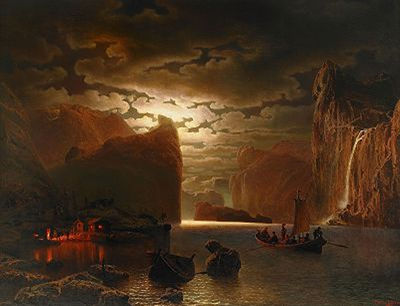
Larson has emphasized the wild, untouched and often inaccessible nature. The cliffs in the background that tower up and reflect against the evening sky reinforce the feeling of inaccessibility. The late dinner light creates deep shadows which emphasize the shapes of nature.
During the second half of the 1850s, Larsson had plans to create a school for landscape painters with von Schadowskolan in Düsseldorf as a model. The place for the school would be Flenshult, whose scenic and varied surroundings according to Marcus Larson were ideal sources to draw from and for "landscape painters were inexhaustible for several centuries" (idem., P. 231).
The idea fell to Charles XV, himself a landscape painter, and he gave his financial support for the project. In 1857, Marcus Larson had a building built for the purpose in Flenshult. Larson had imagined a five-story studio with two towers located on a hill overlooking five churches. A 22-meter-high flagpole was to be erected on top of one of the towers. A sketch of the house published in "Illustrerad Tidning" 1859 shows a more unassuming building in only two floors, but with a balcony-enclosed upper floor with glass walls in all directions. A number of artists came to live in the artist collective, due to Flenshult's isolated location, mainly originating from Småland and Östergötland, among them Knut Ekvall, Pamela Noreaus and Frans Roselli.
The business only lasted for two years. On the evening of May 2, 1859, the building caught fire and on returning home, Larson saw his studio burn like a care box at the top, a sight that could not have been entirely different from his many depictions of burning ships. Even the contemporaries marveled at this coincidence. The time in Flenshult with both the construction of the studio and the fire of the same was told in Stockholms Dagblad 1880. In the short story "Luskungen" in "Mitt liv och leverne", 1907, Albert Engström has recounted parts of the same story.
Markus Larsson passed away in London in 1864.