Page loaded successfully. Showing biography for Maud Lewis.
Maud Lewis BIOGRAPHY
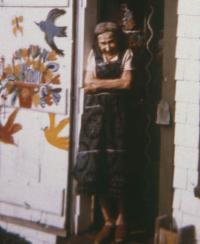
1903 Ohio, Nova Scotia - 1970 Digby, Nova Scotia. Known for: Naive landscape-snowscene painting.
Maude Lewis was born in Ohio, Yarmouth Country, Nova Scotia. She started painting Christmas cards with her mother and then sold them on the streets of Yarmouth. When her parents died she went to live... Read full biography
Maude Lewis was born in Ohio, Yarmouth Country, Nova Scotia. She started painting Christmas cards with her mother and then sold them on the streets of Yarmouth. When her parents died she went to live with an aunt in Digby, Nova Scotia. In 1938 she married Everett Lewis and moved to a small one-room... Read full biography
Maude Lewis was born in Ohio, Yarmouth Country, Nova Scotia. She started painting Christmas cards with her mother and then sold them on the streets of Yarmouth. When her parents died she went to live with an aunt in Digby, Nova Scotia. In 1938 she married Everett Lewis and moved to a small one-room cabin near No.2 Highway west of Digby, at a place called Marshalltown. Her husband sold fish from village to village and she sometimes sold some of her cards. He encouraged her to paint and bought... Read full biography
Maude Lewis was born in Ohio, Yarmouth Country, Nova Scotia. She started painting Christmas cards with her mother and then sold them on the streets of Yarmouth. When her parents died she went to live with an aunt in Digby, Nova Scotia. In 1938 she married Everett Lewis and moved to a small one-room cabin near No.2 Highway west of Digby, at a place called Marshalltown. Her husband sold fish from village to village and she sometimes sold some of her cards. He encouraged her to paint and bought her artist's supplies and cut small pieces of plywood that would allow her to paint with her polio-afflicted arms and arthritic condition. She passed her days painting in the doorway of her house and people began to know her and to buy her work. Her... Read full biography
Maude Lewis was born in Ohio, Yarmouth Country, Nova Scotia. She started painting Christmas cards with her mother and then sold them on the streets of Yarmouth. When her parents died she went to live with an aunt in Digby, Nova Scotia. In 1938 she married Everett Lewis and moved to a small one-room cabin near No.2 Highway west of Digby, at a place called Marshalltown. Her husband sold fish from village to village and she sometimes sold some of her cards. He encouraged her to paint and bought her artist's supplies and cut small pieces of plywood that would allow her to paint with her polio-afflicted arms and arthritic condition. She passed her days painting in the doorway of her house and people began to know her and to buy her work. Her story soon became famous; in 1965 an article in the Moncton Times referenced her story. The same year CBC-TV's Tele... Read full biography
Artist Biography
Biography page for Maud Lewis ((1903 - 1970)), known for Naive landscape-snowscene painting. Showing 2 biographical entries and 0 sample artworks.
Maud Lewis - Artist Info
About Maud Lewis
Biography from the Archives of askART
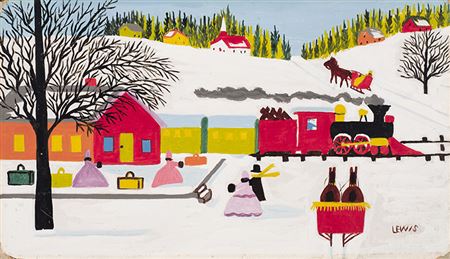 Maude Lewis was born in Ohio, Yarmouth Country, Nova Scotia. She started painting Christmas cards with her mother and then sold them on the streets of Yarmouth. When her parents died she went to live with an aunt in Digby, Nova Scotia.
In 1938 she married Everett Lewis and moved to a small one-room cabin near No.2 Highway west of Digby, at a place called Marshalltown. Her husband sold fish from village to village and she sometimes sold some of her cards. He encouraged her to paint and bought her artist's supplies and cut small pieces of plywood that would allow her to paint with her polio-afflicted arms and arthritic condition. She passed her days painting in the doorway of her house and people began to know her and to buy her work.
Her story soon became famous; in 1965 an article in the Moncton Times referenced her story. The same year CBC-TV's Telescope produced the programme "The Once-Upon-a-Time World of Maude Lewis" that featured her life and paintings and also included comments by Bill Ferguson and Claire Stenning, owners of the Ten Mile House Gallery, and Halifax artist John Cook [1918 - 1984].
In 1967 work by Maud Lewis was included at the Centennial Exhibition of Primitive Art in New Brunswick at the Beaverbrook House, Saint John.
In 1970 she died at the Digby General Hospital. Some of her paintings are in the White House and the Legislative Buildings of the Province of Nova Scotia. Some collectors of her paintings include Robert L. Stanfield (former premier of Nova Scotia) and President Richard Nixon, among many others. Her use of color and style was admired for its naturalist approach, both technically and thematically; she did not mixed colors but used them straight out of the tube and she mostly painted simple everyday life scenes of Nova Scotia.
Writings about
"About This and That - The Passing of Maude." Digby Courier 6 Aug. 1970.
"Digby artist dies; her primitive style paintings in the White House." Mail Star (Halifax) 1 Aug. 1970.
"Digby's Artist, Maude Lewis, Laid To Rest." Digby Courier 6 Aug. 1970.
"Digby's Artist, Mrs. Maude Lewis Dies." Chronicle-Herald (Halifax) 1 Aug. 1970.
"Maude in Hospital." Digby Courier 27 Mar. 1969.
"Once Upon-A-Time World of Maude Lewis." Moncton Times 20 Nov. 1965.
"Telescope Visits Painter Maude Lewis of Digby." Yarmouth Herald 24 Nov. 1965.
"The Maud Lewis Touch." Chronicle Herald (Halifax) 6 Aug. 1970.
Barnard, Murray. "The Little Old Lady Who Paints Pretty Pictures." Star Weekly (Toronto) 10 Jul. 1965.
MacDonald, Colin S.. The Dictionary of Canadian Artists. (Volumes 1-8 by Colin S. MacDonald, and volume 9 by Anne Newlands and Judith Parker) Ottawa: National Gallery of Canada, 2009
McCoy, Doris. "Frail Woman with A Body Brush." Atlantic Advocate (Fredericton) Jan. 1967.
Vowel, Jean. "The Sketch Pad." Times (Port Alberni) 1 Dec. 1965.
Source: Canadian Women Artists History Initiative* - http://cwahi.concordia.ca/sources/artists/nameSearch.php?artist=lewis
Posthumous exhibition
"The Illuminated Life of Maud Lewis", Art Gallery of Nova Scotia, Halifax, 1997
Source: Canadian Encyclopedia (online) - http://www.thecanadianencyclopedia.com/index.cfm?PgNm=TCE&Params=M1ARTM0011321
* For more in-depth information about these terms and others, see AskART.com Glossary http://www.askart.com/AskART/lists/Art_Definition.aspx.
Submitted to askART by M.D. Silverbrooke
Biography from Tennants
Maud Lewis was a Canadian folk artist and remains one of Canada’s best-loved artistic figures. Living in poverty for most of her adult life, she painted joyous, nostalgic and vibrant pictures of rural life in her Nova Scotia home.
Maud Lewis, nee Dowley, was born into a middleclass family in Yarmouth, Nova Scotia. Her father was a blacksmith and owned a harness shop, but despite relative affluence Maud’s childhood was not easy. She suffered from Juvenile rheumatoid arthritis, resulting in severely sloping shoulders, curvature of the spine and a recessed chin; Lewis spent much of her life in pain. Her mother, however, had an artistic nature, and taught Maud to paint Christmas cards which they would sell.
After her parents died in the mid-1930s, Maud had no resources and went to live with her aunt in Digby, Nova Scotia. After seeing an advert for a live-in housekeeper 40-year-old bachelor Everett Lewis had placed, Maud turned up on his doorstep in nearby Marshalltown. Whilst apparently the pair did not hit it off immediately, a few days later Maud returned to his house and stated that she would not be his housekeeper but would be his wife. The pair married in 1938, and Maud moved into the tiny 4.2m x 3.8m house, with one-room and sleeping loft, where they would live for the rest of their lives, with no running water or electricity.
Everett was a fish peddler, and Maud began accompanying him on his rounds, selling the Christmas cards she painted. Soon, Everett gave Maud her first set of oil paints, and they began selling her paintings too, all for very modest prices. Due to her ailments, Maud could not find employment, and indeed Everett even took over all domestic duties whilst Maud turned their little house into her studio and painted industriously – including every surface in their home. When Everett gained more stable employment, Maud put up a sign and sold her paintings from their home, which was on the side of the highway. Neighbours and tourists soon began flocking to purchase her colourful work but determined not to raise prices and put off buyers, the pair continued to live in poverty.
Working on a small scale due to her limited mobility, Maud painted on cheap materials, such as a pulpboard used in the building trade known as beaverboard, and later ready-cut Masonite. After painting the board with a white ground, she would draw on an outline and then apply paint straight from the tube without mixing or blending. Maud focused on a set range of subjects, mostly derived from memories of childhood and her surroundings in Nova Scotia before the onset of modernity; cats, deer and oxen, landscapes and depictions of harbour scenes, horse-drawn carts and sleighs. Nostalgic, yet optimistic, her works a happy simplicity with a touch of humor. Her most popular subjects were painted again and again, with minor variations, such as the present example Sandy Cove. This was one of only a select few subjects she painted across three decades. Sandy Cove is located on a long peninsular in the Bay of Fundy, not far from the Lewis’ home in Marshalltown. The other work up for sale, The Bride, is a more unusual subject for the artist, with far fewer variations known.
Coming to the attention of a journalist, Maud became the subject of a radio documentary and subsequently a newspaper article in the mid-1960s. Her work captured the attention of the nation, and she achieved widespread recognition. However, with only limited ability to paint, she struggled to keep up with orders, and resolutely refused to charge more for her paintings, despite the likes of a staff member at the Whitehouse during Nixon’s presidency requesting more of Lewis's works to add to his collection.
Today, her work is represented in museums and galleries around the world, with a large collection being found in the Art Gallery of Nova Scotia. Following her death from pneumonia in 1970s and Everett’s death in 1979, a permanent memorial was erected on the site of their home. Having captured the nations hearts, Maud’s life would become the subject of books, plays, and three films.