Page loaded successfully. Showing biography for Max Ernst.
Max Ernst BIOGRAPHY
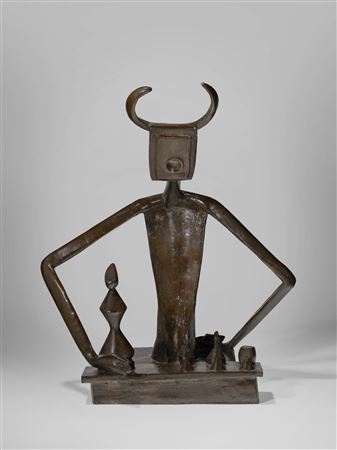
1891 Cologne, Germany - 1976 Paris, France. Known for: Abstraction, surrealism, dada art.
Max Ernst was born on April 2, 1891 in a small Rhineland town called Bruhl, outside Cologne. His father, a fiercely authoritarian Roman Catholic, was an amateur painter who taught at a school for... Read full biography
Max Ernst was born on April 2, 1891 in a small Rhineland town called Bruhl, outside Cologne. His father, a fiercely authoritarian Roman Catholic, was an amateur painter who taught at a school for deaf-mutes. From earliest childhood, Ernst seems to have acquired haunting visual images which became... Read full biography
Max Ernst was born on April 2, 1891 in a small Rhineland town called Bruhl, outside Cologne. His father, a fiercely authoritarian Roman Catholic, was an amateur painter who taught at a school for deaf-mutes. From earliest childhood, Ernst seems to have acquired haunting visual images which became factors in his work throughout his life. He was a nervous impressionable boy, in constant friction with authority. During an illness, Ernst stared at the wood flooring and ended up discovering a new... Read full biography
Max Ernst was born on April 2, 1891 in a small Rhineland town called Bruhl, outside Cologne. His father, a fiercely authoritarian Roman Catholic, was an amateur painter who taught at a school for deaf-mutes. From earliest childhood, Ernst seems to have acquired haunting visual images which became factors in his work throughout his life. He was a nervous impressionable boy, in constant friction with authority. During an illness, Ernst stared at the wood flooring and ended up discovering a new painting technique that he called "frottage." He took paper and pencil, laid them over the textured surface and scribbled away. Allied to this was Ernst's use of paint sponged and knifed on a canvas, with the images it suggested sharpened with a brush.... Read full biography
Max Ernst was born on April 2, 1891 in a small Rhineland town called Bruhl, outside Cologne. His father, a fiercely authoritarian Roman Catholic, was an amateur painter who taught at a school for deaf-mutes. From earliest childhood, Ernst seems to have acquired haunting visual images which became factors in his work throughout his life. He was a nervous impressionable boy, in constant friction with authority. During an illness, Ernst stared at the wood flooring and ended up discovering a new painting technique that he called "frottage." He took paper and pencil, laid them over the textured surface and scribbled away. Allied to this was Ernst's use of paint sponged and knifed on a canvas, with the images it suggested sharpened with a brush. Ernst went to the University of Bonn, studying philosophy and psychiatry at a time, 1909, when the subject was barely a... Read full biography
Artist Biography
Biography page for Max Ernst ((1891 - 1976)), known for Abstraction, surrealism, dada art. Showing 4 biographical entries and 0 sample artworks.
Max Ernst - Artist Info
About Max Ernst
Biography from the Archives of askART
 Max Ernst was born on April 2, 1891 in a small Rhineland town called Bruhl, outside Cologne. His father, a fiercely authoritarian Roman Catholic, was an amateur painter who taught at a school for deaf-mutes. From earliest childhood, Ernst seems to have acquired haunting visual images which became factors in his work throughout his life. He was a nervous impressionable boy, in constant friction with authority. During an illness, Ernst stared at the wood flooring and ended up discovering a new painting technique that he called "frottage." He took paper and pencil, laid them over the textured surface and scribbled away. Allied to this was Ernst's use of paint sponged and knifed on a canvas, with the images it suggested sharpened with a brush.
Ernst went to the University of Bonn, studying philosophy and psychiatry at a time, 1909, when the subject was barely asknowledged as a discipline. After serving in the German artillery in World War I, he continued painting, and eventually reached Paris at a time when Dada was in full swing and Surrealism was about to be born. He first was involved in a menage-a-trois with French poet Paul Eluard and his wife Gala (Salvador Dali's future spouse). Ernst's first wife was the art historian Luise Strauss, who bore him a son, Jimmy. He then married high-strung Marie-Berthe Aurenche, who reveled in her status as an illegitimate descendant of Louis XVI. In the late 1930s, having left his wife and disassociated himself from the Surrealists, Ernst spent an idyllic interlude renovating an old farmhouse with his then-lover, painter Leonora Carrington. In 1939, he was held in a French prison camp on the false accusation that he was spying, He escaped, only to discover that Leonora Carrington had had an emotional breakdown. She had sold his house for a bottle of brandy, leaving him homeless.
In 1940 he took refuge in New York and married the heiress and art patron Peggy Guggenheim a year later. After the war ended, he divorced Peggy, married artist Dorothea Tanning and built a house in Arizona. Life there resulted in a magnificent series of Arizona mountains, bleak and burning under their immobile suns.
Ernst had a distinct prophetic faculty; immersed in the 20th century and lacking any nostalgia, he could feel what was coming. His predictive powers also had to do with art style itself. He made some small paintings by swinging a punctured can of paint on a string above a canvas flat on the floor; the resulting pattern of drips clearly anticipated Jackson Pollock. There was no chance technique - staining, rubbing, splashing, accidental manipulation, transfer blots - that Ernst did not pioneer. His was one of the most durable and fertile talents of our entire culture, a great enemy of the trivial, the bogus and the solemn.
Eventually, Ernst migrated back to Europe and a small house in the south of France, where he did lithographs and engravings. He continued working long after the Dada and Surrealist movements were history. He was the master of invoked accident and controlled chance and even past eighty years old, was still inventing. Ernst was never a leader in any serious, ideological sense. Despite his technical ingenuity, he never settled down and fully exploited any of his means; to achieve any of these respectable goals would have tied him down. He died in Paris on April 1, 1976.
Sources include:
Time Magazine, March 5, 1973
Robert Hughes in Time Magazine, April 12, 1976
Compiled and written by Jean Ershler Schatz, artist and researcher from Laguna Woods, CaliforniaBiography from the Archives of askART
 Of German birth, Max Ernst became one of the leading modernist painters in Europe in the early and mid 20th century and was one of the leading figures of the Dada and Surrealist movements in Paris and New York. Many of his paintings reflect the terror that he experienced during World War II as well as the style of Surrealism that he adopted from French influences.
In Berlin, he exhibited in 1913, and by 1919 had founded the Dada group in Cologne, Germany with Hans Arp. He lived in France from 1920 to 1940, and was drawn there to exhibit with the Surrealists led by Andre Breton. Ernst was in the first Surrealist exhibit in Paris, which was in 1925.
In 1939, he was held in a French prison camp on the false accusation that he was spying. He escaped, only to discover that his lover Leonora Carrington had had an emotional breakdown and had sold his house for a bottle of brandy, leaving him homeless. Shortly after, in 1940, he successfully sought refuge in the United States and lived in New York City where Marcel Duchamp and Andre Breton had also migrated. They and Ernst founded the Surrealist magazine.
He married artist Dorothea Tanning, and during 1943, the couple visited Sedona, where they stayed for three years. By the early 1950s, he and Tanning were in France, and in 1958, he became a French citizen.
Source:
Peter Hastings Falk (Editor), Who Was Who in American ArtBiography from Ketterer Kunst, Munich
The thematic group "La forêt" became part of Max Ernst's artistic creation in the mid 1920s. These pictures show the self-actualization and reification of matter and fracture in ever new ways. They include a wide range of aggregate states of the "Forest" theme, which, owing to the variety and independence of the applied techniques, differ strongly from one another. In one work he contrasts the multi-layer green-black structure with the bright pale blue of the sky and a large rising sun disc in bright yellow. It is like a clear flicker of hope and newly gained freedom. While forests in his paintings are usually dark and gloomy, this work is characterized by much more friendly colors, which is why it is unarguable that it occupies a special position in the group of the "La forêt" pictures.
An interesting fact in this context is that Ernst had his first retrospective in Germany after end of the war in 1951. It was shown in his hometown Brühl. A year earlier Max Ernst had gone on his first longer trip to Germany and Paris after the war. [EH]Biography from Auctionata
Max Ernst was born in 1891. The German painter, graphic artist, and sculptor studied philosophy, psychology and art history at the University of Bonn.
As a part of his studies, he worked on the art of mental illness and often visited museums. Ernst decided to devote himself entirely to painting in 1912, thanks to the friendship and encouragement of August Macke.
Along with Johnannes Baargeld, and Hans Arp, he co-founded the DADA group in 1919. In 1922, he moved to Paris, where he joined the Surrealist circle. He became one of its most important exponents.
During World War Second, he went in exile to America in 1941. In 1953, Max Ernst went back to France and became a French citizen. Ernst is known for his surreal, fantastic images with enigmatic figures.