Page loaded successfully. Showing biography for Max Kaus.
Max Kaus BIOGRAPHY
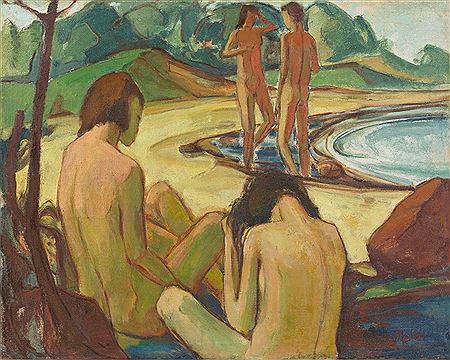
1891 Berlin, Germany - 1977 Berlin. Known for: Decorative painting, printmaking-lithography and woodcuts.
Max Kaus was born in Berlin on March 11, 1981. He attended the School for Crafts and the Applied and Decorative Arts in Berlin-Charlottenburg. In 1913 he moved into his first studio, and a travel... Read full biography
Max Kaus was born in Berlin on March 11, 1981. He attended the School for Crafts and the Applied and Decorative Arts in Berlin-Charlottenburg. In 1913 he moved into his first studio, and a travel grant brought him to Paris in 1914. At the onset of World War I, however, he was forced to return home,... Read full biography
Max Kaus was born in Berlin on March 11, 1981. He attended the School for Crafts and the Applied and Decorative Arts in Berlin-Charlottenburg. In 1913 he moved into his first studio, and a travel grant brought him to Paris in 1914. At the onset of World War I, however, he was forced to return home, where he volunteered as an ambulance driver and medical orderly in 1916; fortuitously, it was this volunteering that brought him in contact with several inspirational artists, including Erich Heckel,... Read full biography
Max Kaus was born in Berlin on March 11, 1981. He attended the School for Crafts and the Applied and Decorative Arts in Berlin-Charlottenburg. In 1913 he moved into his first studio, and a travel grant brought him to Paris in 1914. At the onset of World War I, however, he was forced to return home, where he volunteered as an ambulance driver and medical orderly in 1916; fortuitously, it was this volunteering that brought him in contact with several inspirational artists, including Erich Heckel, Anton Kerschbaumer, and Otto Herbig. It was at this time he began to focus on printmaking, namely lithography and woodcuts. After the war he supported himself by accepting commissions for decorative painting. Kaus's first one-man show was at the... Read full biography
Max Kaus was born in Berlin on March 11, 1981. He attended the School for Crafts and the Applied and Decorative Arts in Berlin-Charlottenburg. In 1913 he moved into his first studio, and a travel grant brought him to Paris in 1914. At the onset of World War I, however, he was forced to return home, where he volunteered as an ambulance driver and medical orderly in 1916; fortuitously, it was this volunteering that brought him in contact with several inspirational artists, including Erich Heckel, Anton Kerschbaumer, and Otto Herbig. It was at this time he began to focus on printmaking, namely lithography and woodcuts. After the war he supported himself by accepting commissions for decorative painting. Kaus's first one-man show was at the Ferdinand Möller Gallery in 1919; after meeting Otto Mueller and Karl Schmidt-Rottluff at the "Free Secession" in 1920, he became a part of s... Read full biography
Artist Biography
Biography page for Max Kaus ((1891 - 1977)), known for Decorative painting, printmaking-lithography and woodcuts. Showing 2 biographical entries and 0 sample artworks.
Max Kaus - Artist Info
About Max Kaus
Biography from the Archives of askART
 Max Kaus was born in Berlin on March 11, 1981. He attended the School for Crafts and the Applied and Decorative Arts in Berlin-Charlottenburg. In 1913 he moved into his first studio, and a travel grant brought him to Paris in 1914. At the onset of World War I, however, he was forced to return home, where he volunteered as an ambulance driver and medical orderly in 1916; fortuitously, it was this volunteering that brought him in contact with several inspirational artists, including Erich Heckel, Anton Kerschbaumer, and Otto Herbig. It was at this time he began to focus on printmaking, namely lithography and woodcuts. After the war he supported himself by accepting commissions for decorative painting.
Kaus's first one-man show was at the Ferdinand Möller Gallery in 1919; after meeting Otto Mueller and Karl Schmidt-Rottluff at the "Free Secession" in 1920, he became a part of several artist's groups who furthered study of Expressionism in Berlin, but by the end of the 1920s he returned to the more classical roots of his youth and took a position as a teacher at the Master School for the Applied and Decorative Arts, teaching landscape painting and figurative drawing. In 1927 he was awarded the Albrecht Dürer Prize by the city of Nuremburg.
During the 1930's, Kaus traveled throughout Europe to study, and took a position a an art teacher the United States School in Berlin, but was increasingly exposed to persecution by the National Socialists. In 1937 his works were removed from museums and in 1938 he was forced to give up teaching until after the end of the war.
1949 saw his promotion to full professor—and, eventually, Deputy Director— at the Hochschule für bildende Künste in Berlin. He continued to teach and create art well into his late life; he died in Berlin in 1977.
Source:
Annex GalleriesBiography from Auctionata
Max Kaus initially completed an apprenticeship as a decorator, then studied at Unterrichtsanstalt des Kunstgewerbemuseums in Berlin and then at the Academy under Erich Heckel and Ernst Ludwig Kirchner. After initially working as a decorative painter, he moved into his first studio in 1913. During his military service, he met the artist Erich Heckel, who encouraged him to devote himself to lithography and woodcut printing.
After the war, Kaus worked again as a freelance artist and in 1919 he had his first solo exhibition at Galerie Ferdinand Möller. As a member of the 'Freie Secession' he became acquainted with Otto Mueller and Karl Schmidt-Rottluff. From 1926 onwards he worked as a teacher for landscape painting, nude and animal drawing.
While traveling through Germany, Austria and northern Italy he found the motifs for his landscapes, which defined his oeuvre during the 1930s. At the beginning of World War II, he was forced to abandon his teaching position in Berlin, his works were removed from museums.
In 1945 he was appointed professor at the Academy of Fine Arts in Berlin, where he was deputy director under Karl Hofer. The post-war oeuvre of the artist include the North Sea and vedutas of Rome, the 'Veniziana' series as well as the portraits and still lives from his late creative period.
Kaus was honored for his work with the Albrecht-Dürer Prize of Nuremberg, the Villa Romana Prize and the Berlin Art Prize.