Page loaded successfully. Showing biography for Merina Lujan Pop Chalee.
Merina Lujan Pop Chalee BIOGRAPHY
1908 Castle Rock, Utah - 1993 Santa Fe, New Mexico. Known for: Native figure, animal easel and mural painting.
Born Merina Lujan in Castle Rock, Utah, she had strong ties to the Taos Pueblo, the New Mexico home of her father, Joseph Cruz Lujan. At the Pueblo, she received the name Pop Chalee, which means... Read full biography
Born Merina Lujan in Castle Rock, Utah, she had strong ties to the Taos Pueblo, the New Mexico home of her father, Joseph Cruz Lujan. At the Pueblo, she received the name Pop Chalee, which means "Blue Flower" in English. Although, she also spent much time away from the Pueblo, (her mother, Merea... Read full biography
Born Merina Lujan in Castle Rock, Utah, she had strong ties to the Taos Pueblo, the New Mexico home of her father, Joseph Cruz Lujan. At the Pueblo, she received the name Pop Chalee, which means "Blue Flower" in English. Although, she also spent much time away from the Pueblo, (her mother, Merea Luenberger, was from Utah) the Taos culture had a special life-long influence on her including exposure to the Taos Art Colony painters. As an artist "she devoted herself to the flat, two-dimensional... Read full biography
Born Merina Lujan in Castle Rock, Utah, she had strong ties to the Taos Pueblo, the New Mexico home of her father, Joseph Cruz Lujan. At the Pueblo, she received the name Pop Chalee, which means "Blue Flower" in English. Although, she also spent much time away from the Pueblo, (her mother, Merea Luenberger, was from Utah) the Taos culture had a special life-long influence on her including exposure to the Taos Art Colony painters. As an artist "she devoted herself to the flat, two-dimensional 'traditional' style of Indian painting", (King) but injected lighthearted imaginary touches that appealed to the wide audience of both adults and children. Many of her works are large and small interior forest scenes with fantasy creatures enhanced by... Read full biography
Born Merina Lujan in Castle Rock, Utah, she had strong ties to the Taos Pueblo, the New Mexico home of her father, Joseph Cruz Lujan. At the Pueblo, she received the name Pop Chalee, which means "Blue Flower" in English. Although, she also spent much time away from the Pueblo, (her mother, Merea Luenberger, was from Utah) the Taos culture had a special life-long influence on her including exposure to the Taos Art Colony painters. As an artist "she devoted herself to the flat, two-dimensional 'traditional' style of Indian painting", (King) but injected lighthearted imaginary touches that appealed to the wide audience of both adults and children. Many of her works are large and small interior forest scenes with fantasy creatures enhanced by imagination-driven colors. Usually a central subject is a single deer, who, in turn is surrounded by pairs or families o... Read full biography
Artist Biography
Biography page for Merina Lujan Pop Chalee ((1908 - 1993)), known for Native figure, animal easel and mural painting. Showing 1 biographical entries and 0 sample artworks.
Merina Lujan Pop Chalee - Artist Info
About Merina Lujan Pop Chalee
Name variants
Pop Chalee, Merina Lujan Hopkins, Merina Lujan, Pop Chalee
Biography from the Archives of askART
 Born Merina Lujan in Castle Rock, Utah, she had strong ties to the Taos Pueblo, the New Mexico home of her father, Joseph Cruz Lujan. At the Pueblo, she received the name Pop Chalee, which means "Blue Flower" in English. Although, she also spent much time away from the Pueblo, (her mother, Merea Luenberger, was from Utah) the Taos culture had a special life-long influence on her including exposure to the Taos Art Colony painters.
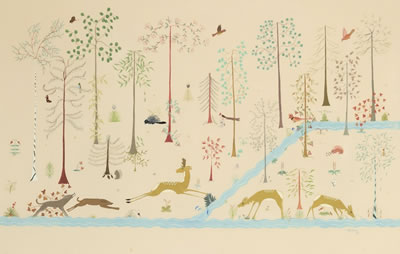
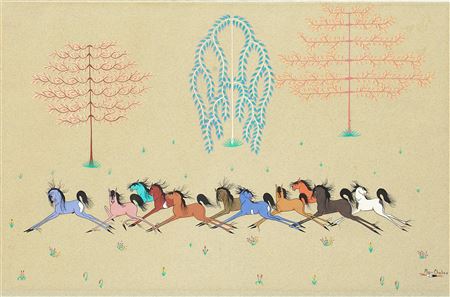
As an artist "she devoted herself to the flat, two-dimensional 'traditional' style of Indian painting", (King) but injected lighthearted imaginary touches that appealed to the wide audience of both adults and children. Many of her works are large and small interior forest scenes with fantasy creatures enhanced by imagination-driven colors. Usually a central subject is a single deer, who, in turn is surrounded by pairs or families of animals, Indian figures, flowers, bird-like creatures, and flying horses. Many of her small paintings have opaque watercolor on black paper, and almost all of her paintings have very bright coloration.
She began art training in 1935 at age 29. She studied at the Santa Fe Indian School in the Studio classes with Dorothy Dunn, whose flat decorative style she emulated. From the beginning, she was singled out as a special art student, and shortly after her 1937 graduation from the Indian School, she had a studio and a positive response from collectors for her whimsical paintings.
She also became a mural painter and completed several murals in airports, banks, hotels and stores including Marshall Fields in Chicago, Santa Fe Railroad Ticket Office in Santa Fe, New Mexico State Capitol Building, the Albuquerque Airport and the Grand Hotel on Mackinac Island.
An early commission was Maisel's Trading Post in Albuquerque. Of the several artists selected, which included Harrison Begay, Pablita Velarde and Joe Herrera, she was the only one who did not paint traditional tribal subjects but instead, did one of her imaginary, dreamy forest scenes in bold colors and decorative style. In the 1940s, she painted twelve murals for the Albuquerque Airport Terminal building. Then with expansion of the building, they were in storage for two decades, but by 1990 were re-installed and featured with special places and lighting for each mural in the second level or Great Hall of the remodeled International airport.
In the 1940s in Phoenix, Arizona, she had a radio talk show on which she told many Indian legend stories and talked about Southwest Indian art. She married Edward Lee (Ntay), a member of the Navajo tribe, and they had an art and ornamental art store in Scottsdale. "The barely five-foot-tall painter was a colorful promoter, dressed in a white, Pueblo-style dress, which was complemented with elaborate silver and turquoise jewelry. Her dark hair, dramatically parted in the middle, was worn in braids which fell almost to her waist." (King)
Her work was exhibited throughout the United States including at the National Gallery of Art in Washington DC, the Southwest Museum in Los Angeles, Elliott O'Hara School in Biddeford, Maine; the Gallery of Living Artists in New York City; and the Heard Museum in Phoenix, Arizona.
Sources include:
Jean Snodgrass King, "Pop Chalee", North American Women Artists of the Twentieth Century, pp. 449-450
Charlotte Rubinstein, American Women Artists
Patrick Lester, The Biographical Directory of Native American Painters
_________________________
The following correction was supplied by Virginia L. Clark:
Pop Chalee was born in Utah to Merea Margherete Luenberger, a woman of predominantly Swiss heritage and NOT East Indian heritage - a rumor promulgated by Dorothy Dunn's writings (see The World of Flower Blue by Margaret Cesa, Red Crane Books, Santa Fe, 1997).