Page loaded successfully. Showing biography for Michael Kmit.
Michael Kmit BIOGRAPHY
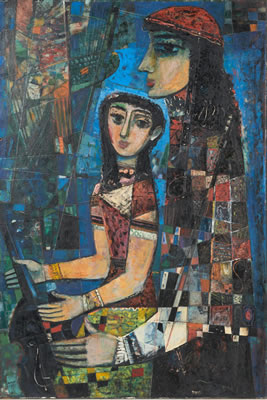
1910 Stryi, Galicia and Lodomeria, (Now Ukraine) - 1981 Sydney, Australia. Known for: Modernist figure, portrait and floral still-life painting.
Michael Kmit was a Ukrainian painter who spent twenty-five years in Australia. He is notable for introducing a neo-Byzantine style of painting to Australia, and winning a number of major Australian... Read full biography
Michael Kmit was a Ukrainian painter who spent twenty-five years in Australia. He is notable for introducing a neo-Byzantine style of painting to Australia, and winning a number of major Australian art prizes including the Blake Prize (1952) and the Sulman Prize (in both 1957 and 1970). In 1969 the... Read full biography
Michael Kmit was a Ukrainian painter who spent twenty-five years in Australia. He is notable for introducing a neo-Byzantine style of painting to Australia, and winning a number of major Australian art prizes including the Blake Prize (1952) and the Sulman Prize (in both 1957 and 1970). In 1969 the Australian artist and art critic James Gleeson described Kmit as "one of the most sumptuous colourists of our time". Michael Kmit studied at the Academy of Fine Arts, Kraków, but due to the conflict... Read full biography
Michael Kmit was a Ukrainian painter who spent twenty-five years in Australia. He is notable for introducing a neo-Byzantine style of painting to Australia, and winning a number of major Australian art prizes including the Blake Prize (1952) and the Sulman Prize (in both 1957 and 1970). In 1969 the Australian artist and art critic James Gleeson described Kmit as "one of the most sumptuous colourists of our time". Michael Kmit studied at the Academy of Fine Arts, Kraków, but due to the conflict in World War II, he was forced to leave his homeland and found himself a displaced person in Innsbruck, Austria where he met Dorothea (Edda) in 1945. They married in Landeck and later moved to Bregenz where his two daughters, Xenia & Tania (Tatiana)... Read full biography
Michael Kmit was a Ukrainian painter who spent twenty-five years in Australia. He is notable for introducing a neo-Byzantine style of painting to Australia, and winning a number of major Australian art prizes including the Blake Prize (1952) and the Sulman Prize (in both 1957 and 1970). In 1969 the Australian artist and art critic James Gleeson described Kmit as "one of the most sumptuous colourists of our time". Michael Kmit studied at the Academy of Fine Arts, Kraków, but due to the conflict in World War II, he was forced to leave his homeland and found himself a displaced person in Innsbruck, Austria where he met Dorothea (Edda) in 1945. They married in Landeck and later moved to Bregenz where his two daughters, Xenia & Tania (Tatiana) were born, in 1946 and 1948. While in post-war Europe Kmit studied under cubist Fernand Léger in Paris, and futurist Carlo Carrà in Italy.... Read full biography
Artist Biography
Biography page for Michael Kmit ((1910 - 1981)), known for Modernist figure, portrait and floral still-life painting. Showing 2 biographical entries and 0 sample artworks.
Michael Kmit - Artist Info
About Michael Kmit
Biography from the Archives of askART
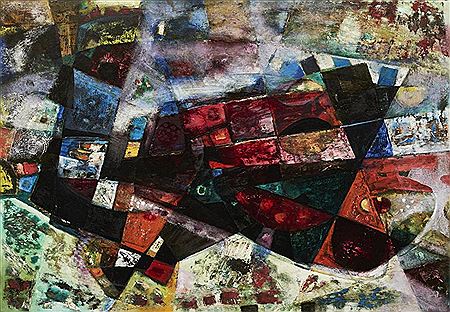 Michael Kmit was a Ukrainian painter who spent twenty-five years in Australia. He is notable for introducing a neo-Byzantine style of painting to Australia, and winning a number of major Australian art prizes including the Blake Prize (1952) and the Sulman Prize (in both 1957 and 1970). In 1969 the Australian artist and art critic James Gleeson described Kmit as "one of the most sumptuous colourists of our time".
Michael Kmit studied at the Academy of Fine Arts, Kraków, but due to the conflict in World War II, he was forced to leave his homeland and found himself a displaced person in Innsbruck, Austria where he met Dorothea (Edda) in 1945. They married in Landeck and later moved to Bregenz where his two daughters, Xenia & Tania (Tatiana) were born, in 1946 and 1948. While in post-war Europe Kmit studied under cubist Fernand Léger in Paris, and futurist Carlo Carrà in Italy.
Kmit emigrated to Australia in 1949, as part of the Australian Government's immigration scheme. He was contracted to work in Sydney for two years in a job selected for him by the Australian Government's employment service. He initially worked at a cement factory in Villawood, New South Wales, and then as a railway porter as contracted reimbursement for his passage. But after Kmit met the artists James Gleeson and Paul Haefliger, who were impressed with his work, he was introduced to other artists including Donald Friend and Russell Drysdale. His artist friends later helped him find lodging at Merioola and work nearer to the artist community in Sydney. Painting at night, during the day Kmit worked as a railway porter and cleaner while he established himself "as one of Australia's best artists" of the time. He lived in Elizabeth Bay with his family until he moved to the United States.
Kmit's images, inspired by the Byzantine style of religious icon painting, were well received in Australia for their fresh approach and new subjects. Labeled neo-Byzantine, his paintings integrated stylized portraiture with geometric cubist and constructivist forms, patterns and vivid color.
During the 1950s, before leaving for the United States at the latter end of the decade, Kmit was a major influence on many artists, particularly those of the Merioola Group (also known as the "Charm School"). Gleeson described Kmit as "one of the most sumptuous colourists of our time". Paul Haefliger wrote: "Of all the foreign aspirants to art who have visited these shores since the war, Michael Kmit is the only one who has made an impression on the present generation of painters."
After winning a string of awards including the Blake Prize (1953) and the Sulman Prize (1957), he left Australia for the United States in 1958, residing in the San Francisco-Bay Area of California. His American period did not result in a lot of success and also, due to the end of his marriage, he went through a period of depression. Returning in 1965 his style and format had changed and the high praise for his work was replaced with cautious criticism. He married Norma Randall a few years after his return to Australia and his son Michael Kmit Junior was born in May, 1968. However, by the time Cassandra in 1979 was painted, only two years before his death, Kmit had returned to the previous vigour of his 1950s works.
In 1951 Michael Kmit showed his work for the first time in Brisbane at the Johnstone Gallery, where the owner Brian Johnstone intended to exhibit "the most creative work in Australia today", particularly that of "brilliant" younger artists. Until his death Kmit exhibited in numerous group shows throughout the Australian States of Queensland, Victoria, Western Australia, Tasmania, New South Wales and South Australia, including selections for the Archibald, Wynne and Sulman prizes. Kmit was an honorary member, and exhibited with the Ukrainian Artists Society of Australia.
A selection of exhibitions included:
1952 — Society of Artists Spring Exhibition, Sydney
1952 — Show of Sixes Annual Exhibition, Macquarie Galleries
1953 — Society of Artists Annual Exhibition, Dept. of Education Art Gallery, Sydney
1953 — Show of Sixes Annual Exhibition, Macquarie Galleries
1954 — Exhibited with the Sydney Group
1956 — Society of Artists Annual Exhibition, 1956
1956 — 'Contemporary Australian Painting', Pacific Loan Exhibition, Art Gallery of NSW and on board the SS Orcades
1957 — Society of Artists Exhibition, drawings, prints. David Jones Gallery
1957 — Show of Eights, Macquarie Galleries
1965 — Dominion Galleries, Darlinghurst Sydney
1965 — Australian Galleries, Melbourne
1968 — Solo exhibition, Von Bertouch Galleries, Newcastle
1979 — Solo exhibition, Niagara Lane Galleries, Melbourne (7–27 June 1979)
1974 — Group Show Official Opening of Phillip Bacon Galleries Queensland
1979 — Solo exhibition in Holdsworth Galleries Woollahra, Sydney
1980 — Solo Exhibition at the Fine Art Gallery, Western Australia
1980 — Blake Exhibition in Sydney
1982 — Solo exhibition, Von Bertouch Galleries, Newcastle (26 Feb – 14 Mar)
2010 — Centenary Exhibition (retrospective), Studio W – Woolloomooloo Sydney
Awards
1952 — Blake Prize for Religious Art (Second prize) – with The Ascension
1953 — Blake Prize for Religious Art with The Evangelist, John Mark
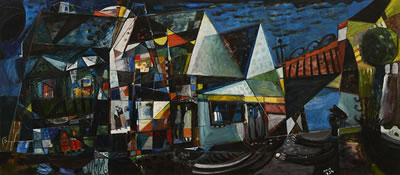
1954 — Perth Prize for Contemporary Art with King's Cross Facade
1955 — Critics Prize for Contemporary Art
1956 — Darcy Morris Memorial Prize
1957 — Sulman Prize — with The Voice of Silence
1967 — Melrose Art Prize, Adelaide ($500)
1970 — Sulman Prize — with Philopena
Collections held
• Ballarat Fine Art Gallery, Ballarat
• National Gallery of Australia, Canberra
• Art Gallery of New South Wales
• National Gallery of Victoria
• Art Gallery of Western Australia
• Art Gallery of South Australia
• Tasmanian Museum and Art Gallery
• Collections in Universities of Sydney, Queensland, and Monash
• Harold E. Mertz Collection of Australian Art, University of Texas, USA
• Cbus Collection of Australian Art
Source:
Wikipedia ("Michael Kmit"), accessed September 2015Biography from the Archives of askART
 The following information is from Barbara Murray.
I met Michael Kmit when he was hospitalized in Stockton California in 1961. After the occupational therapists found out who he was, they supplied art materials for him, and he began to paint. I went to visit my former associate, and he showed me some of his work. He was a gentle, shy, interesting man.
After he was released from the hospital, he lived in a small upstairs apartment. There were paintings on every wall going upstairs and every possible space in the tiny living area. The therapist said he needed to sell some so he could have money to return home.
My first painting was of sunflowers, size 27 x 21. I was newly married without a lot of money for paintings, but he let me pay $10.00 a week until paid in full. I then purchased The Golden Fleece, size 17 x 14; Target, 25 x 20; Bouquet, 7 ½ x 6; and Orchid in Vase, 28 x 20.
In 1964, I asked him to paint my stern-faced Scottish grandfather. I had a picture for him to look at. He said he would be pleased to paint it. It hangs in my living room with the photo next to it. Granddad looks really stern, all 34 x 17 ½ inches of him.
Faye Griswald, the therapist invited my husband and me to her house for a farewell dinner when he was returning to Australia. We had a lovely time, and although we knew how anxious he was to return home, we were sorry to see him go.
He left beautiful memories that we have shared with friends and family all these years. Michael Kmit enriched our lives; we were honored to have known him.
Barbara Murray