Page loaded successfully. Showing biography for Moses Soyer.
Moses Soyer BIOGRAPHY
1899 Czarist, Russia - 1974 Hampton Bays, New York. Known for: Figure-dancers, social realism.
Dedicated to art expression with social-realist themes of the Depression Era in America, Moses Soyer was born in Czarist Russia in 1899, and was one of three artistic brothers, the others being... Read full biography
Dedicated to art expression with social-realist themes of the Depression Era in America, Moses Soyer was born in Czarist Russia in 1899, and was one of three artistic brothers, the others being Raphael and Isaac. Raphael Soyer was Moses' identical twin. Later in his career, Moses Soyer turned to... Read full biography
Dedicated to art expression with social-realist themes of the Depression Era in America, Moses Soyer was born in Czarist Russia in 1899, and was one of three artistic brothers, the others being Raphael and Isaac. Raphael Soyer was Moses' identical twin. Later in his career, Moses Soyer turned to the depiction of female figures, especially ballet dancers. The Soyer brothers were raised in an intellectual atmosphere created by their father, a Hebrew scholar. In 1912, the Soyers emigrated to the... Read full biography
Dedicated to art expression with social-realist themes of the Depression Era in America, Moses Soyer was born in Czarist Russia in 1899, and was one of three artistic brothers, the others being Raphael and Isaac. Raphael Soyer was Moses' identical twin. Later in his career, Moses Soyer turned to the depiction of female figures, especially ballet dancers. The Soyer brothers were raised in an intellectual atmosphere created by their father, a Hebrew scholar. In 1912, the Soyers emigrated to the United States and eventually settled in New York City. Moses Soyer's artistic studies began in 1916, and included classes in New York at Cooper Union, the National Academy of Design, the Educational Alliance, and the Modern School, where he was... Read full biography
Dedicated to art expression with social-realist themes of the Depression Era in America, Moses Soyer was born in Czarist Russia in 1899, and was one of three artistic brothers, the others being Raphael and Isaac. Raphael Soyer was Moses' identical twin. Later in his career, Moses Soyer turned to the depiction of female figures, especially ballet dancers. The Soyer brothers were raised in an intellectual atmosphere created by their father, a Hebrew scholar. In 1912, the Soyers emigrated to the United States and eventually settled in New York City. Moses Soyer's artistic studies began in 1916, and included classes in New York at Cooper Union, the National Academy of Design, the Educational Alliance, and the Modern School, where he was influenced by Robert Henri and George Bellows. After traveling to Europe on a fellowship, Soyer taught at several schools until The Depression... Read full biography
Artist Biography
Biography page for Moses Soyer ((1899 - 1974)), known for Figure-dancers, social realism. Showing 2 biographical entries and 0 sample artworks.
Moses Soyer - Artist Info
About Moses Soyer
Biography from the Archives of askART
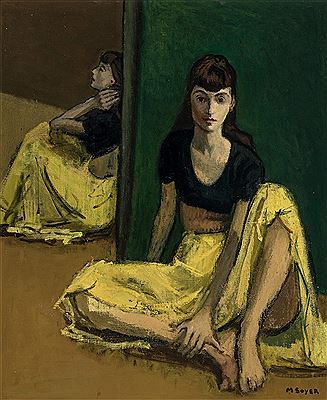 Dedicated to art expression with social-realist themes of the Depression Era in America, Moses Soyer was born in Czarist Russia in 1899, and was one of three artistic brothers, the others being Raphael and Isaac. Raphael Soyer was Moses' identical twin. Later in his career, Moses Soyer turned to the depiction of female figures, especially ballet dancers.
The Soyer brothers were raised in an intellectual atmosphere created by their father, a Hebrew scholar. In 1912, the Soyers emigrated to the United States and eventually settled in New York City.
Moses Soyer's artistic studies began in 1916, and included classes in New York at Cooper Union, the National Academy of Design, the Educational Alliance, and the Modern School, where he was influenced by Robert Henri and George Bellows. After traveling to Europe on a fellowship, Soyer taught at several schools until The Depression made such teaching positions scarce.
The Depression, in fact, set the mood for most of Soyer's art expression. The Works Project Administration provided him with work as well as the fellowship of other artists, but the era itself provided the social sentiments which permeate most of Soyer's work. Using some of the techniques of his favorite artists, such as Van Rijn Rembrandt and Gustave Courbet, he portrayed his subjects in the perseverance of hard work or in the uncertainty of unemployment.
As an artist, Soyer was particularly sensitive to the lack of work during the Depression and to the fact the Works Projects Administration provided employment for many artists who would have remained unemployed. He was opposed to landscape painting, and pursued the opportunity to use art for the purpose of making realistic social statements about his time.
Together, Moses and his twin worked on some large projects, such as a mural commissioned by the Works Projects Administration for the Kingsessing Station Post Office in Philadelphia.
After the Depression, Soyer tended towards ballet subjects, reminiscent of Degas, yet his work retained his own personal style of conveying sentimental moods. His paintings remained popular throughout his life. Soyer died in 1974.
Source: Web-site of Comenos Fine ArtBiography from the Archives of askART
 MEMBER: The Hamptons Bays Art Colony. Established before the start of WW II by fellow fauvist, David D. Burliuk, it was a summer art colony away from the rat race of nearby New York City.
Burliuk bought a small house in early 1941 in a quiet area in the East End still easily accessible to New York City. Soon Nicolai Cikovsky joined him as did other Russian émigrés, brothers Raphael and Moses Soyer. Moses bought a house on the same street, Squiretown Road, while his brother Raphael Soyer and Cikovsky took residences in North Sea.
Burliuk led the group because he was the oldest member and because his property included a gallery for all. Consequently the group congregated at Burliuk's place; it became their salon.
A photo of the Hamptons Bays Art Colony members posing (Copyright 2008 The New York Times Company) had this caption: "Standing, from left, in 1952, Nat Werner, Moses Soyer, David Burliuk and George Constant; in front, Raphael Soyer, left, and Nicolai Cikovsky."
Submitted by Mark Grove