Page loaded successfully. Showing biography for Nigel Cooke.
Nigel Cooke BIOGRAPHY
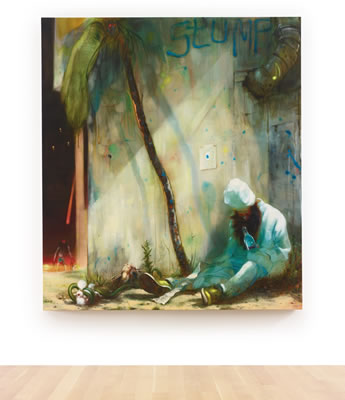
Born 1973 Manchester, England. Known for: Figurative, abstract painting, atmospherics.
Nigel Cooke is known for evocative works that merge figurative forms with abstract and elemental atmospherics. Since the late 1990s, Cooke has explored and stretched the boundaries of figurative... Read full biography
Nigel Cooke is known for evocative works that merge figurative forms with abstract and elemental atmospherics. Since the late 1990s, Cooke has explored and stretched the boundaries of figurative painting, creating a highly diverse and distinctive body of work. More recently, his work has assessed... Read full biography
Nigel Cooke is known for evocative works that merge figurative forms with abstract and elemental atmospherics. Since the late 1990s, Cooke has explored and stretched the boundaries of figurative painting, creating a highly diverse and distinctive body of work. More recently, his work has assessed this output, moving into a succinct language with which to investigate his wide range of interests. Informed by a range of fields from palae-ontology, neuroscience, classical mythology and zoology, the... Read full biography
Nigel Cooke is known for evocative works that merge figurative forms with abstract and elemental atmospherics. Since the late 1990s, Cooke has explored and stretched the boundaries of figurative painting, creating a highly diverse and distinctive body of work. More recently, his work has assessed this output, moving into a succinct language with which to investigate his wide range of interests. Informed by a range of fields from palae-ontology, neuroscience, classical mythology and zoology, the linear construction of Cooke’s latest paintings recalls brain circuitry, the human or animal body and landscape formations simultaneously. The artist is interested in folding familiar dualities such as the mind and body, or the human brain and the... Read full biography
Nigel Cooke is known for evocative works that merge figurative forms with abstract and elemental atmospherics. Since the late 1990s, Cooke has explored and stretched the boundaries of figurative painting, creating a highly diverse and distinctive body of work. More recently, his work has assessed this output, moving into a succinct language with which to investigate his wide range of interests. Informed by a range of fields from palae-ontology, neuroscience, classical mythology and zoology, the linear construction of Cooke’s latest paintings recalls brain circuitry, the human or animal body and landscape formations simultaneously. The artist is interested in folding familiar dualities such as the mind and body, or the human brain and the natural world, into a single fluid gesture. His organic abstractions are loaded with mammalian and geological fragments, creating an i... Read full biography
Artist Biography
Biography page for Nigel Cooke ((Born 1973)), known for Figurative, abstract painting, atmospherics. Showing 2 biographical entries and 0 sample artworks.
Nigel Cooke - Artist Info
About Nigel Cooke
Biography from the Archives of askART
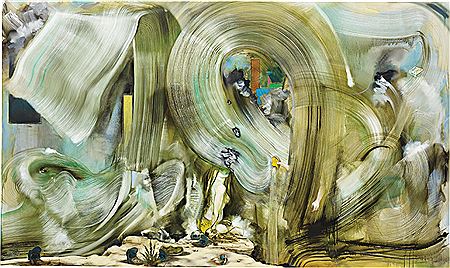 Nigel Cooke is known for evocative works that merge figurative forms with abstract and elemental atmospherics.
Since the late 1990s, Cooke has explored and stretched the boundaries of figurative painting, creating a highly diverse and distinctive body of work. More recently, his work has assessed this output, moving into a succinct language with which to investigate his wide range of interests.
Informed by a range of fields from palae-ontology, neuroscience, classical mythology and zoology, the linear construction of Cooke’s latest paintings recalls brain circuitry, the human or animal body and landscape formations simultaneously.
The artist is interested in folding familiar dualities such as the mind and body, or the human brain and the natural world, into a single fluid gesture. His organic abstractions are loaded with mammalian and geological fragments, creating an instability and movement in the image as well as an ambiguity between a vast array of natural associations.
Using notational sketches and paintings made on location at various sites around the world, Cooke distills his impressions of specific places and the people in them into a personal vocabulary of forms that evolves and repeats through time, with autobiographical material often infusing and directing the process. Developing an emotive and highly focused use of colour alongside these forms, Cooke’s calligraphic images are delicately balanced, with structure and collapse held together in a state of tension.
The paintings contrast staining techniques on raw linen with classical techniques of layering and spatial depth, indebted to both abstract expressionism and the figurative compositions of European Classicism. Much of the work’s rehearsals and revisions are visible in the final image, which play fine, schematic areas against passages of gestural impasto.
Cooke’s background in masterfully executed figurative painting provides the sense of drawing and representational rendering that permeate the abstract marks. In their unfixed and writhing otherness, they engage with the self as a porous system, in flux between animal states and prehistory, between the inner life and the ecosystems of the world at large.
Nigel Cooke studied at the Royal College of Art and Goldsmiths College, where he gained a PhD in Philosophy, writing about non-linear systems in the thought of George Bataille, Michel Serres and others. Making often atypical connections between disparate fields - cave paintings and surrealism, insect mimicry and information physics - his theoretical writings ultimately explored representation as a function of the natural world, and formed the basis of his conception of the value of painting and its possibilities.
His paintings are held in several of the world’s major public collections, including the Museum of Modern Art, New York; Tate Gallery, London; Solomon R. Guggenheim Museum, New York; Hammer Museum, Los Angeles; Astrup Fearnely Museet for Moderne Kunst, Oslo; Milwaukee Art Museum.
Source:
Website of Pace Gallery, New York, 2022Biography from Dreweatts & Bloomsbury Auctions
Nigel Cooke is known for his realist paintings tinged with abstraction. His work often depicts scenes of urban decay that symbolizes the degeneration of the cultural landscape. Much of his artwork makes direct reference to art history.
His artistic influences were Van Gogh, Philip Guston and Francis Bacon. Bacon was one of Cooke's formative influences. The rawness of Bacon's paintings appealed to Cooke who described Bacon's work as "…magical, this real presence of the uniqueness of the vision. I was spellbound by the idea of living with something that you make, that's like a character, but a thing in the world that's got its own life." (quoted in 'Interview Magazine', 21st September 2015).