Page loaded successfully. Showing biography for Oleg Vassiliev.
Oleg Vassiliev BIOGRAPHY
1931 Moscow, Russia - 2013 Shoreview, Minnesota. Known for: Realist landscape with figure painting, etching, book design, illustration.
Following is a review of an exhibition at the Museum of Russian Art, Minneapolis:. Mary Abbe, "Victorious Vassiliev", Minneapolis Star Tribune, Stage and Arts section, September 15, 2011. By the time... Read full biography
Following is a review of an exhibition at the Museum of Russian Art, Minneapolis:. Mary Abbe, "Victorious Vassiliev", Minneapolis Star Tribune, Stage and Arts section, September 15, 2011. By the time the Soviet Union collapsed in political and economic bankruptcy in 1991, dissident artist Oleg... Read full biography
Following is a review of an exhibition at the Museum of Russian Art, Minneapolis:. Mary Abbe, "Victorious Vassiliev", Minneapolis Star Tribune, Stage and Arts section, September 15, 2011. By the time the Soviet Union collapsed in political and economic bankruptcy in 1991, dissident artist Oleg Vassiliev had already established himself as an influential figure in the West. Despite -- or perhaps because of -- the scorn Soviet officials had heaped on his work, the international art world welcomed... Read full biography
Following is a review of an exhibition at the Museum of Russian Art, Minneapolis:. Mary Abbe, "Victorious Vassiliev", Minneapolis Star Tribune, Stage and Arts section, September 15, 2011. By the time the Soviet Union collapsed in political and economic bankruptcy in 1991, dissident artist Oleg Vassiliev had already established himself as an influential figure in the West. Despite -- or perhaps because of -- the scorn Soviet officials had heaped on his work, the international art world welcomed him, and starting in the 1980s his paintings and graphic designs filtered out to shows at galleries and museums throughout Europe and the United States. His work was included in a 1999 show of Soviet-era pop art at the University of Minnesota's... Read full biography
Following is a review of an exhibition at the Museum of Russian Art, Minneapolis:. Mary Abbe, "Victorious Vassiliev", Minneapolis Star Tribune, Stage and Arts section, September 15, 2011. By the time the Soviet Union collapsed in political and economic bankruptcy in 1991, dissident artist Oleg Vassiliev had already established himself as an influential figure in the West. Despite -- or perhaps because of -- the scorn Soviet officials had heaped on his work, the international art world welcomed him, and starting in the 1980s his paintings and graphic designs filtered out to shows at galleries and museums throughout Europe and the United States. His work was included in a 1999 show of Soviet-era pop art at the University of Minnesota's Weisman Art Museum. And on Saturday the Museum of Russian Art in Minneapolis will open an exhibit of more than 20 of his p... Read full biography
Artist Biography
Biography page for Oleg Vassiliev ((1931 - 2013)), known for Realist landscape with figure painting, etching, book design, illustration. Showing 2 biographical entries and 0 sample artworks.
Oleg Vassiliev - Artist Info
About Oleg Vassiliev
Name variants
Oleg Vasiliev
Biography from the Archives of askART
 Following is a review of an exhibition at the Museum of Russian Art, Minneapolis:
Mary Abbe, "Victorious Vassiliev", Minneapolis Star Tribune, Stage and Arts section, September 15, 2011
By the time the Soviet Union collapsed in political and economic bankruptcy in 1991, dissident artist Oleg Vassiliev had already established himself as an influential figure in the West. Despite -- or perhaps because of -- the scorn Soviet officials had heaped on his work, the international art world welcomed him, and starting in the 1980s his paintings and graphic designs filtered out to shows at galleries and museums throughout Europe and the United States.
His work was included in a 1999 show of Soviet-era pop art at the University of Minnesota's Weisman Art Museum. And on Saturday the Museum of Russian Art in Minneapolis will open an exhibit of more than 20 of his paintings to accompany a suite of 30 Vassiliev etchings that debuted there in August. Inspired by an Anton Chekhov story, the etchings were executed in Paris in 1991 and have never been shown together before.
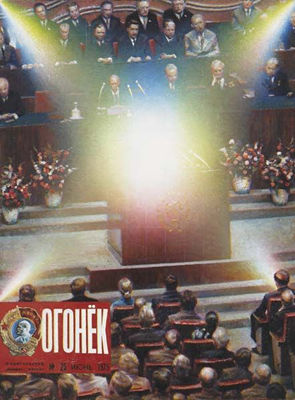
During the Soviet era, artists were expected to be propagandists for government policies and to work in a realistic style. Those who conformed were rewarded with state support, shows, travel opportunities and prestigious posts as "official artists." The "unofficials" who didn't bend to the system had few if any career options and were often hounded by political authorities. Still, like Vassiliev they gained respect in other circles -- including the international avant garde -- for their principled resistance.
"You had to have the pluck to do it," said Masha Zavialova, the museum's Russian-born curator. "There were a very limited number of them, only two or three dozen" in the whole Soviet Union."
Despite his renown in the art world, Vassiliev is hardly a household name in Minnesota, where he now resides. Born in Moscow in 1931, he graduated from the prestigious Surikov Art Institute in Moscow in 1958 and worked for the next three decades as a book designer and illustrator, a below-the-radar profession that allowed him time to pursue his own art in private. With his lifelong friend Eric Bulatov, another dissident painter, he turned out beautifully designed children's books enlivened with sophisticated silhouettes, whimsical animal figures and charming folk characters, samples of which are included in the show.
"He and his friend would do a half-year of children's books and then go camping in the wilderness for six or seven weeks to purify themselves and get it out of their minds," said Zavialova.
While Vassiliev admired colleagues who defied authorities by showing art that didn't conform to the official Socialist-Realist style, he didn't have the stomach for confrontation himself. "The path to socio-political struggle ... was impossible for me," he said in a 1997 biographical essay. "What we created for ourselves in the studio, we tried not to show to the officials. Our only viewers were friends and a narrow circle of acquaintances."
Even so, he was essentially blackballed because "in our social system, even this pursuing of one's own work was criminal, according to the principle 'He who is not with us is against us,'" he wrote.
Aside from a one-night exhibit at a Moscow cafe in 1968, Vassiliev had no solo shows in the Soviet Union. After the U.S.S.R. dissolved in 1991, however, he realized his childhood dream of seeing his work on the walls of the Tretyakov Gallery in Moscow as well as in the Russian Museum in St. Petersburg. Both institutions now own his work, as do the Pushkin Museum in Moscow and similar institutions as far afield as Bern, Switzerland; Athens, Greece; Lexington, Ky., and Denver.
Following the political upheavals, Vassiliev and his wife emigrated and lived for a period in Paris and then New York City. His wife died last year, after which the artist -- who has health issues and speaks very little English -- moved to St. Paul to be close to a son who lives there.
Elegant and introspective, Vassiliev's paintings and etchings are technically adroit, and to Western eyes there is nothing startling in their style or politics. Quite the contrary. Many of his most recent paintings are so suavely executed they look almost photo-realistic.
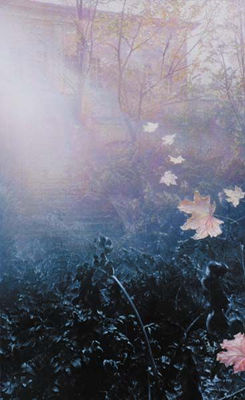
He frequently depicts the wide, flat terrain of northern Russia and its beloved birch forests, their fallen leaves a symbolic drift of memories and lost time. Often he shows silhouetted figures gliding into the scenes on skis, or poised at the edge of a vista as if standing on a stage. Peering at the landscape through painted frames, the shadowy figures seem to be contemplating both the road ahead and the past.
"His theory is that a painting's structure has three key elements: time, light and material objects," said Zavialova. The basic geometry of the paintings is strikingly consistent, whether he's rendering a landscape or an abstraction. Typically they consist of four subtly suggested isosceles triangles that converge as a horizon line at the canvas' midpoint. The implied forms pull the eye into a vortex or suggest a path through woods. In one especially lovely image, he memorializes his wife walking from a beach into a transfiguring bowl of light at the center of the canvas.
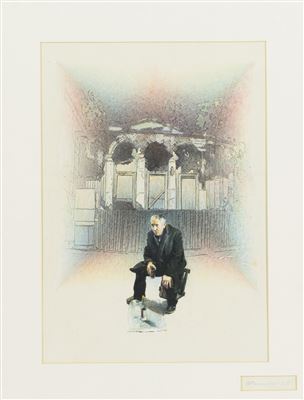
A distinctly private man, Vassiliev often masks his identity behind a blank rectangle or turns his back, even in self-portraits. Past and present frequently merge in his work. In a recurrent image, he sits -- as if on stage -- a glass of vodka in hand, a half-ruined house floating behind him like a dream etched onto a theater scrim.
The Chekhovian prints are notably poignant, created to accompany, but not to illustrate, a love story (oversimplifying here) about a naive artist and the brutal world that came after him. Using his son as a model for several figures, Vassiliev produced 15 nostalgic meditations on the intimate privacies of 19th-century country life. Those he contrasted with 15 dramatic impressions of an intensely politicized Soviet era that's laced with Bolshevik and Stalinist posturing, clippings from the newspaper Pravda and revolutionary reds and blacks.
A tour de force of graphic design, the series is -- like so much of Vassiliev's work -- an elegiac evocation of two tragic centuries of Russian life.
Internet Source:
http://www.startribune.com/entertainment/stageandarts/129894953.html?page=2&c=yBiography from the Archives of askART
 Following is the obituary of the artist by Mary Abbe in the Minneapolis Star Tribune, Sunday, February 3, 2013.
Soviet dissident artist Oleg Vassiliev, painter of grace
Internationally known for his serene paintings and elegant graphic designs, Oleg Vassiliev was not permitted an official show in the Soviet Union until after his homeland dissolved in 1991.
Vassiliev died Friday, Jan. 25, at a hospice near his home in Shoreview. He was 81 and had been ill with cancer.
After the U.S.S.R. collapsed, Vassiliev and his wife, Kira, emigrated, first to Paris and then to New York City. His wife died in 2010, after which he moved to Shoreview to be closer to their son, Alexei, who survives him.
His death was announced by the Museum of Russian Art in Minneapolis. The museum staged two exhibitions of Vassiliev's art in 2011, a quasi-retrospective of more than 20 paintings, and a show of 30 etchings inspired by a story by Anton Chekhov. The museum also marked his 80th birthday in November 2011 with a gala that attracted artists, publishers and collectors from as far as Paris, Moscow and New York.
The Weisman Art Museum at the University of Minnesota also included his work in a 1999 show of Soviet-era pop art.
Born in Moscow in 1931, Vassiliev graduated from the Surikov Art Institute in Moscow in 1958 and spent the next three decades designing and illustrating books, including children's tales. The innocuous profession enabled him to earn a living while pursuing his own art in private.
Non-confrontational by temperament, he slipped into a kind of internal exile to avoid antagonizing the Soviet authorities. "The path to socio-political struggle ... was impossible for me," he wrote in a 1997 biographical essay. "What we created for ourselves in the studio, we tried not to show to the officials." His only exhibit during Soviet times was a one-night show at a Moscow cafe in 1968.
After the Soviet collapse, however, major institutions acquired his work, including the Tretyakov Gallery and the Pushkin Museum in Moscow and the Russian Museum in St. Petersburg, as well as museums in Bern, Switzerland; Athens, Greece; Lexington, Ky., and Denver, Colo.
Vassiliev often used isosceles triangles as structural devices in his delicately marked paintings, arranging them so they appeared to converge at the canvas' midpoint. In both landscapes and abstractions, the forms pull the eye deep into the interior space of the painting.
He loved the flat terrain of northern Russia with its stark birch forests, and often used drifts of leaves to suggest memories or past time. Frequently, he depicted skiers peering in from the edge of a canvas. The figures were veiled portraits of himself and his lifelong friend Eric Bulatov, a fellow artist and book illustrator with whom he frequently took wilderness camping trips to escape the tedium of their official jobs. Even in self-portraits, the intensely private artist would typically turn his back to the viewer as if gazing away into the life of the mind.
A memorial event will be held in spring, most likely on the East Coast.