Page loaded successfully. Showing biography for Oscar Yakovlevich Rabin.
Oscar Yakovlevich Rabin BIOGRAPHY
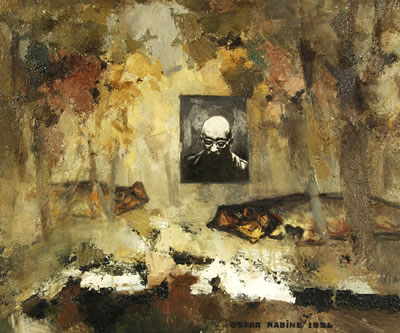
1928 Moscow, Russia - 2018 Florence, Italy. Known for: Expressionist, political themed landscape and still-life paintings.
Oskar Rabin, Defiant Artist During Soviet Era, Dies at 90, Obituray, The New York Times, by Neil Genzlinger, November 11 2018. Mr. Rabin painted still lifes and landscapes, often imbuing them with... Read full biography
Oskar Rabin, Defiant Artist During Soviet Era, Dies at 90, Obituray, The New York Times, by Neil Genzlinger, November 11 2018. Mr. Rabin painted still lifes and landscapes, often imbuing them with wry critiques of Soviet life, but his fame rested as much on his defiance as on his artistic ability.... Read full biography
Oskar Rabin, Defiant Artist During Soviet Era, Dies at 90, Obituray, The New York Times, by Neil Genzlinger, November 11 2018. Mr. Rabin painted still lifes and landscapes, often imbuing them with wry critiques of Soviet life, but his fame rested as much on his defiance as on his artistic ability. In 1974 he was among the organizers of an outdoor exhibition in Moscow by so-called nonconforming artists — those who were denied exhibitions in recognized galleries and museums because they refused... Read full biography
Oskar Rabin, Defiant Artist During Soviet Era, Dies at 90, Obituray, The New York Times, by Neil Genzlinger, November 11 2018. Mr. Rabin painted still lifes and landscapes, often imbuing them with wry critiques of Soviet life, but his fame rested as much on his defiance as on his artistic ability. In 1974 he was among the organizers of an outdoor exhibition in Moscow by so-called nonconforming artists — those who were denied exhibitions in recognized galleries and museums because they refused to limit themselves to the officially sanctioned style of the day, Socialist realism, which emphasized heroic scenes and sculptures and left no room for impressionism or abstraction or unpleasant subjects. The artists met an unforgiving resistance.... Read full biography
Oskar Rabin, Defiant Artist During Soviet Era, Dies at 90, Obituray, The New York Times, by Neil Genzlinger, November 11 2018. Mr. Rabin painted still lifes and landscapes, often imbuing them with wry critiques of Soviet life, but his fame rested as much on his defiance as on his artistic ability. In 1974 he was among the organizers of an outdoor exhibition in Moscow by so-called nonconforming artists — those who were denied exhibitions in recognized galleries and museums because they refused to limit themselves to the officially sanctioned style of the day, Socialist realism, which emphasized heroic scenes and sculptures and left no room for impressionism or abstraction or unpleasant subjects. The artists met an unforgiving resistance. “When they gathered in an open lot on September 15,” Hedrick Smith, who was then a reporter in Moscow for The New York Time... Read full biography
Artist Biography
Biography page for Oscar Yakovlevich Rabin ((1928 - 2018)), known for Expressionist, political themed landscape and still-life paintings. Showing 2 biographical entries and 0 sample artworks.
Oscar Yakovlevich Rabin - Artist Info
About Oscar Yakovlevich Rabin
Name variants
Oskar Rabin, Oscar Iakovlevitch Rabine
Biography from the Archives of askART
 Oskar Rabin, Defiant Artist During Soviet Era, Dies at 90, Obituray, The New York Times, by Neil Genzlinger, November 11 2018
Mr. Rabin painted still lifes and landscapes, often imbuing them with wry critiques of Soviet life, but his fame rested as much on his defiance as on his artistic ability.
In 1974 he was among the organizers of an outdoor exhibition in Moscow by so-called nonconforming artists — those who were denied exhibitions in recognized galleries and museums because they refused to limit themselves to the officially sanctioned style of the day, Socialist realism, which emphasized heroic scenes and sculptures and left no room for impressionism or abstraction or unpleasant subjects. The artists met an unforgiving resistance.
“When they gathered in an open lot on September 15,” Hedrick Smith, who was then a reporter in Moscow for The New York Times, wrote in his 1976 book “The Russians,” “they were brutally dispersed by plainclothes police dressed as workers and operating bulldozers and dump trucks.”
By some accounts, the police had to pluck Mr. Rabin from the upper reaches of a bulldozer he had clung to as it advanced on him. The aborted art show has ever since been known as the Bulldozer Exhibition.
The international reaction was so strong that a few months later the Soviets allowed another show by the nonconforming artists, but the tensions remained. Mr. Rabin continued to incur official wrath and endure the occasional arrest.
In 1978 officials encouraged him to make a trip to Paris; while he was there they stripped him of his citizenship. He lived in Paris the rest of his life, even though he became celebrated in Russia after the fall of the Soviet Union.
“The Russia-themed pictures that I sometimes paint even now are not nostalgic,” he wrote in “Three Lives,” a 1986 memoir. “These are pictures-cum-recollections — just a memory about the past. For no matter what sort of past it was, you cannot erase it from your heart.”
Oskar Yakovlevich Rabin (whose name is, variously, also given as “Oscar” and “Rabine”) was born on Jan. 2, 1928, in Moscow. His parents were both doctors, and both died of illnesses when he was a boy; an orphan, he spent the years of World War II living in children’s dorms.
In 1944 he was sent to live with an aunt in the Latvian city of Riga. He trained at an art academy there, then studied at, but was expelled from, the Surikov Art Institute in Moscow.
It was in the mid-1950s that he fell in with a group of artists and intellectuals who were creating artworks and writings that were outside the sanctioned parameters. By 1958 he and his wife, Valentina Kropivnitskaya, also an artist, were living in a camp barracks in the Lianozovo District near Moscow, their home a frequent gathering spot for the renegades, who became known as the Lianozovo Group.
“Its participants were united not by some common artistic ideology,” the art collector Alexander Glezer wrote in 1995, “but rather by their uncompromising stand in the fight for freedom of expression and the right to display their works to their compatriots.”
Mr. Rabin’s paintings tended toward the expressionistic and were decidedly un-heroic, putting him at odds with the official definition of art.
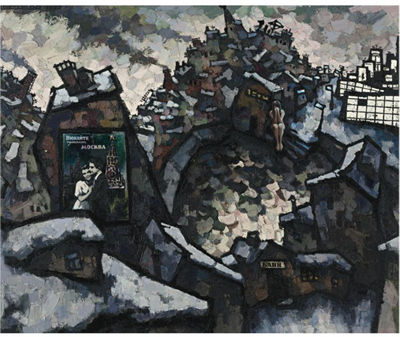
“Rabin depicted dreary everyday reality,” Natalia Kolodzei, executive director of the Kolodzei Art Foundation and an expert in the art of Russia and the former Soviet Union, said by email. “Dilapidated hovels, suburban slums, neglected cemeteries, religious symbols, street signs, and newspapers full of personal and narrative significance.”
One work from 1968, “Still Life With Fish and Pravda,” featured a glass and a dead fish atop crumpled pages of Pravda, the official Communist Party newspaper, a provocatively ambiguous fragment of a headline showing.
In his book, he expressed mock indignation that such a painting was deemed not to fit the sanctioned realism of the time.
“I was reproached for my still lifes, for vodka bottles, and for a herring sitting on a newspaper,” he wrote.
“But haven’t you ever drunk vodka with a herring? At all the feasts, including the official ones, one drinks vodka.”
Such cheeky works, and his outspokenness, made Mr. Rabin a prominent figure among the nonconforming artists.
“Middle-aged and essentially hairless, Rabin developed the incongruous status of a bald rock star,” John McPhee wrote in his book The Ransom of Russian Art (1994).
In 1990, President Mikhail S. Gorbachev restored Mr. Rabin’s citizenship. His works have since been exhibited many times in Russia, as well as in the West. His work is in numerous museums and has been sold at leading auction houses.
Mr. Rabin’s wife died in 2008. A son, Alexandre, died in 1994.
Ms. Kolodzei said that though Mr. Rabin’s paintings could be grim, many had a subtle ray of hope.
“Light, which plays an important spiritual role in much of Rabin’s work, can be seen as symbolizing the warmth of the cultural gatherings in the Rabins’ home,” she said.
The light ultimately prevailed.
“Artists like Oskar Rabin can be said to have contributed to the ideological erosion and ultimate failure of the Soviet system,” she said. “In a system where everything was defined as political, it was impossible to escape politics even in art; thus some nonconformist art movements became imbued with political meaning from their very inception no matter what the artist(s) may have intended.”
Mr. Smoljanski, who worked on his documentary for eight years, said Mr. Rabin led by example.
“He showed us all — without any pathos or heroics — how to stay free in a country not designed for freedom,” he said on Facebook. “He never compromised with his persecutors. Never betrayed his ideals.”Biography from Saatchi Gallery
I worked as if possessed, trying to paint slick, syrupy, 'safe' things which were easily within the reach of the understanding of the 'powers that be'. I then destroyed these paintings one by one. I just couldn't bear to look at them'.
'In my painting, I experience the pleasure from the process itself, mixing and laying down the colours, enjoying their brightness and dimness, the subtle and broad brushstrokes, their smell. Then, I want express sorrow, happiness, hate, anger, love, thoughts about life and people. I want to capture life and communicate it through my own feelings. To achieve this, for symbols I use normal objects around me. Their meaning in painting is different than in real life'.
Born in 1928
Oskar Yakovlevich Rabin's work, celebrated in the West as 'Solzhenitsyn in painting', honestly and eloquently reflected the mood in society during the 1960's and 1970's. An outstanding master with a deeply individual way of seeing the world, Oskar Rabin was one of the originators of non-conformism and one of the organisers of the 'Lianozovo Group' which grew up around Evgeny Kropivnitski. Over a period of seven years (1958-1965), the former camp barracks in Lianozovo, where Oskar Rabin lived with his wife, Valentina Kropivnitskaya, acted as the centre of the progressive intelligentsia.
Surrounded by his family, life in a Moscow suburb with 'ignoble' objects from everyday Soviet material life and its dramatic absurdity was for many years the central theme of Rabin's creativity. The artist's favourite genres included landscape, still-life and interiors, continuing in the tradition of 1920's European expressionism. Trying to imbue his painting with a social-critical tone and bring out the 'anti-humanity' of modern man's environment, Rabin uses a distortion of perspective, the principals of deformation and the destruction of large-scale relationships.
Through his emotionally saturated style, as well as his laconic manner, Rabin interweaves different genres and artistic devices, elements of collage and assemblage are introduced into the paintings. The drama of the works is highlighted by chronological 'markers', denoted by fragments of newspapers, stickers and labels. The uncorrupted truth of life, seen by the communist authorities as dissidence, released from the chains social-realism, was cause for Oskar Rabin to lose his Soviet citizenship.
Moving to Paris in 1978, he gained there new inspiration and international recognition.
'His subjects are taken from the life around him, in other words he uses it as material. During the ten years or so that he lived in the barracks, he painted barracks. After moving to a new house, he painted new houses. He rethinks reality and gives it an exceptionally individual colouring. The face of the artists is staring out from behind each object introduced onto the composition's canvas. His particular choice of items barely changes from one painting to the next: buildings, churches, bottles, fish, cats, crosses, icons and advertisements. Less often there are flowers, samovars, teapots, road signs…'. Leonid Kropivnitski
"I would compare Oscar Rabin with Gustav Kurbe, who cut down the Vendôme column, a symbol of absolutism. In the same way Rabin was a legend of unofficial art, which cut down the invisible column of the Soviet official art." Leonid Sokov