Page loaded successfully. Showing biography for Otis Kaye.
Otis Kaye BIOGRAPHY
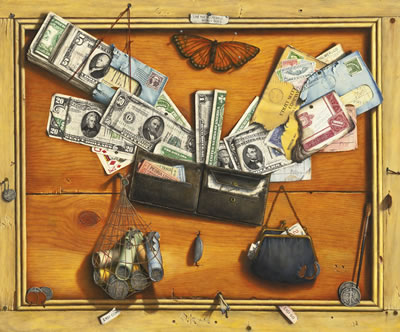
1885 Neemah, Michigan - 1974 Dresden, Germany. Known for: Trompe l'oeil still life-currency, genre painting.
Born in Michigan, Otis Kaye is considered the last of the trompe l'oeil still life painters, recognized primarily for his skill with American currency. At that time, the early part of the 20th... Read full biography
Born in Michigan, Otis Kaye is considered the last of the trompe l'oeil still life painters, recognized primarily for his skill with American currency. At that time, the early part of the 20th century, people were highly interested in this subject matter because the Federal Government was just... Read full biography
Born in Michigan, Otis Kaye is considered the last of the trompe l'oeil still life painters, recognized primarily for his skill with American currency. At that time, the early part of the 20th century, people were highly interested in this subject matter because the Federal Government was just beginning to print uniform money, replacing that which individual banks issued. Kaye was also an etcher and did exquisitely detailed drawings of birds, insects and animals. Although he lived well into the... Read full biography
Born in Michigan, Otis Kaye is considered the last of the trompe l'oeil still life painters, recognized primarily for his skill with American currency. At that time, the early part of the 20th century, people were highly interested in this subject matter because the Federal Government was just beginning to print uniform money, replacing that which individual banks issued. Kaye was also an etcher and did exquisitely detailed drawings of birds, insects and animals. Although he lived well into the 20th century, he was part of the still life tradition of 19th century trompe l'oeil painters, which included John Haberle, John Frederick Peto and William Harnett. Kaye was born to European immigrants and lived briefly in Michigan where his parents... Read full biography
Born in Michigan, Otis Kaye is considered the last of the trompe l'oeil still life painters, recognized primarily for his skill with American currency. At that time, the early part of the 20th century, people were highly interested in this subject matter because the Federal Government was just beginning to print uniform money, replacing that which individual banks issued. Kaye was also an etcher and did exquisitely detailed drawings of birds, insects and animals. Although he lived well into the 20th century, he was part of the still life tradition of 19th century trompe l'oeil painters, which included John Haberle, John Frederick Peto and William Harnett. Kaye was born to European immigrants and lived briefly in Michigan where his parents had a successful lumber business. His father died in a mill accident, and the family sold the business, and he and his... Read full biography
Artist Biography
Biography page for Otis Kaye ((1885 - 1974)), known for Trompe l'oeil still life-currency, genre painting. Showing 2 biographical entries and 0 sample artworks.
Otis Kaye - Artist Info
About Otis Kaye
Biography from the Archives of askART
 Born in Michigan, Otis Kaye is considered the last of the trompe l'oeil still life painters, recognized primarily for his skill with American currency. At that time, the early part of the 20th century, people were highly interested in this subject matter because the Federal Government was just beginning to print uniform money, replacing that which individual banks issued.
Kaye was also an etcher and did exquisitely detailed drawings of birds, insects and animals. Although he lived well into the 20th century, he was part of the still life tradition of 19th century trompe l'oeil painters, which included John Haberle, John Frederick Peto and William Harnett.
Kaye was born to European immigrants and lived briefly in Michigan where his parents had a successful lumber business. His father died in a mill accident, and the family sold the business, and he and his mother went to Dresden, Germany where he enrolled in engineering school.
He had a successful engineering career, moving to Chicago to join a cousin in the 1920s. Like so many, he suffered tremendous financial loss in the stock market crash in 1929.
A brief stay in New York from 1904 to 1905 sparked his interest in trompe l'oeil style when he saw the trompe l'oeil painting of Nicholas Brooks, whose specialty was currency. Although Kaye remained an engineer, he continued his art work throughout his engineering career.
He also taught himself etching by copying the works of Rembrandt and Whistler, and many of his prints have illusionistic coins on top of the printed image.
Sources include:
Spanierman Galleries
Gerald Peters GalleriesBiography from Spanierman Gallery
Best known for his images of American currency, Otis Kaye continued the trompe l'oeil tradition of William M. Harnett, John Haberle and John Frederick Peto well into the twentieth century. A master of visual illusion, Kaye was known for his technical virtuosity as well as for his highly inventive compositions. He was also fond of the visual pun: many of Kaye's money pictures from the 1920s and the 1930s include humorous references to the economic and social eccentricities of the era, as well as to the paintings by the trompe l'oeil artists who preceded him.
Kaye was born in Neemah, Michigan, where his father, a German immigrant, and his Czechoslovakian mother operated a successful lumber business. After his father was killed in a mill accident in 1903, Kaye and his mother sold their share of the business to their partner, who encouraged Otis to pursue a career as an engineer.
Kaye and his mother moved to New York City in 1904. It was there that he first became interested in art, frequenting, but not formally attending, the New York School of Art. Kaye also came into contact with Nicholas Alden Brooks (active 1888-1904), a noted still life painter whose depictions of money, playbills and posters would influence Kaye's own thematic preferences. He even purchased two of Brooks's paintings - - Fifty Dollar Bill on the Bank of Augusta (1890, Private collection) and Full of Old Curiosities (1890, Private collection) - - for his own collection.
In 1905, Kaye went to Dresden, Germany to study engineering. After completing his training, he joined his mother in Hamburg. During these years, Kaye made a number of delicate drawings of figures, animals and insects.
After his mother's death around 1914, Kaye returned to the United States. He lived and worked in Pittsburgh until the mid-1920s, during which time he had the opportunity to familiarize himself with the still lifes of William Harnett. So inspired, he began painting depictions of currency in his spare time, working in the precise, highly detailed manner associated with the trompe l'oeil tradition.
By the late 1920s, Kaye had moved to Chicago to live with his cousin, Paul Banks, Sr., also an engineer. In many of his early paintings, Kaye included subtle references to Banks and his wife, Bess Hoffman, who allowed him and his family to live rent-free in their home. After around 1930, Kaye expanded his thematic repertoire to include other trompe l'oeil motifs, such as firearms and musical instruments. He also began to paint the figure and taught himself etching techniques by copying prints by Rembrandt and Whistler, always signing them with his own name. Kaye also added clever witticisms, such as a painted coin affixed to the image with trompe l'oeil cellophane tape.
Kaye made a brief trip back to Germany in 1937. Much to his surprise, he sold two of his paintings in Munich, the only sales he seems to have made during his lifetime. Indeed, Kaye's artistic activity was strictly a private affair; he made no attempt to sell his paintings, supporting himself through his work as an engineer. Unfortunately, the 1909 ban on the production of illusionistic money pictures, the result of the increase in counterfeit currency at the turn of the century, prevented Kaye from exhibiting his work. He would certainly have been aware of the fact that John Haberle's meticulous renderings of paper money, which included verifiable serial numbers and signatures, were so convincing that Secret Service agents requested that he give up painting money since he was making what they considered to be counterfeit bills.
Returning to Chicago, Kaye and his cousin established their own engineering firm which they called J.J. Billsby and Company. Although the venture was prosperous, the cousins dissolved their partnership after the end of the second world war. However by now, Kaye was financially secure and was thus able to devote more of his time to art. He continued to paint, draw and etch throughout the 1950s and 1960s, depicting money and other paper oddities, as well as monumental figure compositions and landscapes. He also explored themes such as card games, horse racing and allegories.
Kaye lost his wife and daughter in a tragic car accident in the 1950s. Around the same time, his son moved to Europe, virtually disappearing from sight. After making a short trip to New York City in the spring of 1969, Kaye returned to Dresden, possibly in search of his son. He remained there until his death in 1974.
CL
©The essay herein is the property of Spanierman Gallery LLC and is copyrighted by Spanierman Gallery LLC and may not be reproduced in whole or in part, without written permission from Spanierman Gallery LLC nor shown or communicated to anyone without due credit being given to Spanierman Gallery LLC.