Page loaded successfully. Showing biography for Palmer Cole (Hedgeman) Hayden.
Palmer Cole (Hedgeman) Hayden BIOGRAPHY
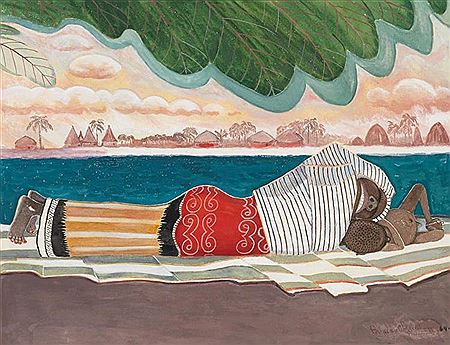
1890 Widewater, Virginia - 1973 New York City. Known for: African-American figure, ethnic urban genre.
PALMER COLE HAYDEN (1890–1973). Palmer Hayden was a prolific painter who sought to portray the African American experience, capturing both rural life in the American South as well as the bustling... Read full biography
PALMER COLE HAYDEN (1890–1973). Palmer Hayden was a prolific painter who sought to portray the African American experience, capturing both rural life in the American South as well as the bustling pace of New York City. In their documentation of ordinary activities—those associated with family,... Read full biography
PALMER COLE HAYDEN (1890–1973). Palmer Hayden was a prolific painter who sought to portray the African American experience, capturing both rural life in the American South as well as the bustling pace of New York City. In their documentation of ordinary activities—those associated with family, church, work, and recreation— Hayden’s works are often characterized by their narrative breadth and illustrative qualities. His mastery of watercolor resulted in impressionistic seascapes, river scenes,... Read full biography
PALMER COLE HAYDEN (1890–1973). Palmer Hayden was a prolific painter who sought to portray the African American experience, capturing both rural life in the American South as well as the bustling pace of New York City. In their documentation of ordinary activities—those associated with family, church, work, and recreation— Hayden’s works are often characterized by their narrative breadth and illustrative qualities. His mastery of watercolor resulted in impressionistic seascapes, river scenes, and landscapes throughout his career. Born in Widewater, Virginia, Peyton Cole Hedgeman was one of twelve children born to James and Nancy Hedgeman. Inspired by his artistically-inclined older brother, he began drawing as a small child, eagerly... Read full biography
PALMER COLE HAYDEN (1890–1973). Palmer Hayden was a prolific painter who sought to portray the African American experience, capturing both rural life in the American South as well as the bustling pace of New York City. In their documentation of ordinary activities—those associated with family, church, work, and recreation— Hayden’s works are often characterized by their narrative breadth and illustrative qualities. His mastery of watercolor resulted in impressionistic seascapes, river scenes, and landscapes throughout his career. Born in Widewater, Virginia, Peyton Cole Hedgeman was one of twelve children born to James and Nancy Hedgeman. Inspired by his artistically-inclined older brother, he began drawing as a small child, eagerly sketching the surrounding countryside and copying images of the African American folk hero, John Henry. The artist’s infatuation with... Read full biography
Artist Biography
Biography page for Palmer Cole (Hedgeman) Hayden ((1890 - 1973)), known for African-American figure, ethnic urban genre. Showing 2 biographical entries and 0 sample artworks.
Palmer Cole (Hedgeman) Hayden - Artist Info
About Palmer Cole (Hedgeman) Hayden
Biography from The Johnson Collection
PALMER COLE HAYDEN (1890–1973)
Palmer Hayden was a prolific painter who sought to portray the African American experience, capturing both rural life in the American South as well as the bustling pace of New York City. In their documentation of ordinary activities—those associated with family, church, work, and recreation— Hayden’s works are often characterized by their narrative breadth and illustrative qualities. His mastery of watercolor resulted in impressionistic seascapes, river scenes, and landscapes throughout his career.
Born in Widewater, Virginia, Peyton Cole Hedgeman was one of twelve children born to James and Nancy Hedgeman. Inspired by his artistically-inclined older brother, he began drawing as a small child, eagerly sketching the surrounding countryside and copying images of the African American folk hero, John Henry. The artist’s infatuation with the legend of Henry,—a “steel-driving man” and the subject of classic folk songs, stories, books, and plays—would eventually inform his iconic series, Ballad of John Henry, a group of twelve paintings executed between 1944 and 1947.
Hayden documented the world around him even when his life was in a state of constant flux. Around the age of sixteen, he relocated to Washington, DC, and worked as an errand boy and porter, before joining the famous Ringling Brothers Circus as a roustabout. At night, Hayden would capture the circus animals and performers on paper, a pastime which led to his being assigned to produce promotional posters, cards, and various graphics.
After moving to New York in 1912, Hayden enlisted in the United States Army. During his first of three enlistments, he continued to draw in both a professional and recreational capacity, finding a map drawing tutor in his second lieutenant. In his second tour of duty, Hayden was assigned to the Tenth Cavalry at West Point, where he cared for and trained horses. Around this time, he undertook his first formal artistic training in the form of an army correspondence drawing course, on which he spent ten of his eighteen-dollars-per-month salary. Palmer’s name change reportedly occurred during his army days: when a commanding sergeant mispronounced “Peyton Hedgeman,” the young soldier decided it best not to correct him. However, another account concludes that the derivation was simply the result of a clerical error. In either case, Hayden legally adopted the new name shortly thereafter.
At the conclusion of his military service, Hayden began taking charcoal drawing courses at Columbia University in New York while working as a mail clerk and a janitor. Later, he studied at the Cooper Union and, for two summers, held a working fellowship at the Commonwealth Art Colony in Boothbay Harbor, Maine. There, under the tutelage of Asa Randall, Hayden painted some of his first waterfront scenes—a subject he would pursue throughout his life. Hayden held various odd jobs during the late 1920s, but it was an auspicious furniture-moving gig that propelled him into the next stage of his artistic career. After rearranging household furniture for Alice M. Dike, he was given a brochure advertising a competition sponsored by the newly-established Harmon Foundation, an organization that aimed to recognize the achievements of black artists in literature, music, drama, and the visual arts. In 1926, Hayden was awarded four-hundred dollars upon winning the foundation’s inaugural first prize for a seascape titled Schooners. In support of his promising talent, Dike gifted Hayden three-thousand dollars to underwrite his studies in Europe. The thirty-seven-year-old artist left for Paris in 1927. Hayden later recalled that at that point in his life, “Fate or Luck prepared the way for serious study and application of art.”
During his five years abroad, Hayden connected with some of the twentieth century’s most acclaimed artists, including Hale Woodruff and Henry Ossawa Tanner, as well as the esteemed philosopher Alain Locke. Within a year of his arrival, Hayden had distinguished himself, earning a solo exhibition at the Galerie Bernheim-Jeune in Paris in November 1927. He also participated in group shows at the Salon des Tuileries in 1930 and the American Legion Exhibition in 1931.
While in Paris, Hayden was often teased by his fellow artist friends—including Woodruff and Augusta Savage—about his penchant for waterscapes. Hayden’s undated painting South Ferry is one of many seascapes he produced throughout his long career, finding inspiration not only in the docks of Maine, but also the busy industrial ports in France.
When he returned to the United States in 1932, Hayden worked as an artist for the Works Progress Administration. In 1937, he created The Janitor Who Paints, one of his most well-known works. Despite his training and awards, the American press and art market were often disparaging of Hayden’s part-time employment as a janitor and undermined his success by describing him as a “dabbler” and “hobbyist” rather than a fine artist. Hayden remarked that The Janitor Who Paints served as a “protest painting,” illustrating not only his personal struggles but those of the African American community at large.
Hayden’s return to the United States marked a shift in his approach to art and art making. “I soon discovered that the profession of a painter is not too lucrative, and I decided to paint to support my love of art, rather than have art support me,” he said. That passion led to Hayden’s representation in major museum collections, including the Metropolitan Museum of Art, the Smithsonian American Art Museum, the Smithsonian American Art Museum, and the Museum of African American Art, among others.
The Johnson Collection,Spartanburg, South Carolina
thejohnsoncollection.orgBiography from National Museum of American Art-Smithsonian
"I decided to paint to support my love of art, rather than have art support me." — Palmer Hayden quoted in Nora Holt, "Painter Palmer Hayden Symbolizes John Henry," New York Times, 1 Feb. 1947.
Palmer Hayden was an artist whose association with the Harlem Renaissance was more spiritual than stylistic. Born on January 15, 1890, in Widewater, Virginia, to Nancy and John Hedgeman, Hayden was christened Peyton Cole Hedgeman, but later changed his name to Palmer Hayden, the name he signed on all of his works. Hayden's interest in drawing began during his childhood.
His first formal contact with art did not occur, however, until his enlistment in the army during World War I, when he enrolled in a drawing correspondence course. Hayden's military duty took him to West Point and the Philippines. Following his discharge from the army, Hayden moved to New York and worked part-time while studying art with Victor Perard at the Cooper Union School of Art.
During his early years Hayden also studied painting with Asa G. Randall at the Boothbay Art Colony in Maine in 1925. Hayden was awarded a working fellowship to Boothbay, and devoted most of his time to painting boats and marine subjects. His Boothbay period paintings were exhibited in New York in 1926 at the Civic Club and won two Harmon Foundation awards—the coveted gold medal and a cash prize of $400.
With this money and a personal contribution from a patron, Hayden sailed for Paris in 1927, and studied in Brittany and in Paris at the École des Beaux Arts. Within a year Hayden had distinguished himself and mounted a one-man show at the Galerie Bernheim in Paris in November 1928. He also exhibited in group shows in Paris at the Salon des Tuileries in 1930 and the American Legion Exhibition in 1931. Hayden's portrayal of African-American subject matter in many of his paintings in the latter show was unusual in Paris at that time.
Hayden was in Paris during the final years of the Harlem Renaissance of the 1920s, but he had lived in New York during the formative years of that pivotal period. He knew Harlem Renaissance artists and shared their efforts, triumphs, and frustrations. Hayden maintained close contact with the Harmon Foundation while in the United States, and exhibited annually in the Harmon Foundation shows from 1928 to 1932 when he was in Paris.
Although Hayden received thorough academic training in New York, Maine, and Paris, his works always retained a flat naive character, which he developed independently during his youth. One of Hayden's best-known early works is Fétiche et Fleurs of 1926, which clearly linked Hayden with the African-Cubist tradition of Harlem and Paris. The small still-life composition depicts a vase of lilies, an ashtray, and a Gabonese Fang head on a table covered with a Kuba textile from Zaire. This painting was one of the earliest by an African-American artist to incorporate actual African imagery, and was awarded Mrs. John D. Rockefeller's prize for painting in the Harmon Show of 1933.
Following his return from Paris in 1932, Hayden worked on the United States Treasury Art Project and the W.P.A. Art Project from 1934 to 1940, and painted scenes of the New York waterfront and other local subjects. During the late 1930s Hayden developed a consciously naive style, which represented various aspects of African-American life. One of the first paintings that heralded Hayden's new style was Midsummer Night in Harlem, 1938, in which he effectively evoked the mood of Harlem's residents congregating outside to escape the heat inside the tenements.
Despite the flat forms and stylized figures, the compositional arrangement and treatment of perspective reveal Hayden's academic training. African-American art historian James Porter apparently misunderstood Hayden's objectives when he criticized Midsummer Night in Harlem as a talent gone astray," and compared the painting to "one of those billboards that once were plastered on public buildings to advertise black face minstrels." Hayden insisted, however, that he was not striving for satirical effects in his African-American folk paintings, but that he wanted to achieve a new type of expression.
In 1944 Hayden began painting the Ballad of John Henry series that would occupy him for the next ten years. The series comprises a group of twelve paintings depicting scenes from the life of the legendary African-American folk hero who inspired the ballad named after him. An exhibition of these paintings and others dealing with African-American folklore was held at the Countee Cullen Library in Harlem in 1952.
Hayden was also represented in the large exhibition, The Evolution of the Afro-American Artist, sponsored by the City University of New York, the Urban League, and the Harlem Cultural Council and presented in the fall of 1967 in the great hall of the City University. From the late 1960s until his death in 1973, Hayden continued to paint subjects based on African-American themes, but in a more cosmopolitan manner than his earlier works.
Source: Regenia A. Perry, Free within Ourselves: African-American Artists in the Collection of the National Museum of American Art (Washington, D.C.: National Museum of American Art in Association with Pomegranate Art Books, 1992)