Page loaded successfully. Showing biography for Paul Henry.
Paul Henry BIOGRAPHY
1876 Belfast, Ireland - 1958. Known for: Post impressionist landscape and figure painting.
Paul Henry (1876-1958). Henry's landscape painting depicts the terrain of the west of Ireland reduced to its key essentials of sky, bog and turf. In his use of mass and color, he can be seen as the... Read full biography
Paul Henry (1876-1958). Henry's landscape painting depicts the terrain of the west of Ireland reduced to its key essentials of sky, bog and turf. In his use of mass and color, he can be seen as the first Irish post-Impressionist artist - recording the traditional way of life but in a modern style.... Read full biography
Paul Henry (1876-1958). Henry's landscape painting depicts the terrain of the west of Ireland reduced to its key essentials of sky, bog and turf. In his use of mass and color, he can be seen as the first Irish post-Impressionist artist - recording the traditional way of life but in a modern style. He is now regarded by many critics as one of the most influential Irish landscape artists of the twentieth century, and an important painter in the history of Irish art. Born in Belfast, Paul Henry... Read full biography
Paul Henry (1876-1958). Henry's landscape painting depicts the terrain of the west of Ireland reduced to its key essentials of sky, bog and turf. In his use of mass and color, he can be seen as the first Irish post-Impressionist artist - recording the traditional way of life but in a modern style. He is now regarded by many critics as one of the most influential Irish landscape artists of the twentieth century, and an important painter in the history of Irish art. Born in Belfast, Paul Henry attended the Belfast School of Art after which a family member financed a trip to Paris in 1889, where (like John Lavery) he studied at the Academie Julian and was influenced (later) by the rural realism and plein-air painting of Jean Francois Millet,... Read full biography
Paul Henry (1876-1958). Henry's landscape painting depicts the terrain of the west of Ireland reduced to its key essentials of sky, bog and turf. In his use of mass and color, he can be seen as the first Irish post-Impressionist artist - recording the traditional way of life but in a modern style. He is now regarded by many critics as one of the most influential Irish landscape artists of the twentieth century, and an important painter in the history of Irish art. Born in Belfast, Paul Henry attended the Belfast School of Art after which a family member financed a trip to Paris in 1889, where (like John Lavery) he studied at the Academie Julian and was influenced (later) by the rural realism and plein-air painting of Jean Francois Millet, the Barbizon landscape artist. Henry spent a relatively short period of time in the French capital but became one of its best-... Read full biography
Artist Biography
Biography page for Paul Henry ((1876 - 1958)), known for Post impressionist landscape and figure painting. Showing 3 biographical entries and 0 sample artworks.
Paul Henry - Artist Info
About Paul Henry
Biography from the Archives of askART
 Paul Henry (1876-1958)
Henry's landscape painting depicts the terrain of the west of Ireland reduced to its key essentials of sky, bog and turf. In his use of mass and color, he can be seen as the first Irish post-Impressionist artist - recording the traditional way of life but in a modern style. He is now regarded by many critics as one of the most influential Irish landscape artists of the twentieth century, and an important painter in the history of Irish art.
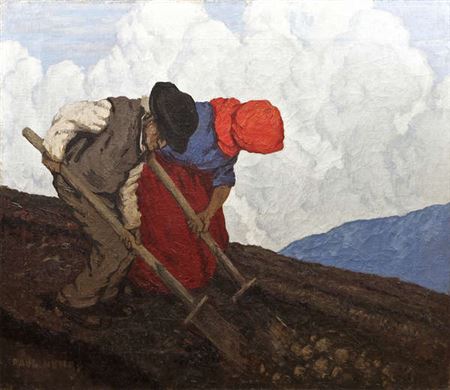
Born in Belfast, Paul Henry attended the Belfast School of Art after which a family member financed a trip to Paris in 1889, where (like John Lavery) he studied at the Academie Julian and was influenced (later) by the rural realism and plein-air painting of Jean Francois Millet, the Barbizon landscape artist. Henry spent a relatively short period of time in the French capital but became one of its best-known Irish artists of the time. He also met Grace Mitchell his wife-to-be, and developed a particular skill in the use of charcoal, which became his favorite medium. In 1900, he moved to London, where he worked as a newspaper illustrator and art teacher. After a few years he returned to Ireland and moved to Achill Island off the County Mayo coast. It was here that Henry discovered his true style as an artist, painting scenes of Irish peasants digging potatoes, cutting turf cutting and harvesting seaweed.
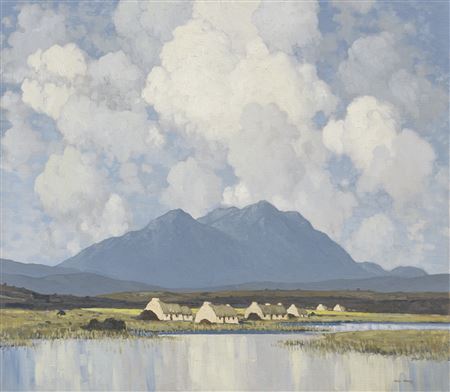
In 1919, he moved to Dublin where - along with several other painters including Jack B. Yeats and Mary Swanzy - he quickly founded the Society of Dublin Painters. By this time, Henry's style of painting began to focus on pure landscapes typically comprising mountains, a lake and some cottages, topped by a sky which takes up half the painting. In 1922, he gained his first international acclaim when the Musée du Luxembourg purchased his painting: A West of Ireland Village.
During the 1920s several of Paul Henry's works were reproduced as posters or prints and helped to establish the standard scenic view of Ireland in tourist literature and in government publications. Even today, his pictorial naturalism continues to represent a vision of Ireland that many people regard as truly authentic. Henry was appointed a full member of the Royal Hibernian Academy in 1928 and became one of the first members of the Royal Ulster Academy of Arts. He died in 1958.
Paul Henry's paintings include:
In Connemara, Turf Sacks In Connemara, A Western Lough, Achill Cottages, Achill Head, Fishing Boat Achill, Blasket Island, Bog Cutting, Cloudy Day, Launching the Currach, Scene on Aran Island, Silent Waters, Thatched Cottages, On Killary Bay, The Road to the Mountains, The Tower, The Watcher, Turf Sacks, Turf Sacks By A Pool, The Roadside Cottages, Cottages by A Still Lough, Cottages by the Lake, Glencree, Dusk, Evening on the Bog, Misty Morning, Mountain and Lake, Mountain and Lake After Rain, Mountain Landscape West of Ireland, Grace O'Malley's Castle, Head of an Old Man, Killary Harbour, Connemara Hills, Storm on a Connemara Lake, Cloudy Day Connemara, Windswept Trees Connemara, Lakeside Cottages.
Henry's works are represented in all major collections of Irish painting.
Source:
Online Encyclopedia of Irish and World Art
http://www.visual-arts-cork.com/irish-artists/paul-henry.htmBiography from Adam's (James Adam & Sons Ltd.)
Paul Henry was born in 1876 in Belfast, Ireland. In his autobiography, An Irish Portrait (London, 1951, p.48), Paul Henry wrote that John Millington Synge had ‘touched some chord which resounded as no other music ever had done' and, he tells us, it was of Riders to the Sea that he was thinking as he left London 'on the couple of weeks' holiday' he had promised himself. Despite Henry’s increasing reputation as a graphic artist in London, it was to Achill he was drawn and so captivated was he that he was to spend nine years there - as a sort of home-coming, for his maternal grandfather, the Rev. Thomas Berry, had preached the gospel on Achill in the mid-1830's. Soon after his arrival on the island Henry made for the village of Keel, on its southern shore. He was enthralled by the life he found there. 'Achill called to me as no other place had ever done', he wrote (An Irish Portrait, p. 50), yet, he said, although 'the persuasiveness of it’s voice charmed me', it was not easy to follow its meaning. It was, however, an emotional call and he decided to settle there, 'not as a visitor but to identify myself with its life and to see it every day in all its moods.' In particular the peasantry working in the fields reminded him of Millet, whose work he knew as a student in Paris. The hatted male figure, digging with a spade, is almost a direct quote from Millet's The Spaders. The fields in Achill were very small - 'a man might own a field or two beside his door and another bit of land, about the size of a small suburban front garden, a mile or so away' -having, for hereditary reasons, been sub-divided many times over the years. The potatoes are being harvested from ridges, the traditional method of cultivation on Achill. Like Millet, Henry wanted to paint a scenes of life as it really was, the harshness of daily routine being evident from the back-breaking work and the small return of crops produced. 'I have yet to see people who worked so hard for so little gain', he wrote years later. 'It meant incessant toil with the spade', ploughs being useless on those stony fields (An Irish Portrait, p. 57). In pictures such as this, Henry introduced a new realism to Irish art. Gone is the 'stage Irishness' of much nineteenth century art and, as with Millet's field workers, we realize that life was difficult, being neither heroic nor idyllic, and the simple toil of the figures gives a natural dignity to their efforts that is more convincing than much academic painting of the time. In his early Achill period potato digging was a favourite subject for Henry and he made numerous versions of this composition and with similar poses appearing. The man digging may be Johnny Toolis, who appears in The Potato Harvest (SBK425) and The Potato Diggers (SBK295). Paul Henry passed away in 1958 in Ireland. We are indebted to Dr S. B. Kennedy whose writings formed the basis of this note.Biography from Bearnes, Hampton & Littlewood
Paul Henry was born in Belfast in 1876. From 1898, he studied art at the Academy Julian in Paris, and then at Whistler's Studio. He is an Irish artist noted for depicting the West of Ireland landscape in a spare Post Impressionist style.
He married in 1903, and returned to Ireland in 1910. From then until 1919, he lived on Achill Island where he painted extensively. While painting, he was learning to capture the peculiar interplay of light and landscape specific to the West of Ireland.
In 1919, he moved to Dublin and founded the Society of Dublin Painters. He passed away in 1958.