Page loaded successfully. Showing biography for Per Vilhelm Cedergren.
Per Vilhelm Cedergren BIOGRAPHY
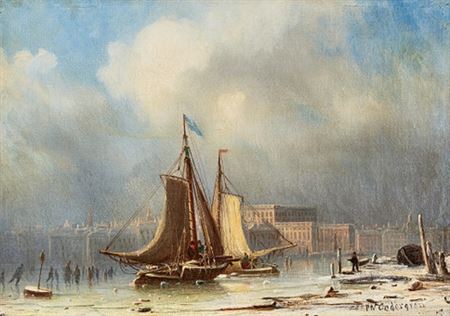
1820 - 1896. Known for: Marine painting.
The marine painter Per Wilhelm Cedergren (Stockholm 1820-1896 Spånga) was intimately associated with the marine life. As a child he lived at Skeppsholmen where his father was a block and turning... Read full biography
The marine painter Per Wilhelm Cedergren (Stockholm 1820-1896 Spånga) was intimately associated with the marine life. As a child he lived at Skeppsholmen where his father was a block and turning master at Stockholm's warship. According to the son's autobiographical notes (G. Webe, "Pehr Wilhelm... Read full biography
The marine painter Per Wilhelm Cedergren (Stockholm 1820-1896 Spånga) was intimately associated with the marine life. As a child he lived at Skeppsholmen where his father was a block and turning master at Stockholm's warship. According to the son's autobiographical notes (G. Webe, "Pehr Wilhelm Cedergren. Shipbuilding shipbuilder-marine painter", in "Forum Navale.", No. 28, Naval History Society, 1973), the father often sat on the hook. Like so many others during this time, he escaped hard... Read full biography
The marine painter Per Wilhelm Cedergren (Stockholm 1820-1896 Spånga) was intimately associated with the marine life. As a child he lived at Skeppsholmen where his father was a block and turning master at Stockholm's warship. According to the son's autobiographical notes (G. Webe, "Pehr Wilhelm Cedergren. Shipbuilding shipbuilder-marine painter", in "Forum Navale.", No. 28, Naval History Society, 1973), the father often sat on the hook. Like so many others during this time, he escaped hard reality with the help of booze. The family lived in a cold and drab attic room where they slept directly on the floor. As a nine-year-old, Cedergren was entered as a crown's ship's boy. He later painted both in text and image how he, as a ship's boy,... Read full biography
The marine painter Per Wilhelm Cedergren (Stockholm 1820-1896 Spånga) was intimately associated with the marine life. As a child he lived at Skeppsholmen where his father was a block and turning master at Stockholm's warship. According to the son's autobiographical notes (G. Webe, "Pehr Wilhelm Cedergren. Shipbuilding shipbuilder-marine painter", in "Forum Navale.", No. 28, Naval History Society, 1973), the father often sat on the hook. Like so many others during this time, he escaped hard reality with the help of booze. The family lived in a cold and drab attic room where they slept directly on the floor. As a nine-year-old, Cedergren was entered as a crown's ship's boy. He later painted both in text and image how he, as a ship's boy, froze, cooled and got hit in time and time. In the winters he went to the shipbuilding school and in the summers he was out and hurt on bo... Read full biography
Artist Biography
Biography page for Per Vilhelm Cedergren ((1820 - 1896)), known for Marine painting. Showing 1 biographical entries and 0 sample artworks.
Per Vilhelm Cedergren - Artist Info
About Per Vilhelm Cedergren
Biography from Uppsala (also see Stockholms Auktionsverk)
The marine painter Per Wilhelm Cedergren (Stockholm 1820-1896 Spånga) was intimately associated with the marine life. As a child he lived at Skeppsholmen where his father was a block and turning master at Stockholm's warship.
According to the son's autobiographical notes (G. Webe, "Pehr Wilhelm Cedergren. Shipbuilding shipbuilder-marine painter", in "Forum Navale.", No. 28, Naval History Society, 1973), the father often sat on the hook.
Like so many others during this time, he escaped hard reality with the help of booze. The family lived in a cold and drab attic room where they slept directly on the floor. As a nine-year-old, Cedergren was entered as a crown's ship's boy. He later painted both in text and image how he, as a ship's boy, froze, cooled and got hit in time and time. In the winters he went to the shipbuilding school and in the summers he was out and hurt on board the ship.
When Cedergren was 18, his father died and he went ashore and became a carpenter apprentice at Skeppsholmen. At the yard there were inhuman harsh working conditions. Cedergren's tendency to draw got attention, and after a few years, he got to work on drawing templates from which ships were to be built.
For each new building, the old drawings were planed carefully away from the floor of the mall. Later he got to work on shipbuilding, production of models and ship designs.
On Sundays, he squeezed out the meager salary of competing with the rowing dams.
When Cedergren was twenty, the public life researcher Nils Månsson Mandelgren (1813-1899) happened to visit his parents' home and then noticed a painting on the wall that Cedergren made. Mandelgren offered him free tuition for three months at the Academy of Fine Arts Sunday School.It was the only artistic education he ever received.
Mandelgren needed drawing helpers and on his behalf Cedergren drew boats and other marine and made survey drawings. Through the Academy of Art he came into contact with other artists, among them Marcus Larsson (1825-1864). In 1850 and a few years ahead he was contracted by Larsson to carry out advanced tackles on boats and ships in his paintings.
As quartermaster at Kongl, of the fleet, Cedergren 1851 was given the privilege to travel to the world exhibition in London together with several other craftsmen.
During the trip he engaged in industrial espionage on English shipyards together with his colleague and good friend John Fredrik Andersson from Skeppsholmen . They managed to copy the drawings to the race sailing concert America.
America had just won the sailing race, which she then named - America's Cup - the world's most desirable sailing trophy. The drawings formed the basis for the race sailor Sweden, which next year was built on the Andersing-owned Essingevarvet in Stockholm. Sweden soon challenged America and was winning over her during a legendary race.
Cedergren's marine paintings are usually documentary depictions of ships and boats, especially in the Stockholm environment. He also made many ship portraits, probably to order. The royal family bought several of his paintings and Karl XV even bought a small farm for him outside Drottningholm.
Cedergren is represented at the National Museum, the Maritime Museum and the Nordic Museum (drawings completed during the trip to England 1851). At the Marin Museum in Karlskrona there are personal documents from him including his autobiographical notes in four bands.