Page loaded successfully. Showing biography for Percy (Henry Percy) Gray.
Percy (Henry Percy) Gray BIOGRAPHY
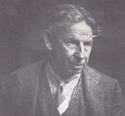
1869 San Francisco, California - 1952 San Francisco, California. Known for: Landscape, coastal view, and portrait painting.
Percy Gray was a talented American painter whose career spanned over forty years from 1906 to 1952. During these years of modernist turmoil in American art, Gray adhered to a single artistic goal --... Read full biography
Percy Gray was a talented American painter whose career spanned over forty years from 1906 to 1952. During these years of modernist turmoil in American art, Gray adhered to a single artistic goal -- to extract poetic reverberations from California's natural beauty. Percy Gray was born in San... Read full biography
Percy Gray was a talented American painter whose career spanned over forty years from 1906 to 1952. During these years of modernist turmoil in American art, Gray adhered to a single artistic goal -- to extract poetic reverberations from California's natural beauty. Percy Gray was born in San Francisco in 1869 to a family with a rich artistic and literary heritage. Gray's father emigrated from England to Australia, married and moved to San Francisco, where he thrived in the insurance business.... Read full biography
Percy Gray was a talented American painter whose career spanned over forty years from 1906 to 1952. During these years of modernist turmoil in American art, Gray adhered to a single artistic goal -- to extract poetic reverberations from California's natural beauty. Percy Gray was born in San Francisco in 1869 to a family with a rich artistic and literary heritage. Gray's father emigrated from England to Australia, married and moved to San Francisco, where he thrived in the insurance business. Percy grew up in the young city, which harbored ambitions to become a major cultural center. During a childhood illness, he discovered a talent for art. He attended the California School of Design from 1886 - 1888 and began a career as a newspaper... Read full biography
Percy Gray was a talented American painter whose career spanned over forty years from 1906 to 1952. During these years of modernist turmoil in American art, Gray adhered to a single artistic goal -- to extract poetic reverberations from California's natural beauty. Percy Gray was born in San Francisco in 1869 to a family with a rich artistic and literary heritage. Gray's father emigrated from England to Australia, married and moved to San Francisco, where he thrived in the insurance business. Percy grew up in the young city, which harbored ambitions to become a major cultural center. During a childhood illness, he discovered a talent for art. He attended the California School of Design from 1886 - 1888 and began a career as a newspaper illustrator, ending up with a job at the "New York Journal" in 1895. Gray spent the next eleven years a... Read full biography
Artist Biography
Biography page for Percy (Henry Percy) Gray ((1869 - 1952)), known for Landscape, coastal view, and portrait painting. Showing 5 biographical entries and 0 sample artworks.
Percy (Henry Percy) Gray - Artist Info
About Percy (Henry Percy) Gray
Name variants
Henry Percy Gray
Biography from the Archives of askART
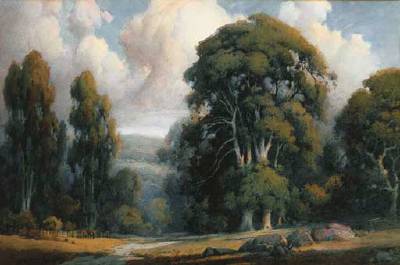 Percy Gray was a talented American painter whose career spanned over forty years from 1906 to 1952. During these years of modernist turmoil in American art, Gray adhered to a single artistic goal -- to extract poetic reverberations from California's natural beauty.
Percy Gray was born in San Francisco in 1869 to a family with a rich artistic and literary heritage. Gray's father emigrated from England to Australia, married and moved to San Francisco, where he thrived in the insurance business. Percy grew up in the young city, which harbored ambitions to become a major cultural center. During a childhood illness, he discovered a talent for art. He attended the California School of Design from 1886 - 1888 and began a career as a newspaper illustrator, ending up with a job at the "New York Journal" in 1895.
Gray spent the next eleven years as a newspaper artist in New York City but also found time to study at the Art Students League and with William Merritt Chase.
As a newspaper illustrator, Gray learned how to get the facts of a scene down quickly and correctly. In 1906, Gray was dispatched to San Francisco to cover the catastrophe caused by the earthquake and fire that occurred in April of that year. He then remained in the city of his youth, and launched into a career as an exhibiting artist.
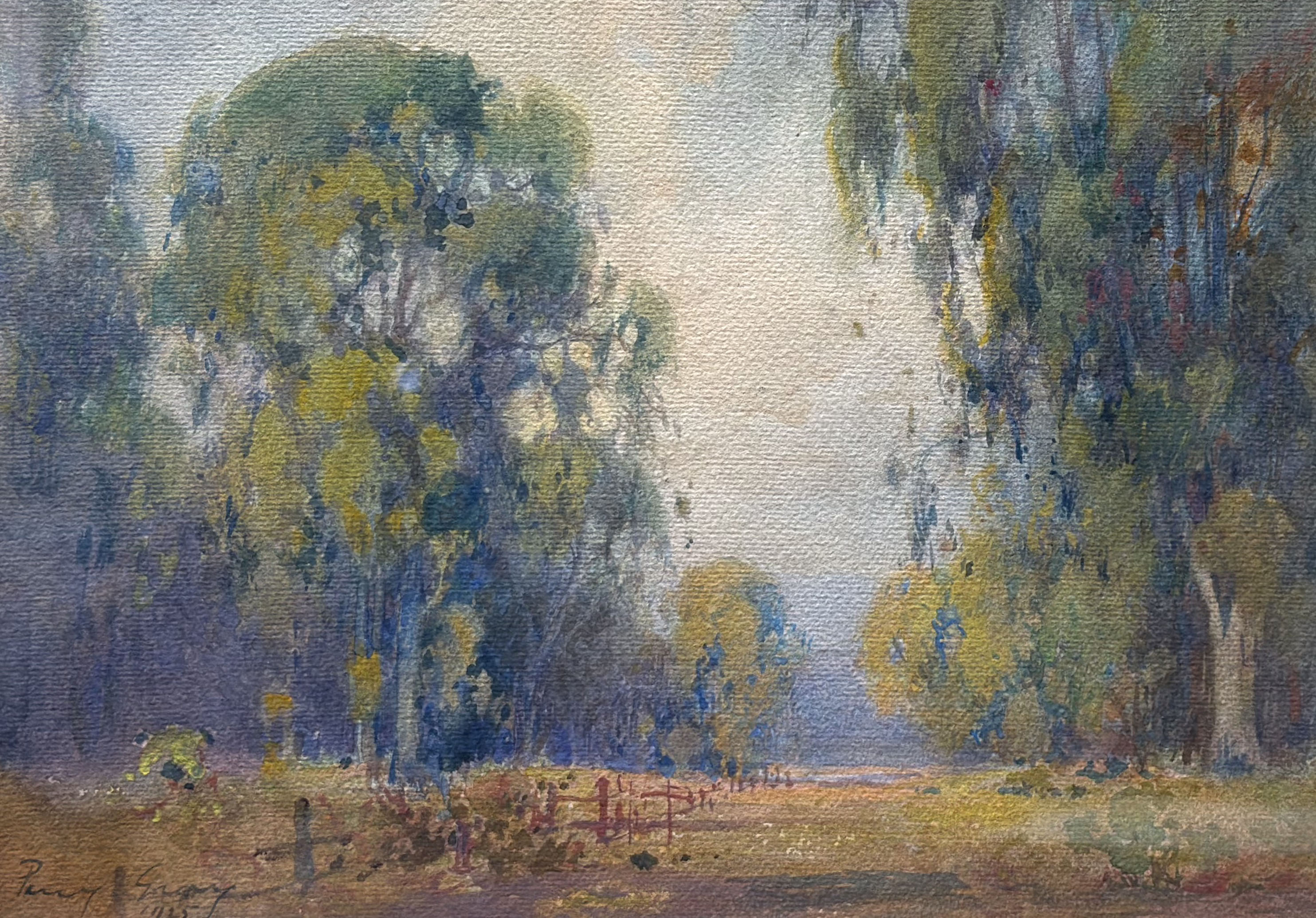
Gray's first paintings, exhibited in 1907, depicted stretches of ocean with waves breaking against headlands. Gray soon began to explore other subjects, including landscapes with eucalyptus trees swaying in the fog, their indistinct outlines full of ghostly suggestiveness. His ability to extract emotional responses from real California scenery was praised in the press.
The San Francisco Examiner critic noted: "Although Gray is a painter-realist, he endows his pictures with the eerie charm of romance. He knows how to bring out the misty quality of the air, the mystery of clouds sailing by, the soul of trees and the fragrance of flowers."
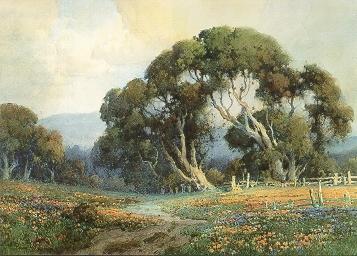
In addition to eucalyptus trees, Gray watercolors often depict fields of California flowers seen in springtime. This subject allowed Gray to apply to his watercolors the high-keyed palette and broken brushstrokes learned from William Merritt Chase. "Don't hesitate to exaggerate color and light!" Chase would expostulate to his students, and Gray sometimes added more flowers and brilliant color than the scene actually portrayed.
Although Gray often painted bright works in the impressionist mode, his primary inspiration was directed towards muted landscapes in the style now known as "tonalism." The emotions most typically expressed in his pictures were those of quiet, introspective pleasure, rather than sublimity or joy. He loved to paint clouds. One time he was painting near the coast on a cloudy day when a farm boy approached. "It's a pity, Mister," the farm boy remarked, "that you did not come out to work on a clear day. Why, sometimes you can see all the way to the Farallones (twenty miles)." Replied Gray: "That's just what I don't want."
Gray's work became popular, and his paintings, exhibited at various San Francisco galleries, were sought after. In 1915, his watercolor, Out of the Desert, Oregon, won a bronze medal at the Panama Pacific International Exposition. For most of the time between 1912 and 1923, Gray lived in Burlingame while maintaining a studio in San Francisco.
To the surprise of some of his friends, in 1923, at age 53, the "avowed bachelor" married and moved into the historic Bonifacio adobe in Monterey. Some of Gray's best paintings from his Monterey years celebrate the fortitude of coastal cypress trees in their struggle to survive the constant battering of the elements symbolic of the struggles of human life.
In 1939, the Grays sold their Monterey home and returned to San Francisco. In 1941, they settled in the quiet village of San Anselmo in Marin County, about fifteen miles north of San Francisco near the base of Mount Tamalpais. Gray was in his seventies but continued to paint with considerable virtuosity. After his wife died in 1951, he moved back to San Francisco and set up a studio where he died of a heart attack while at his easel on October 10, 1952.
Source:
Information provided by Antoinette Vaughn, who credits Alfred Harrison of the Carmel Art AssociationBiography from the Archives of askART
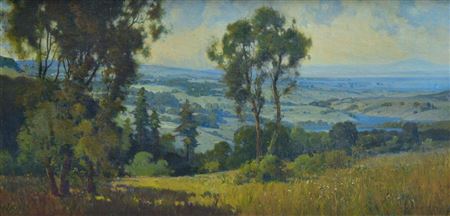 Born in San Francisco, California, Percy Gray became one of that state's best-known professional landscape painters in the late 19th and early 20th centuries. He is most often associated with Northern California landscapes with oaks or eucalyptus trees, and these paintings with colorful lupines and poppies are the most collectible. He also did a few portraits and etchings.
As he matured, he developed an allergy to oil paint, so he changed to watercolor. In his paintings, he created distinct perspectives and atmospheric qualities by using a unique method of building up paint.
He was from a British family where twelve of his ancestors were artists. He grew up in Northern California, and developed an early love of the landscape from spending his summers at the family home at Inverness in Marin County.
In his early teens, he suffered an illness that confined him to bed for a prolonged time, and to keep him occupied, his brother bought him art supplies. It was almost immediately obvious that Henry had special talent, and by the time, he was 16 and entering the San Francisco School of Design, his work was collectible. He studied at the School with Emil Carlsen and then began his career as a sketch artist for the San Francisco "Call" newspaper.
In 1895, he went to New York and worked eleven years as head of the art department for William Randolph Hearst's New York Journal. At night, he studied at the Art Students League with William Merritt Chase, whose theories of landscape painting had a life-long influence on Gray.
In 1906, after the earthquake and fire, he returned to San Francisco and worked until 1920 as illustrator for the Examiner. By 1920, he felt established enough as a landscape painter to become a full-time artist.
From 1918 to 1923, Gray had maintained a studio in San Francisco and lived in his studio in the Montgomery Block, but in 1923, he married and settled in Monterey, renovating an historic home once occupied by William Tecumseh Sherman, the famous Civil War General.
ln 1939, he and his wife moved to Marin County, and after his wife died in 1951, he again became a resident in San Francisco, living in the Bohemian Club until his death in his studio from a heart attack in 1952.
In addition to California landscapes, he painted scenery of surrounding states including Arizona, Washington, and Oregon. He also painted some portraits of Southwest Indians but declared many times that he did not enjoy portrait painting.
His great love was roaming the hills in the San Francisco area, sketching the basics, and completing landscapes in his studio. The work of his later years is not considered as desirable as earlier paintings because it was more sombre and contemplative. Many collections have his paintings including the Crocker Museum at Sacramento and the Stanford Museum at Palo Alto.
Source:
American Art Review
Michael David Zellman, 300 Years of American Art
Edan Hughes, Artists in California, 1786-1940Biography from the Archives of askART
 Born in San Francisco, California on October 3, 1869, Percy Gray was from a long line of British artists. He studied locally at the School of Design under Emil Carlsen, and then worked as a quick-sketch artist for the San Francisco Call newspaper.
In 1895 he moved to New York City where he spent 11 years working as head of the art department for the New York Journal. While in NYC he studied at the Art Students League and with William Merritt Chase. Gray returned to San Francisco in 1906 and joined the art department of the Examiner where he remained until about 1915. By that time he had established himself as a professional landscape painter.
From 1918-23 he maintained a studio in San Francisco's old Monkey Block (now the Transamerica Pyramid), which also served as his living quarters. About 1910 he began signing his paintings in script instead of the block letters he had used since student days.
In 1923 Gray married and settled in Monterey where the newlyweds purchased for their home and had rebuilt on another site, the historic Casa Bonifacio. Working from his studio attached to the house, Gray attained total mastery of his watercolor technique during his Monterey years. In 1939 they sold the home, and after two years in San Francisco, settled in San Anselmo in Marin County.
The last year of Gray's life was spent as a resident of the Bohemian Club in his native city. He died of a heart attack in his studio on October 10, 1952. Although he painted oils and produced 20 etchings, he is best known for his atmospheric watercolors. His works most often depict the glades and valleys of northern California, with slopes of poppies and lupines under oak and eucalyptus trees. The rocky California coast was often his subject as well as Southwestern desert scenes; while 25 portraits of American Indians represent the bulk of his portraiture.
Member: SFAA; The Family (SF); Bohemian Club; Sequoia Club; Carmel AA; SWA. Exh: Mechanics' Inst. (SF), 1888; Golden Gate Park Museum, 1910; Del Monte Art Gallery (Monterey), 1910; Arizona State Fair, 1915 (1st prize); PPIE, 1915 (medal); Bohemian Club, 1922. In: CHS; NMAA; Oakland Museum; Brooklyn Museum; Bohemian Club; Bancroft Library (UC Berkeley); CPLH; Crocker Museum (Sacramento); Stanford Museum; Monterey Peninsula Museum; Santa Barbara Museum.Biography from the Archives of askART
Born in San Francisco, CA on Oct. 3, 1869. From a long line of British artists, Percy Gray studied locally at the School of Design under Emil Carlsen. He then worked as a quick-sketch artist for the San Francisco Call. In 1895 he moved to NYC where he spent 11 years working as head of the art department for the New York Journal. While in NYC he studied at the ASL and with Wm M. Chase. Gray returned to San Francisco in 1906 and joined the art department of the Examiner where he remained until about 1915. By that time he had established himself as a professional landscape painter. From 1918-23 he maintained a studio in San Francisco's old Monkey Block (now the Transamerica Pyramid) which also served as his living quarters. About 1910 he began signing his paintings in script instead of the block letters he had used since student days. In 1923 Gray married and settled in Monterey where the newlyweds purchased for their home and had rebuilt on another site, the historic Casa Bonifacio. Working from his studio attached to the house, Gray attained total mastery of his watercolor technique during his Monterey years. In 1939 they sold the home and after two years in San Francisco settled in San Anselmo in Marin County. The last year of Gray's life was spent as a resident of the Bohemian Club in his native city. He died of a heart attack in his studio on Oct. 10, 1952. Although he painted oils and produced 20 etchings, he is best known for his atmospheric watercolors. His works most often depict the glades and valleys of northern California, with slopes of poppies and lupines under oak and eucalyptus trees. The rocky California coast was often his subject as well as Southwestern desert scenes; while 25 portraits of American Indians represent the bulk of his portraiture.
Member: SFAA; The Family (SF); Bohemian Club; Sequoia Club; Carmel AA; SWA.
Exh: Mechanics' Inst. (SF), 1888; Golden Gate Park Museum, 1910; Del Monte Art Gallery (Monterey), 1910; Arizona State Fair, 1915 (1st prize); PPIE, 1915 (medal); Bohemian Club, 1922. In: CHS; NMAA; Oakland Museum; Brooklyn Museum; Bohemian Club; Bancroft Library (UC Berkeley); CPLH; Crocker Museum (Sacramento); Stanford Museum; Monterey Peninsula Museum; Santa Barbara Museum.Biography from William A. Karges Fine Art
 Percy Gray is considered one of California’s most important historical artists and more specifically, one of the state’s signature watercolorists.
Born in San Francisco in 1869 to a family with an artistic heritage, Gray’s grandparents (on his father’s side) were painters in England. Other relatives were involved in the arts as well. After realizing he, too, had inherited a passion for art, Gray eventually enrolled at the California School of Design in San Francisco at the age of sixteen. During this period, he also spent time conscientiously observing and visually cataloging the Northern California landscape with fellow artists such as John Gamble. After working as an illustrator for newspapers in San Francisco and New York City, by 1906 he was back in the Bay Area and began his full-time career as a landscape painter.
Grey originally started working with oils. However, he became allergic to these materials, prompting his switch to watercolor, the medium for which he is best remembered today. Throughout his career his style was reminiscent of the Barbizon School artists and is often described as “tonal”: grays, browns, and greens were usually his palette of choice. This individualistic approach set him apart from many of his contemporaries who were more interested in “Impressionism” and the lighting effects the sun had on their subjects. Gray frequently preferred to paint on overcast days, typical of Northern California. His paintings of clouds and moody skies above the trees made for a romantic, poetic expression. The inclusion of wildflowers in his paintings also contributed to the romantic theme found in his work.
Creating visual poetry, large eucalyptus and oak trees are abundant in his watercolors, as well as cypress trees when his studio was located in Monterey; all very characteristic of the California landscape where he lived and traveled. Gray spent his last years back in Marin County continuing to paint until his death in 1952. Today, Percy Gray is unquestionably considered one of the most successful and well-known landscape painters to have worked in California during the early 20th Century. His work has been exhibited at many public institutions including at the Metropolitan Museum of Art, Smithsonian American Art Museum, Crocker Art Museum, Oakland Museum, Santa Barbara Museum, Brooklyn Museum, and the Monterey Museum of Art.