Page loaded successfully. Showing biography for Peter Booth.
Peter Booth BIOGRAPHY
Born 1940. Known for: Painting.
Peter Booth (b.1940). From his auspicious debut in the groundbreaking exhibition The Field, held at the National Gallery of Victoria in 1968, Peter Booth has proceeded to achieve international... Read full biography
Peter Booth (b.1940). From his auspicious debut in the groundbreaking exhibition The Field, held at the National Gallery of Victoria in 1968, Peter Booth has proceeded to achieve international recognition as one of the most important and influential artists of his generation. If it was his large,... Read full biography
Peter Booth (b.1940). From his auspicious debut in the groundbreaking exhibition The Field, held at the National Gallery of Victoria in 1968, Peter Booth has proceeded to achieve international recognition as one of the most important and influential artists of his generation. If it was his large, monochromatic abstract works which initially attracted widespread acclaim, today it is his immensely vivid and painterly figuration for which Booth is best renowned. Drawing upon epic legends of the... Read full biography
Peter Booth (b.1940). From his auspicious debut in the groundbreaking exhibition The Field, held at the National Gallery of Victoria in 1968, Peter Booth has proceeded to achieve international recognition as one of the most important and influential artists of his generation. If it was his large, monochromatic abstract works which initially attracted widespread acclaim, today it is his immensely vivid and painterly figuration for which Booth is best renowned. Drawing upon epic legends of the past and prophecies for an imagined future, these dramatic, poetic images of the human spirit poignantly explore fundamental human emotions and anxieties, issues of spiritual turmoil, social alienation and the devolution of civilization. Framed within... Read full biography
Peter Booth (b.1940). From his auspicious debut in the groundbreaking exhibition The Field, held at the National Gallery of Victoria in 1968, Peter Booth has proceeded to achieve international recognition as one of the most important and influential artists of his generation. If it was his large, monochromatic abstract works which initially attracted widespread acclaim, today it is his immensely vivid and painterly figuration for which Booth is best renowned. Drawing upon epic legends of the past and prophecies for an imagined future, these dramatic, poetic images of the human spirit poignantly explore fundamental human emotions and anxieties, issues of spiritual turmoil, social alienation and the devolution of civilization. Framed within a world both imagined and observed, Booth's vision transcends the immediate or particular to acquire a... Read full biography
Artist Biography
Biography page for Peter Booth ((Born 1940)), known for Painting. Showing 1 biographical entries and 0 sample artworks.
Peter Booth - Artist Info
About Peter Booth
Biography from Deutscher and Hackett Sidney
Peter Booth (b.1940)
From his auspicious debut in the groundbreaking exhibition The Field, held at the National Gallery of Victoria in 1968, Peter Booth has proceeded to achieve international recognition as one of the most important and influential artists of his generation. If it was his large, monochromatic abstract works which initially attracted widespread acclaim, today it is his immensely vivid and painterly figuration for which Booth is best renowned. Drawing upon epic legends of the past and prophecies for an imagined future, these dramatic, poetic images of the human spirit poignantly explore fundamental human emotions and anxieties, issues of spiritual turmoil, social alienation and the devolution of civilization. Framed within a world both imagined and observed, Booth's vision transcends the immediate or particular to acquire a universality comparable to the musings of his greatest artistic predecessors, including Goya, Blake and Shakespeare.
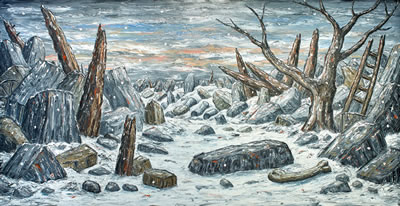
During the winter of 1989 Booth commenced his celebrated group of 'snow paintings'. Preceded by a series of wet and windy landscapes, the quiet chill of the snow paintings represented a transition in Booth's oeuvre, which he parallels to the journey in Milton's epic sequence of poems, Paradise Lost (1667) to Paradise Regained (1671). More specifically however, the series was inspired by the artist's re-reading of Shakespeare's Macbeth (1606) with its chilling themes of ambition and evil bearing resonance for Booth in contemporary Western greed, and its disregard for the planet. Accordingly, in many of these works, snow throws a white curtain of silence over the charred and blackened landscape, heralding the end of man's aggression towards his fellow man and the environment, like the omen of destruction foretold by the decimation of the forest of Biran in Macbeth.
As Jason Smith elucidates, 'for Booth, the winter landscape is one of serenity and the promise of renewal. It reminds us of the resilience of nature and is a metaphor for human endurance against the physical and psychological trials of life.'1 1.
Note:
1. Smith, J., 'Peter Booth: Human / Nature', in Peter Booth: Human / Nature, National Gallery of Victoria, Melbourne, 2003, p. 14-15