Peter Howson BIOGRAPHY
Artist Biography
Biography page for Peter Howson ((Born 1958)), known for Modernist figurative, portrait and landscape painting. Showing 2 biographical entries and 0 sample artworks.
Peter Howson - Artist Info
About Peter Howson
Biography from the Archives of askART
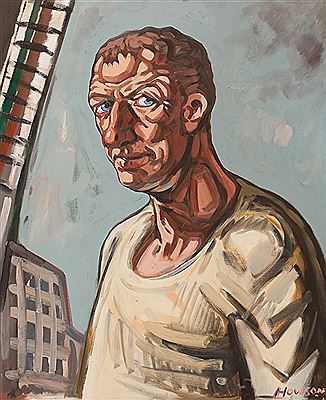
 Peter Howson was born in London in 1958 and moved to his adopted Scotland in 1962, where he studied at Glasgow School of Art (1975-7 and 1979-81). Alongside contemporaries such as Adrian Wiszniewski, Ken Currie and Stephen Campbell who were known collectively as the Glasgow Boys, Howson was one of the central figures in the school of Scottish figurative painting that rose to prominence in the 1980s.
Howson made his name with large format paintings showing massive, predominantly male figures portrayed in a bold, muscular style that used line and colour to powerful, expressive effect. The almost grotesque form of his overly-developed bodies was to become the focus of much of Howson's most lauded work. Howson's stated abhorrence of violent culture is reflected and often replicated in much of his work and there seems to be an intrinsic link between the potent, and sometimes literal, violence of his paintings and their depiction of muscle-bound monsters. His portrayals of Glasgow's down-and-outs and working class macho culture amidst the industrialized wasteland of Clydeside in the west of Scotland in the 1970s and 1980s gained him a vast amount of public and media attention. In The Scottish Trilogy (1987), for example, he combines national symbols such as Robert Burns, stags and a bottle of whiskey with images of squalor and depravity to demonstrate the gulf between perceptions of a mythical Scotland and the harsh contemporary reality. This bleak view was developed in several subsequent series, such as Blind Leading the Blind I-X (1991), which was inspired by the painting of the same name by Bruegel.
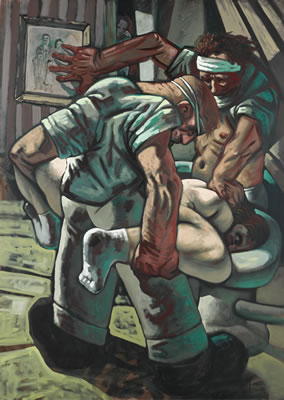
In 1993 Howson was appointed the Official British War Artist for Bosnia, and his visits to the region provided him with a highly charged subject matter that gave new ethical direction and motivation to his work. Among the paintings derived from this experience was Croatian and Muslim (1994), depicting two men raping a woman while pushing her head into a lavatory. This and other images of sexual violence and brutality opened up a lively debate as to what the role of the war artist should be. After being exhibited in London, the Bosnian collection was shown at the Paris Art Fair in 1997 to great acclaim.
In 1995, two years after his last Bosnia excursion, Howson was asked by John Cox, the director of Scottish Opera to create the set designs for Cox's own production of Mozart's Don Giovanni, which resulted in a uniquely dark production. In the same year, Howson was introduced to a television scriptwriter, Dean Lemmon, who was losing his battle with a particularly virulent form of AIDS-related cancer and asked Howson to paint a full size nude portrait to illustrate his final days. The stunning result has lead to Howson painting a number of portraits since, including one of former Celtic footballer Henrik Larsson and two nude studies of Madonna.
Following the success of his commission with Scottish Opera, Howson painted a series of seven canvasses based on Stravinsky's opera, The Rake's Progress. The paintings follow the life of the eponymous Tom Rake as he explores the seedier side of life, ending in his bankruptcy and eventual insanity. The first four pieces were a radical departure in style and introduced a more vivid palette to his work. The resulting show, held at Flowers East in London, opened in January 1996 to rave reviews, and lead to John McEnroe selecting a number of works to be exhibited at his own gallery in New York.
In 1998 he made a portfolio of 50 etchings, Undergound, that demonstrated his continuing interest in allegorical portraiture and reflected his life in the South of England following his move to London in 1994. He was awarded the Henry Moore Foundation Prize in 1988, the Lord Provost's Medal of Glasgow in 1995 and was made Doctor of Letters, Honoras Causa, by the University of Strathclyde in 1996.
Collections
Howson is represented in the following collections: National Galleries of Scotland, Edinburgh; Hunterian Museum and Art Gallery, University of Glasgow, Scotland; Tate Gallery, London, amongst others.
Source:
Sphinx Fine Art
http://www.sphinxfineart.com/Howson-Peter-DesktopDefault.aspx?tabid=45&tabindex=44&artistid=18824Biography from McTear's
Peter Howson OBE has established a formidable reputation as one of his generation's leading figurative painters. Many of his paintings derive inspiration from the streets of Glasgow, where he was brought up. He is renowned for his penetrating insight into the human condition and his heroic portrayals of the mighty and meek. His art is described by Robert Heller as "founded in humanity, especially the human face." Howson was born in London. He studied at Glasgow School of Art from 1975-1977, returning in 1979 to complete a Master's. In 1985, he was made the Artist in Residence at the University of St Andrews and also a part-time tutor at Glasgow School of Art. In 1992, he was commissioned by the Imperial War Museum to record the conflict in the former Yugoslavia. He was appointed official British war artist for Bosnia in 1993 and in 1996 was awarded Doctor of Letters Honoras Causa, University of Strathclyde. Before converting to Christianity in 2000, Howson responded to pain by pursuing hedonism. His experiences of abuse - whether self-inflicted and substance-related or the traumatic events of his childhood - have afforded him an affinity with those individuals who are classed as somehow 'on the edge'. His work has caught the attention of a number of prominent cultural figures, celebrities, and creatives, as well as striking a chord with prisoners, a voiceless demographic from whom Howson receives many letters of support. His ability to speak to the peripheries - to both the exclusive echelons living 'the highlife' and the socially alienated outsiders labelled 'low lives' - is proof of his enduring skill at capturing the maverick, excessive and non-conformist, while also seeking spiritual change. In 2011, Howson completed a dramatic rendering of the martyrdom of St John Ogilvie for the renovated St Andrew's Cathedral in Glasgow. The two-year process of working on the commission was the subject of a BBC documentary. In 2023, Howson was the subject of a major retrospective at the Edinburgh City Art Centre, When the Apple Ripens: Peter Howson at 65, a comprehensive overview of the artist's career. His work has been shown in major exhibitions globally, including Eye on Europe at the Museum of Modern Art, New York, and The Naked Portrait at the Scottish National Portrait Gallery in 2007. Public collections include: Aberdeen Art Gallery; Bankfield Museum, Halifax; British Broadcasting Corporation (BBC); British Council; British Museum, London; Cartwright Hall, Bradford, Christie?s Corporate Collection; City Art Centre, Edinburgh; City Art Gallery, Southampton; Contemporary Art Society; deYoung Museum of Fine Arts, San Francisco; Dundee Art Gallery; Eigsee Festival Collection; Fitzwilliam Museum, Cambridge; Glasgow Museums (Art Gallery and Museum, Kelvingrove); Glasgow Royal Concert Hall; Gulbenkian Collection, Lisbon; Hunterian Museum, Glasgow; Imperial War Museum, London; Isle of Man Arts Council; Kilmarnock and Loudoun District Museums; Library of Congress, Washington DC; Lloyds TSB Group plc, London; The Maclaurin Trust, Ayr; Metropolitan Museum of Art, New York; Ministry of Defence, London; Museum of Modern Art (MOMA), New York; National Gallery of Norway, Oslo; New York Library; Nottingham Castle Museum and Art Gallery; Paisley Art Gallery; Pallant House Gallery; Paul Mellon Centre; Yale University, Washington; People?s Palace Museum; Peter Scott Gallery; Lancaster University, Lancaster; The Fleming Collection, London; Royal Bank of Scotland (RBS); Scottish Amicable; Scottish Development Agency; The Arts Council of Great Britain; The Scottish Arts Council; The Scottish National Gallery of Modern Art, Edinburgh; Scottish Television (STV); Tate Gallery, London; University College of Wales, Aberystwyth; University of Salt Lake City; University of Strathclyde, Glasgow; Victoria & Albert Museum, London; Walker Art Gallery, Liverpool; The Jerwood Collection. Peter Howson's paintings hang in prestigious private and corporate collections worldwide, and his known celebrity buyers include Mick Jagger, Madonna, and David Bowie. "What an artist. They'll be talking about him in a hundred years" - Dr Bendor Grosvenor, art historian and TV Presenter. Britain's Lost Masterpieces?.