Page loaded successfully. Showing biography for Peter Madden.
Peter Madden BIOGRAPHY
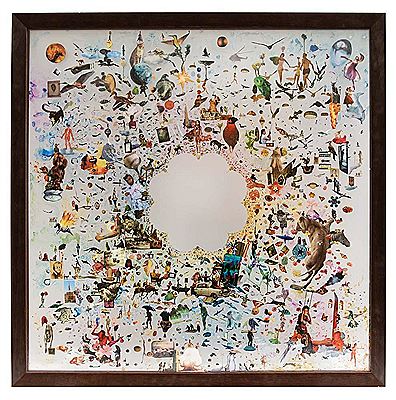
Born 1966 Napier. Known for: Art of collage, painting, organic sculpture.
The following information is from Google, 2025: . Peter Madden draws much of his imagery from old issues of National Geographic, plundering and reworking its discredited ’empire of signs’ to forge... Read full biography
The following information is from Google, 2025: . Peter Madden draws much of his imagery from old issues of National Geographic, plundering and reworking its discredited ’empire of signs’ to forge his own. His surrealistic pictures, objects, and installations have a watchmaker level of detail and... Read full biography
The following information is from Google, 2025: . Peter Madden draws much of his imagery from old issues of National Geographic, plundering and reworking its discredited ’empire of signs’ to forge his own. His surrealistic pictures, objects, and installations have a watchmaker level of detail and intensity. They have been described as ‘microcosms’ and ‘intricate kingdoms thick with flying forms’. A creator of metaphor-rich other-worlds, the New Zealand artist has one foot in the vanitas... Read full biography
The following information is from Google, 2025: . Peter Madden draws much of his imagery from old issues of National Geographic, plundering and reworking its discredited ’empire of signs’ to forge his own. His surrealistic pictures, objects, and installations have a watchmaker level of detail and intensity. They have been described as ‘microcosms’ and ‘intricate kingdoms thick with flying forms’. A creator of metaphor-rich other-worlds, the New Zealand artist has one foot in the vanitas still-life tradition and other in new-age spirituality. On the one hand, he is death-obsessed: a master of morbid decoupage. (Moths and butterflies—symbols of transient life—abound. His assemblages in bell jars suggest some Victorian taxidermist killing... Read full biography
The following information is from Google, 2025: . Peter Madden draws much of his imagery from old issues of National Geographic, plundering and reworking its discredited ’empire of signs’ to forge his own. His surrealistic pictures, objects, and installations have a watchmaker level of detail and intensity. They have been described as ‘microcosms’ and ‘intricate kingdoms thick with flying forms’. A creator of metaphor-rich other-worlds, the New Zealand artist has one foot in the vanitas still-life tradition and other in new-age spirituality. On the one hand, he is death-obsessed: a master of morbid decoupage. (Moths and butterflies—symbols of transient life—abound. His assemblages in bell jars suggest some Victorian taxidermist killing time in his parlour.) On the other hand, with his flocks, schools, and swarms of quivering animal energy, Madden revels in biodiversity.&n... Read full biography
Artist Biography
Biography page for Peter Madden ((Born 1966)), known for Art of collage, painting, organic sculpture. Showing 1 biographical entries and 0 sample artworks.
Peter Madden - Artist Info
About Peter Madden
Biography from the Archives of askART
 The following information is from Google, 2025:
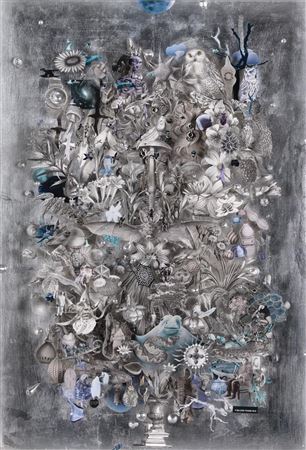
Peter Madden draws much of his imagery from old issues of National Geographic, plundering and reworking its discredited ’empire of signs’ to forge his own. His surrealistic pictures, objects, and installations have a watchmaker level of detail and intensity. They have been described as ‘microcosms’ and ‘intricate kingdoms thick with flying forms’. A creator of metaphor-rich other-worlds, the New Zealand artist has one foot in the vanitas still-life tradition and other in new-age spirituality. On the one hand, he is death-obsessed: a master of morbid decoupage. (Moths and butterflies—symbols of transient life—abound. His assemblages in bell jars suggest some Victorian taxidermist killing time in his parlour.) On the other hand, with his flocks, schools, and swarms of quivering animal energy, Madden revels in biodiversity. His works manage to be at once morbid and abundant, rotting and blooming, creepy and fey.
Following are questions by Robert Leonard about artist Peter Madden.
Robert Leonard:
How did the collage work start
Peter Madden
Peter Madden: My work changed dramatically as a result of going to New York in 1997. I saw how strong contemporary photography was and I saw a major Hannah Hoch retrospective at MOMA—it had great impact on me.1 I came back to New Zealand and began to rethink my work. The possibility of having a photographic practice through collage clicked into place. It just so happened that someone had left a box of National Geographics lying around and one night I started making collages out of them.
After being in New York, the heart of capitalism—after seeing the spectacle of modern and contemporary art first hand—the idea of focusing on something as shitty as National Geographic really appealed.?.?Did you have a relationship to National Geographic before this. When I was a child, an uncle gave me a subscription as a present. We didn’t have many books in our house, so for me those magazines were magical. Now I find it weird that New Zealanders valued National Geographic so highly that they wouldn’t throw their copies away.
Today, I can find forty-years-worth of back issues in second-hand shops to use. Over the years, National Geographic’s photographic style hasn’t changed much. National Geographic is all about photography’s power to control the gaze. Academics talk about the magazine in terms of the Western gaze, the paternalist gaze, the ethnographic gaze, and the capitalist gaze. When National Geographic photographers do a piece on peasants tilling the earth in some Third World country, what you don’t see is how they went there a few days earlier and arranged for the subjects to wear national dress. There’s a contrived authenticity.
Robert Leonard:
How did the collage work" start Do you see your work as working for, against, or alongside National Geographic’s ideological bias Are you enthusing over the magazine, critiquing it, or paralleling it??.?
Peter Madden
It’s a little bit of everything. I don’t think anyone would seriously rebuke National Geographic for doing its thing. It’s so benign, and so intimately linked into its own market and community. I certainly wouldn’t want to tell the magazine what to do. I enjoy reading it, I always have, and others do too. I’m not engaged in a deep, deconstructive, political critique. If anything, my work is a reter-ritorialisation. I liberate photographic fragments from their original snap-and-capture setting and reposition them in the space of art. It’s détournement, then. The photographs in National Geographic are ‘straight’—they are plain, literal, normative. Max Ernst and Hannah Hoch in their collages, and Rene Magritte in his paintings (which also have a collage logic), favour normative source images—often encyclopedia or catalogue illustrations. They play up a poetic possibility latent in those sources. You’re looking at something familiar, but it’s been made strange. Hopefully I do the same.
Robert Leonard
How do you describe yourself?
Peter Madden
I often introduce myself as a ‘post-photographer’ It seems like, whatever I do, I can’t avoid negotiating ‘the photograph’.
Robert Leonard:
What were your first collage works like
Peter Madden
They were small, simple, flat. There was lots of explicit conceptual play with holes, dislocation, and slippage. But, as I went on, the collages became less overtly conceptual, more intuitive, more poetic, more fun. The first proper show was at rm3 in 1999.2 I’d been making collages for a couple of years, but, because it was a project-space, I made an installation. On a tabletop, I created a field of collage sculptures. I cut around figures in the images and folded them up, separating them from their background, from their context. And there was a text border of folded-up letters, a quote from a poem by a local performance poet, David Hornblow.
I remember that installation. It had a sense of intricacy, intensity, accumulation, and abundance. It exceeded one’s ability to map it. It was ‘too much’.I like to make works where it seems that the impossible has become possible, where innumerable fragments are arranged in a crazy temporal symphony, and where I can explore photography’s limitlessness. In collage, there’s a play in time frames and discursive frames; images that belong to different discourses and historical moments come together in the same time and space.
Robert Leonard:
How did the collages on glass and perspex come about?
Peter Madden
The idea of working on a transparent ground came about by accident. A friend working at a framing shop gave me some glazed frames. I started using them as temporary supports for organising my collage elements before sticking them down on paper. Then it struck me—why not leave them on the glass. There, they could be themselves, floating free. I use perspex now, often several sheets. And I use packing to subtly change the depth of the elements. At a distance, the collage looks flat, but, up close, the space opens up. The first collages on glass featured chairs coming together in a somewhat sexual way and had titles such as Lovers, Come Together, We Must Meet, and Encounter. They were all about people connecting.
Robert Leonard:
Chairs feature a lot in your work—can you explain their significance.
Peter Madden
I’ve always seen them as framing devices for the body. They subtly control the body and its movement. The chair is where the body relaxes: you read in a chair, listen to lectures in a chair. I sit in a chair in my studio when I make my collages. So, in my works, the chairs are, in part, about me sitting in my studio, thinking, and making art. Tessa Laird has written on the psychedelic themes in your work.3 My works parallel the drug experience, like some forms of music do—say Hendrix or Can.?.?There’s a sense of psychedelic interconnectedness. I see them as psychedelic image orgasms.
That’s a nice way to experience them. But if there’s orgasm in my work, there’s also trauma. Perhaps there’s trauma in orgasm. Some works suggest a bad trip, monstrous things going down. Some works are certainly frightening. The drug experience can definitely be un-ravelling. But that’s okay. Having a hallucination where you’re covered in maggots is like watching a horror movie. It’s scary but you know it’s not going to last forever.
Robert Leonard:
You laugh at yourself because you know it’s not real. In your collage Shaman (2008), it’s like all the content of the world is passing through the central figure, like a whirlwind. It’s as if he’s channeling the entirety of the world. It could be a self-portrait.
Peter Madden
Shaman is about skin. There are lots of references to skins, and things being flayed and falling apart. That central flayed figure is a body plastinated by the German anatomist Gunther von Hagens. There are lots of clotheslines with clothes. And, of course, the photographic fragments I work with are another form of skin, a kind of memory skin.
Robert Leonard:
A lot of your works suggest folk cosmologies.?.?I have always been fascinated by certain writers who wanted to depict the world in unorthodox ways, like Jorge Luis Borges. He will represent animals, stack them, change them. He will say there is this society that presents their animals in such-and-such a way and they have a whole different taxonomy. That tells us that zoology isn’t neutral, it’s a construct. The way we view the natural world is a convenient form of domination.?.?Sometimes your works suggest ecological disaster, sometimes ecological overcoming. Your image fragments often seem to be in communication with one another, recalling the way birds instinctively fly in formation.
Peter Madden
The images have a rhythm. I group them to create undulating tensions, so they pull on and against one another. For example, I’ll have a group of fish all going one way (in reality, they are fish from different places on the globe) then I’ll transect it with a group of butterflies going another way. In Sleeps with Moths (2008), moths cover a human skeleton. Maggots are missing, but implicit. In that work, we’re looking at the magotting of an image. The maggots have consumed the flesh with their own ‘viewing’. Evil (2005) finds cut-out snakes flattened in a dictionary, perhaps escaping from it. It’s like the weight of words is flattening the snakes, in the way one presses flowers.
Robert Leonard:
What’s more evil, a snake or a dictionary?
Peter Madden
A dictionary. Dictionaries are evil because they presume to shore up ambiguity.
People default to the dictionary. That said, I used to like reading the dictionary, jumping from word to word. The snakes might be a subconscious reference to the snakes-and-ladders aspect of navigating the dictionary.
Robert Leonard:
Let’s talk about your Cities. Which was the first one.?
Peter Madden
It was The Unbuilt Realm of Indeterminapolis (2001–3). I wanted to develop a big idea over a long period of time, not unlike a writer developing a novel. When you take a couple of years to make a work, you have the opportunity to invest it with all these ideas. I greatly admire Maori architecture; the way the whare whakairo is based on an ancestral human body. So, I built my city as a body. There’s a definite head area, a torso, and a leg, and there are pools of resin that are like internal organs. There’s a cave at the back, like an anus. There’s lots of terracing—I was interested in the terracing in Maori pa sites. I included references to many types of architecture, including a slum and a cemetery.
Robert Leonard
Is Indeterminapolis a happy or unhappy place?
Peter Madden
It’s a happy place. It’s alive.
Robert Leonard
But elsewhere you’ve described it as a black hole.
Peter Madden
But black holes are amazing. I think a universe without black holes would definitely be an unhappy place. It’s interesting that cites are never complete; they’re constantly evolving and adapting. If an architect becomes all-powerful, they get to build their own complete city. It usually looks like a disaster zone. Le Corbusier’s city squares are now ghettos of inequity. No one wants to live in his concrete palaces; no one wants anything to do with them. I see grand architectural models, with all their utopian promises, as evil, more evil than The Evil Dead,4 which I actually find joyous, funny, full of life.
The Cities seem to be dead yet alive. They are black, skeletal structures, but teem with coloured, cut-out images.In the Cities, I try to contain as much difference as possible. I populate them with everything imaginable and unimaginable, as in a Borges story. A frog, a fish, a bird, a face on a pin, images of buildings wrapped around building structures, planes flying, planes crashing, planes burning, hummingbirds hanging on wires, cut-out paper flowers, headless people with snakes inserted. At one point, a flourish of whimsy; at another, something heavy. The works feel alive. You have the sense that, if you turn your back on them, things might move.?.
Robert Leonard
You use a Georges Bataille quote to describe your Cities.
Peter Madden
Bataille said, ‘To declare that the universe is not like anything, and is simply formless, is tantamount to saying the universe is something like a spider or spittle.’5 I like the way Bataille disengaged from received ideas. I use the latest photos from Hubble as my desktop wallpaper. They are deliciously informe.?.?How do the Cities differ from and relate to one another??.?Each has a different set of starting principles. With each new one, it’s almost as if another civilisation has come along or the next evolutionary cultural step has been taken. Indeterminapolis is like a crystal. Necrolopous (2004) is see-through, diaphanous, skeletal; it is about the wearing away of flesh.6 Small World View (2009) is about the consumption of resources when a city is made, so it is more dystopic, more keyed to contemporary ecological concerns. Photos of glaciers are wrapped around building shapes, like a skin. It’s tomb-like. It’s devoid of life, but, at the same time, represents I
Robert Leonard
In your Cities, building forms become supports for pictures, architecture gives way to image.
Peter Madden
In The Last City (2009–10), I’m interested in scenes of disaster and disaster architecture. There are photos of Chernobyl interiors, of ice floes, of volcanic explosions, of butterflies in cages. There are also images of things that are attempting to become structures, like Harold Edgerton’s iconic strobe-frozen milk-splash crown. I’ve used an image of a Robert Smithson mirror work from an IMA invitation7 because it combines the natural and the geometric, culture and nature, each reflected in and framed by the other.
I’m interested in Smithson’s ideas about entropy and ‘ruins in reverse’. There’s also a three-armed structure suggesting a construction tower, an oil rig, an antenna, a pylon, a crane. Paper spiders dangle from the tips. There are flat, cut-out paper chimneys that suggest fossil-fuel consumption. Each item can act as a marker for its own entanglement and disentanglement.?.?You seem to be one-part organiser, one-part disorganiser. With the collages, images are stuck in a fixed relation to one another, but, with The Last City, there’s a sense that the organisation is provisional, and the components are movable, like tokens …?.?… in a game.
Robert Leonard
It’s definitely got that going on. It’s like you’ve walked in on a game, with things that influence one another in a particular arrangement.
Peter Madden
There’s a lot of seriousness behind what I do, but I downplay it.
Sources include
1 Photomontages of Hannah Hoch, Museum of Modern Art, New York, 1997. 2 Plane of 1000 Cuts, Rm3, Auckland, 1995.
3 Tessa Laird, ‘The Living Dead’, Natural Selection (online magazine: www.naturalselection.org.nz), no. 2, Winter 2004.
4 The Evil Dead, 1981 (dir. Sam Raimi).
5 Georges Bataille, ‘Formless’ (1929), in ‘Critical Dictionary’, trans. Dominic Faccini, October, no. 60, Spring 1992: 27.
6 Aka Necrolopolous and Necropolis.
7 Peter Madden, Institute of Modern Art, Brisbane, 2010.
8 Escape from Orchid City, City Gallery Welling