Page loaded successfully. Showing biography for Peter Miller.
Peter Miller BIOGRAPHY

1913 - 1996. Known for: Abstract expressionist painting.
The following, submitted by Andrea Theisson, is a review of the exhibition, "Hyperallergic: Two More Women to Add to Modernism's History", at the Francis M. Naumann Fine Art, by John Yau, Janaury... Read full biography
The following, submitted by Andrea Theisson, is a review of the exhibition, "Hyperallergic: Two More Women to Add to Modernism's History", at the Francis M. Naumann Fine Art, by John Yau, Janaury 12-February 23, 2018:. A widely renowned expert on Marcel Duchamp and the many artists that he knew and... Read full biography
The following, submitted by Andrea Theisson, is a review of the exhibition, "Hyperallergic: Two More Women to Add to Modernism's History", at the Francis M. Naumann Fine Art, by John Yau, Janaury 12-February 23, 2018:. A widely renowned expert on Marcel Duchamp and the many artists that he knew and influenced, Naumann has analyzed specific chess games played by this enigmatic artist; written about the early, pre-modernist work of Man Ray; and contributed to our understanding of Beatrice Wood,... Read full biography
The following, submitted by Andrea Theisson, is a review of the exhibition, "Hyperallergic: Two More Women to Add to Modernism's History", at the Francis M. Naumann Fine Art, by John Yau, Janaury 12-February 23, 2018:. A widely renowned expert on Marcel Duchamp and the many artists that he knew and influenced, Naumann has analyzed specific chess games played by this enigmatic artist; written about the early, pre-modernist work of Man Ray; and contributed to our understanding of Beatrice Wood, who lived many lives — ceramicist, devotee of J. Krishnamurti, and co-editor, along with Duchamp and Henri-Pierre Roché, author of the novel, Jules and Jim (1956) and Wood’s lover, of the two issues of the art journal The Blind Man (1917). You may not... Read full biography
The following, submitted by Andrea Theisson, is a review of the exhibition, "Hyperallergic: Two More Women to Add to Modernism's History", at the Francis M. Naumann Fine Art, by John Yau, Janaury 12-February 23, 2018:. A widely renowned expert on Marcel Duchamp and the many artists that he knew and influenced, Naumann has analyzed specific chess games played by this enigmatic artist; written about the early, pre-modernist work of Man Ray; and contributed to our understanding of Beatrice Wood, who lived many lives — ceramicist, devotee of J. Krishnamurti, and co-editor, along with Duchamp and Henri-Pierre Roché, author of the novel, Jules and Jim (1956) and Wood’s lover, of the two issues of the art journal The Blind Man (1917). You may not agree with Naumann’s predilections, but you cannot doubt his passion. The title of the current exhibiti... Read full biography
Artist Biography
Biography page for Peter Miller ((1913 - 1996)), known for Abstract expressionist painting. Showing 3 biographical entries and 0 sample artworks.
Peter Miller - Artist Info
About Peter Miller
Name variants
Henrietta Myers Miller, Henrietta Myers
Biography from the Archives of askART
 The following, submitted by Andrea Theisson, is a review of the exhibition, "Hyperallergic: Two More Women to Add to Modernism's History", at the Francis M. Naumann Fine Art, by John Yau, Janaury 12-February 23, 2018:
A widely renowned expert on Marcel Duchamp and the many artists that he knew and influenced, Naumann has analyzed specific chess games played by this enigmatic artist; written about the early, pre-modernist work of Man Ray; and contributed to our understanding of Beatrice Wood, who lived many lives — ceramicist, devotee of J. Krishnamurti, and co-editor, along with Duchamp and Henri-Pierre Roché, author of the novel, Jules and Jim (1956) and Wood’s lover, of the two issues of the art journal The Blind Man (1917). You may not agree with Naumann’s predilections, but you cannot doubt his passion.
The title of the current exhibition at Francis M. Naumann "Fine Art caught my eye: Two Forgotten Women of American Modernism: Sculptor Mary Callery/Painter Peter Miller (January 12 – February 23, 2018). I quickly learned from Naumann that Peter Miller was the name Henrietta Myers (1913-1996) used when she showed her work, and that Mary Callery (1903-1977) occasionally showed under the name Meric Callery. An item on display in a vitrine was a gallery announcement for a group show that included the name Lenore Krasner on the list of artists.
While Callery and Miller are not considered major figures, their biographies and their indispensable work give anyone interested in modern art a lot to think about. And yet, as Naumann rightfully states in the gallery press release: “[…] with the exception of specialized studies in the field of mid-century American modernism, both artists are absent from historical records of the New York art scene in the mid-1940s. There are several reasons for these omissions, one of which may have been gender.” Their absence does not reflect well upon the city’s museums or their curators.
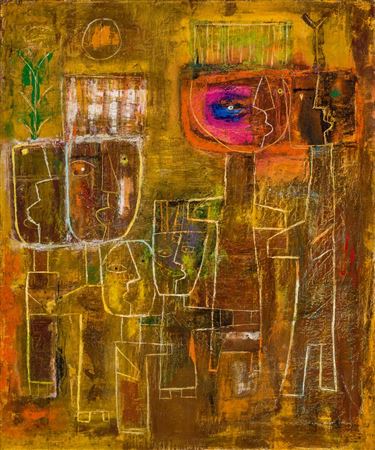
Miller is represented by 14 paintings dating between 1935 and 1950, the years in which Abstract Expressionism came to fruition. While a lot of attention has focused on the ascension of abstraction, Miller seems to have been enthralled with the work of Joan Miró, and eventually owned one, which she and her husband gave to the Philadelphia Museum of Art.
There is an early self-portrait that Miller did while she was studying at the Pennsylvania Academy of Fine Arts. She married in 1935 and traveled to Paris before World War II, where she and her husband met Ernest Hemingway, Henri Matisse and his son, Pierre, who had opened a gallery in New York, and Joan Miró.
After the war, Miller and her husband visited Barcelona once a year while dividing their time between Philadelphia and New Mexico. Matador (1935-1940) shows Miller absorbing Miró’s tightly constructed portraits in which all the parts vie for attention. One also senses that Miller is pushing toward something that is all her own.
It is hard to say whether she got there, since the show is a rather limited if intriguing group of works. Reef (ca. 1950) shows the influence of Max Ernst’s frottage paintings, such as The Entire City (1934). The outlier in all this is the painting Abstract (Orange) (ca. 1950), in which Miller depicts talismanic objects against an orange ground, presaging the work of Philip Taaffe after he went to Tunisia in 1986. I imagine that Miller did more paintings like this, and wonder what a show of them would look like. Abstract (Orange)”is unlike anything else that was being done at the time, and that alone makes it more than a curiosity.Biography from the Archives of askART
 Sometime in the early 1940s Henrietta Myers, an accomplished artist in painting and sculpture, married Earle Miller. Together they managed the family estate which in 1956 was incorporated as the Rock Raymond Farm. During these years, Earle (he did not like the name Charles) and Henrietta focused on creating art.
Henrietta, who painted under the name Peter Miller, was well known in New York art circles, and had numerous successful exhibitions. Earle created a number of truly remarkable lithographs in the 1930s and then focused on sculpture.
Both Earle and Henrietta were represented by the Hahn Gallery in Chestnut Hill, Philadelphia and the Kennedy Gallery in New York. Earle and Henrietta had no children. They used their significant affluence to purchase properties and amass a world-class art collection in Modern Art. The Miller Art Collection included several major Joan Miro paintings, including Still Life with Old Shoes (1937) and Still Life with Toy Horse (1920), and several Alex Calder paintings.
Sometime in the 1930s, the couple purchased a property near Santa Fe, New Mexico where they spent time with the lively artist community in that place and time. The New Mexico exposure was reflected in the Southwest influence in their respective art.
As the Miller’s approached old age in the late 1980s, they set out to protect the Rock Raymond Farm from development by donating the property to the Brandywine Conservancy.
Earle died in February 1991, but Henrietta continued with the family layers to complete the gift, then worth $4.35 million. To further protect the Farm, Henrietta purchased and donated an additional 230 acres to the Natural Lands Trust as a buffer zone.
The Rock Raymond Farm survives intact to this day as a model farm. Earle Miller’s lithographs, though extremely rare, survive in some of the finest museums in America.
Written and submitted by A. Rex Rivolo, Ph. D., Gallery ProfessionalBiography from Gratz Gallery & Conservation Studio
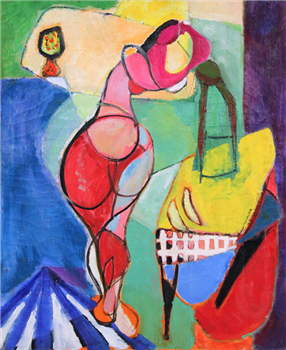 Peter Miller, born Henrietta Myers (1913–1996), was an American Modernist who, in the 1940s, showed at the prestigious gallery of Julien Levy in New York City, the premier showcase for Surrealism in America. Henrietta took an interest in art at a very early age and applied for study at the Pennsylvania Academy of the Fine Arts in Philadelphia. On her application form, she wrote “I would rather fail at painting than succeed at anything else”. Miller lived by these words and remained a dedicated painter throughout her life.
At the Academy, Myers studied under the American Impressionist Daniel Garber and, privately, with the Philadelphia modernist Arthur B. Carles. It was there that Henrietta met her future husband, C. Earle Miller, who was studying sculpture and printmaking. Upon the conclusion of their studies, Miller and Myers traveled to New Mexico. They both fell in love with the terrain and, having established a close relationship with the Native American population there, considered it their spiritual home for the remainder of their lives.
Henrietta changed her name to Peter, for she felt that collectors and critics would take her paintings more seriously if she were identified as male. She reportedly chose the name Peter because she liked the idea that it was derived from the Greek word for “rock” or “stone”. The first public showing of her pictures under this new name was at the Santa Fe Museum, today called the New Mexico Museum of Art.
It might have been through these early exhibitions in Santa Fe that Peter Myers and Earle Miller met and befriended the writer Edith Warner, a person who would remain one of their closest, lifelong friends. Warner ran a tearoom and restaurant near the Rio Grande that would later become a famous meeting place for scientists associated with the Manhattan Project in nearby Los Alamos. It was on her property in the summer of 1935 that Peter and Earle Miller married. A Native American from the San Ildefonso Pueblo, Tilano Montoya, officiated the ceremony. Warner had developed an intimate, lifelong relationship with Montoya, and it was through him that she and the Millers witnessed many performances, ceremonial dances, and spiritual rituals of Native American tribes in the region that would otherwise be closed to visitors outside of the Pueblo community.
In both Pennsylvania and New Mexico, Miller built studios, where at first she continued to be inspired by the modern European masters whose works she admired, particularly Paul Klee and Joan Miró. She and her husband often traveled to Europe, where-likely through letters of introduction from Carles-they met Pablo Picasso, Henri Matisse, and, most notably for her, Miró himself, the great Spanish Surrealist painter who would have a profound influence on her throughout the 1930s and 1940s, from his early Cubist-inspired paintings of the late teens, to the symbol-packed Surrealist landscapes. Many of her paintings from the 1930s also display the lingering influence of Arthur B. Carles.
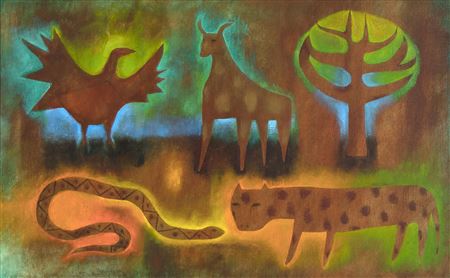
Her first show at the Julien Levy Gallery in 1944 was accompanied by a catalogue with an introduction by Robert Goldwater, a professor of art history at Queens. Goldwater not only pointed out the influence of Miró, but he quite accurately saw a connection between her paintings and the work of Native American artists. Noting that Miller successfully merged the Miró and Native American art influence, he wrote she “has taken the sophisticated shapes and given them a primitive setting.” He thought that Miller’s thin veils of paint evoked “the distant and absolute qualities of the Indian paintings. These pictures are not patterns,” he concluded, “but rather bring before us brilliant, symbolic creatures who move fluidly through an unending continuum.”
After Miller’s first show ended, a critic named Margaret Breuning, summarized her work as a “translation of fantasy and symbolism”. “Color is a particular asset in Miss Miller’s work,” she noted, “accentuating the linear patterns and giving congruency to designs, in a wide chromatic range that varies admirably with the particular theme.”
Critics of Miller’s second show at the Julien Levy Gallery in 1945 saw a clear departure from her earlier reliance upon the work of Klee and Miró. The critic Henry McBride was relieved to find that the influence of these European sources had dissipated. “Peter Miller is now entirely American, and Western American at that.”
Quite a few of Miller’s pictures feature snakes, turtles, lizards, and birds, animals considered sacred to Native Americans in the Southwest, who believed they could communicate with the gods of the underworld through these creatures. Serpents are animals used in rituals by the Pueblos of New Mexico, who performed famous snake dances, which were prayers for water. Miller thought of the creatures rendered in her paintings as much more than the mere depiction of animals, but just as the Native Americans considered them as a means by which to communicate with their deities, she understood their symbolic and spiritual significance.
Between her two shows at the Levy Gallery, Peter Miller was included in The Women, a show of thirty women artists held at Peggy Guggenheim’s Art of this Century Gallery in New York in June of 1945. Guggenheim was among the first to single out and champion the work of female artists, which would earn her the right to be claimed as among the first feminists in the art world.
With all the time that Peter Miller spent in New Mexico, it is hard to imagine that she was unaware of the Transcendental Painting Group, which was established in Albuquerque in 1938 by the artists Raymond Johnson and Emile Bisttram. As their name suggests and their manifesto stated, they strove “to carry painting beyond the appearance of the physical world, through new concepts of space, color, light and design, to imaginative realms that are idealist and spiritual.”
Although Miller received a fair amount of critical acclaim from her shows in New York, she slowly withdrew from the art scene there, preferring instead to spend more time communing with nature at her homes in Pennsylvania and New Mexico.
In the closing years of their lives, the Millers continued to show their work, but in exhibitions at galleries that were more local with a regional focus. She and her husband were given a joint exhibition at the Pennsylvania Academy of the Fine Arts in 1954.
In 1969, Peter Miller showed in an exhibition with Mark Tobey organized for the Peale Galleries of the Academy. In a review of this show, a journalist contacted Miller for a comment on her current work, and she responded: “I find myself going back to the same symbols that stirred the ancient rock painters,” she said. “The link with the past seems magical to me . . . to find yourself free in paint to move backward or forward in time is a marvelous excitement.” Indeed, many of Miller’s paintings from the 1960s and 1970s display a reliance upon the symbolic content of her earlier work, taking on a new power and transcendence, becoming noticeably larger and more colorful. One called The Alchemist’s Dream from the 1960s measures 6-by-8 feet. The electrifying tones are ideal to symbolically represent the chemistry that must take place for the alchemist’s dream to come true.
Alchemy is a medieval pseudoscience that, among other things, concerned itself with the transformation of base metals into gold, as well as an attempt to find a universal elixir of life. The subject of ancient civilizations must have been important to Miller, for a number of her paintings from the 1960s and 1970s illustrate tools and various artifacts that appear to have been unearthed from an archaeological dig.
As she approached the final decades of her life, Miller exhibited her work rarely, yet she continued to maintain a studio and actively painted well into her seventies. To those who knew her well, she shared her devotion to an almost mystical spiritualism, yet she remained staunchly individualistic, possessed with a boundless enthusiasm for life and her generosity was seemingly limitless.
Excerpt from: “Peter Miller, Forgotten Woman of American Modernism”. - Francis M. Naumann – Art Historian