Page loaded successfully. Showing biography for Philip Russell Goodwin.
Philip Russell Goodwin BIOGRAPHY
1881 Norwich, Connecticut - 1935 Mamaroneck, New York. Known for: Animal, field-stream illustration.
Philip R. Goodwin (1881-1935). Excerpt from The American West Reimagined (2021). By Dr. Larry Len Peterson. The release of one of the greatest and most endearing publications in American history,... Read full biography
Philip R. Goodwin (1881-1935). Excerpt from The American West Reimagined (2021). By Dr. Larry Len Peterson. The release of one of the greatest and most endearing publications in American history, Call of the Wild, in July 1903 would have a profound effect on the career of Charles M. Russell, even... Read full biography
Philip R. Goodwin (1881-1935). Excerpt from The American West Reimagined (2021). By Dr. Larry Len Peterson. The release of one of the greatest and most endearing publications in American history, Call of the Wild, in July 1903 would have a profound effect on the career of Charles M. Russell, even though he had nothing to do with it. Who illustrated the book? Not Frederic Remington and not Carl Rungius. No, it was illustrated by a twenty-two year old wunderkind named Philip R. Goodwin who had... Read full biography
Philip R. Goodwin (1881-1935). Excerpt from The American West Reimagined (2021). By Dr. Larry Len Peterson. The release of one of the greatest and most endearing publications in American history, Call of the Wild, in July 1903 would have a profound effect on the career of Charles M. Russell, even though he had nothing to do with it. Who illustrated the book? Not Frederic Remington and not Carl Rungius. No, it was illustrated by a twenty-two year old wunderkind named Philip R. Goodwin who had just opened his New York City studio. Jack London’s novel Call of the Wild was an overnight sensation. The book earned him international acclaim, and royalties from his novels made him the highest paid author in America to date. With an impressive... Read full biography
Philip R. Goodwin (1881-1935). Excerpt from The American West Reimagined (2021). By Dr. Larry Len Peterson. The release of one of the greatest and most endearing publications in American history, Call of the Wild, in July 1903 would have a profound effect on the career of Charles M. Russell, even though he had nothing to do with it. Who illustrated the book? Not Frederic Remington and not Carl Rungius. No, it was illustrated by a twenty-two year old wunderkind named Philip R. Goodwin who had just opened his New York City studio. Jack London’s novel Call of the Wild was an overnight sensation. The book earned him international acclaim, and royalties from his novels made him the highest paid author in America to date. With an impressive career ahead of him, which included illustrating African Game Trails (1909) by Theodore Roosevelt an... Read full biography
Artist Biography
Biography page for Philip Russell Goodwin ((1881 - 1935)), known for Animal, field-stream illustration. Showing 6 biographical entries and 0 sample artworks.
Philip Russell Goodwin - Artist Info
About Philip Russell Goodwin
Biography from the Archives of askART
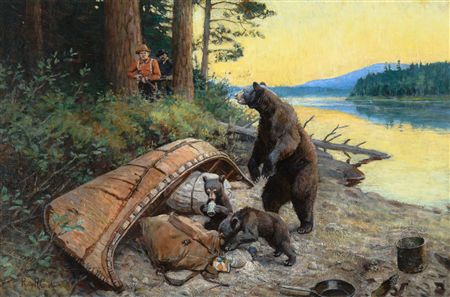 Philip R. Goodwin (1881-1935)
Excerpt from The American West Reimagined (2021)
By Dr. Larry Len Peterson
The release of one of the greatest and most endearing publications in American history, Call of the Wild, in July 1903 would have a profound effect on the career of Charles M. Russell, even though he had nothing to do with it. Who illustrated the book? Not Frederic Remington and not Carl Rungius. No, it was illustrated by a twenty-two year old wunderkind named Philip R. Goodwin who had just opened his New York City studio. Jack London’s novel Call of the Wild was an overnight sensation. The book earned him international acclaim, and royalties from his novels made him the highest paid author in America to date. With an impressive career ahead of him, which included illustrating African Game Trails (1909) by Theodore Roosevelt and hundreds of sporting art images—one of the most famous being the Winchester Horse and Rider (1919) logo—Goodwin would be one of the artists that greatly influenced Charles M. Russell for the rest of his career.
Philip Russell Goodwin was born on September 16, 1881—not 1882 as often erroneously written—in Norwich, Connecticut. Early on he was recognized as a child prodigy attending the prestigious Rhode Island School of Design when he was only fourteen. He soon caught the eye of America’s most famous illustrator, Howard Pyle, who taught such greats as Maxfield Parrish, N.C. Wyeth, Harvey Dunn, Frank Schoonover, W.H.D. Koerner, and Frank Stick. Pyle started the Brandywine School in Chadds Ford, Pennsylvania where many of the great illustrators would study over the years. Goodwin was training there as a teenager ahead of N.C. Wyeth.
Casper Whitney who took over the position of publisher and editor of Outing magazine in 1901 soon commissioned young Goodwin to paint a dozen illustrations for several articles. It was Goodwin who introduced Russell to Whitney, who immediately became a big supporter of the cowboy artist. Goodwin accepted an invitation by the Russells to visit them at Bull Head Lodge in Glacier National Park in Montana in the summer of 1907. By that time the young New Yorker had illustrated a dozen books—including the Call of the Wild; dozens of magazine articles; three covers of the great magazine of the day, The Saturday Evening Post; and sporting advertisements for Harrington and Richardson Arms Company; Kemper Thomas Company; Marble Arms and Manufacturing Company; Marlin Firearms Co.; Peters Cartridge Company; Savage-Stevens; and Winchester Repeating Arms Company. Amazingly, he was only twenty-five years old.
The two artists painted outdoors together for the first time. Lacking formal training, Russell learned much from his younger counterpart as evidenced by masterpieces he generated during the next few years. By the time Goodwin returned in 1910, he had illustrated African Game Trails (1909) by the most famous and popular man in the world, Theodore Roosevelt who called on the best sporting artist in America known for his ability to capture arrested motion. Goodwin would never visit Montana again, although the artists corresponded on occasion.
In 1911 Goodwin spent six weeks in the Canadian Rockies with Carl Rungius who was generally regarded as the most accomplished big game painter. Like Goodwin, Rungius relied on sketches and field photography to lend detail to paintings completed back in the studio. In August 1911 Rungius invited Goodwin to join him and guide Jimmy Simpson on a hunting and sketching trip. As was the case with Russell, Rungius’s paintings were transformed by his time with Goodwin.
National advertising flourished after the war during the roaring twenties as Americans confidently acquired material possessions and had the leisure time to use them. Advertising men answered new desires by establishing brand names that delicately encouraged dissatisfaction with possessions seemingly outmoded but not necessarily worn out. It was the beginning of a golden period for sporting illustration that kept Goodwin busy for years. His work landed on calendars, envelopes, posters, prints, magazine covers, die cut counter top displays, among many other items.
But happy days were over in the 1930s as the Great Depression ravaged almost every American home. In 1912 Goodwin had relocated to Mamaroneck, New York. Eight years later, he moved to another home with a studio located behind it. A life-long bachelor, Goodwin was joined by his mother who lived with him until her death. The Depression battered gun sales. Guns were no longer the tools of sportsmen, but were perceived as tools of war and cruelty. Advertisers only wanted Goodwin’s works that emphasized conservation, fishing, fire prevention, and fun and work in the great outdoors. And they didn’t pay much. The end came on a chilly December 13 day when Goodwin died of pneumonia at the Port Chester Hospital at Port Chester, New York. He was only fifty-four years old.
Few artists have had the resurgence in popularity that Goodwin has enjoyed. The interest in his art—from collectors of sporting art, Western art, and illustrations—has skyrocketed. For example, the National Cowboy and Western Heritage Museum in 2000 celebrated “The Year of the Cowboy” and chose Goodwin’s 1910 oil masterpiece, When Things Are Quiet—a scene of a cowboy with wooly chaps laying on a hill side next to his horse gazing over the cattle in the valley below—on their commemorative poster. Still, another tribute to the genius of Philip R. Goodwin, rightly titled, “America’s Sporting and Wildlife artist.”Biography from the Archives of askART
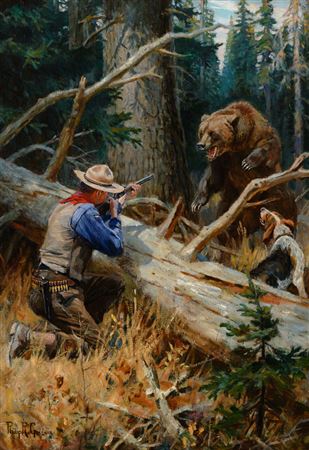 Known for his illustrations of hunting, fishing, and cowboy scenes, especially scenes featuring firearms, Philip R. Goodwin was from Norwich, Connecticut. By the age of eleven, he had already sold his first illustrations to Collier's magazine. He was educated at the Rhode Island School of Design in Providence and the Art Students' League in New York. He also studied with Howard Pyle in Pennsylvania. His works exhibit much of Pyle's earnestness and discipline, but are restricted almost entirely to subjects of hunting and fishing. In this limited area, however, he produced many notable pictures, the subject matter always convincing and dramatic in color.
In his early twenties, he established a studio in New York and met Charles Russell, whose paintings of western subjects provided a great influence on Goodwin's work in that genre. Goodwin's interest in scenes of cowboys and ranch life is evident in Bronco Buster. The two men traveled together on several occasions, sketching source material for their paintings. Meanwhile, Goodwin appeared in such books as Jack London's Call of the Wild.
Goodwin's pictures were also published in Harper's Monthly and Weekly, Outing, Scribner's, and Everybody's magazines, in addition to calendar subjects for Brown & Bigelow, advertising for Winchester Arms and the Marlin Firearms Company. He also illustrated African Game Trails for Theodore Roosevelt. Goodwin's interest in Charles Russell is seen not only in Goodwin's use of bright, vivid colors, but also in the romanticized subject matter, which appears to celebrate the bonding of rider and mount.
(Information on the biography above is based, in part, on writings from the book, The Illustrator in America, 1880 1980, A Century of Illustration, by Walt and Roger Reed.)Biography from American Illustrators Gallery
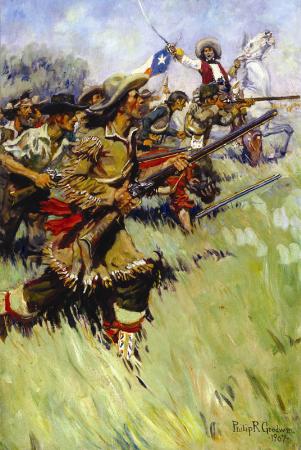 Art consumed Phillip R. Goodwin as a youngster in Norwich, Connecticut. Like other child prodigies who grew up to became professional illustrators, Goodwin sold his first drawing before he was a teenager. At eleven years old, he sold an illustration to Collier's magazine. His proud parents could not believe such early successes and did not wish to stifle his development. Because of his obvious talents, they enrolled him to study at the prestigious Rhode Island School of Design, and later at the Art Students League in New York.
Still later, Goodwin realized that he wanted to become a professional illustrator and that the best place was to study under his idol, Howard Pyle at Drexel Institute in Philadelphia (1899-1900). Pyle was quite impressed with his abilities and attitude and invited him to study further in Wilmington (1901-1903).
Goodwin was a good student with earnest intentions, and Howard Pyle's influence upon him was predictable because Goodwin learned well from the master. He subscribed to Pyle's notion that the artist should travel to those places you would illustrate in order to gain insights and an empathy with the environment.
Another Pyle axiom was to picture your models in authentic costume, and in both cases, Philip R. Goodwin was an exemplary student for he followed rules from The Father of American Illustration, explicitly. During his time in Wilmington, Goodwin grew very close to Pyle, and was one of the most exemplary students.
His commitment and response to Pyle was appreciated by the teacher. As a reward for his loyalty and enthusiasm for illustration, Goodwin was invited to Pyle's fiftieth birthday party. A great honor indeed.
Although he grew up in New England, like so many young men of his generation, Goodwin had a special love for the wild west and for scenes depicting cowboys and Indians, wildlife and hunting, and fly-fishing in particular.
When Goodwin launched his career, he opened a studio in New York City at the time when it seemed a great dichotomy to love the outdoor life, but to settle in the nation's busiest, bustling metropolis. Nethertheless, his talent, genuineness, and perseverance sustained him, and soon Goodwin's illustrations were being published in the most popular magazines including Everybody's, Harper's Monthly and Harper's Weekly, Outing, Persimmon Hill Magazine and Scribner's.
Brown & Bigelow, the nation's largest calendar publisher, published Goodwin's calendars, and he received advertising commissions from major firearms companies including the two biggest manufacturers, Winchester Arms and the Marlin Firearms Company.
His success brought him to the attention of the best book publishers, and he illustrated notable books for the most celebrated authors, such as Call of the Wild by Jack London, and Theodore Roosevelt's African Game Trails, and his career thrived with both critical and popular enthusiasm.
©2004 National Museum of American IllustrationBiography from Coeur d’Alene Art Auction
 Philip Goodwin was born in Norwich, Connecticut in 1881. Sketching was a consuming childhood pastime. He was eleven when he sold his first illustrated story to Collier's"magazine. At seventeen he was a promising student of Howard Pyle at the Brandywine School at Chadds Ford, Pennsylvania, and a classmate of N.C. Wyeth and Frank Schoonover. He later attended the Rhode Island School of Design. Goodwin was also a member of the Art Students League in New York.
While still in his twenties, he became friends with Carl Rungius and Charles Russell, when all three artists maintained studios in close proximity in New York City. Thereafter, whenever possible, Goodwin spent his summers in the West. Probably influenced by Russell, Goodwin became adept at sculpting. After Russell's death, Goodwin helped Nancy Russell assemble the book of her husband's letters, Good Medicine, which contains three of Russell's illustrations to Goodwin.
Sportsmen remember Philip Goodwin's large calendar prints, usually "predicament" paintings, which hung in mercantile establishments across the country during the twenties and thirties. There were also covers for Outdoor Life and Saturday Evening Post and advertising posters for Remington Arms and Winchester Arms. A very special painting, Horse and Rider, became the trademark of the Winchester Company.
Goodwin never married; his lifelong commitment was to the field of illustration. In addition to commercial advertising commissions, he painted for a goodly number of leading authors. Notable among the many books that he illustrated were Call of the Wild"by Jack London and African Game Trails by Theodore Roosevelt.Biography from Altermann Galleries and Auctioneers, II
Born: Norwich, Connecticut 1882
Died: Mamaroneck, New York 1935
Eastern illustrator of the outdoors, painter
Philip R. Goodwin was a student of the Rhode Island School of Design, the Howard Pyle School, and the Art Students League. His specialty was the outdoors, particularly hunting and fishing. He is also listed among the artists who successfully depicted the ranch life of the cowboy.
Persimmon Hill Magazine has reproduced on its cover Goodwin's 1910 When Things Are Quiet, noting that Goodwin's cowboy paintings were influenced by Charles Russell. Goodwin, one of the few New Yorkers Russell liked, visited Russell at the Lazy Kentucky ranch, and at the Bull Head Lodge. During the Depression, Goodwin's saving bank failed, causing serious financial distress. The only important work he had was fun ads and calendar art. His friends felt his worries caused his early death. A few months after his death, Goodwin was rediscovered as an artist. In his estate, however, there were only a few landscapes and the small "comp" sketches prepared for commissions sought, his illustrations having been to order and held by the customers.
Resource: SAMUELS' Encyclopedia of ARTISTS of THE AMERICAN WEST,
Peggy and Harold Samuels, 1985, Castle PublishingBiography from The Coeur d' Alene Galleries L.L.C.
Philip Goodwin specialized in paintings depicting hunting, fishing, and cowboys of the west. He was influenced by C.M. Russell and visited the great artist on occasion. He studied at the Rhode Island School of Design and his illustrations appeared in many publications.