Page loaded successfully. Showing biography for Raimonds Staprans.
Raimonds Staprans BIOGRAPHY

1926 Riga, Latvia - 2026 San Francisco, California. Known for: Abstract imagery-still life painting, sculpture.
Raimonds Staprans, a distinguished Latvian-American artist and playwright, passed away on January 29, 2026, at the age of 99. Known for his vibrant still lifes and landscapes, Staprans also gained... Read full biography
Raimonds Staprans, a distinguished Latvian-American artist and playwright, passed away on January 29, 2026, at the age of 99. Known for his vibrant still lifes and landscapes, Staprans also gained recognition for his plays that often explored the complex history of his native Latvia. His unique... Read full biography
Raimonds Staprans, a distinguished Latvian-American artist and playwright, passed away on January 29, 2026, at the age of 99. Known for his vibrant still lifes and landscapes, Staprans also gained recognition for his plays that often explored the complex history of his native Latvia. His unique artistic style, characterized by bold colors and flattened perspectives, created a compelling tension between representation and abstraction. Born in Riga, Latvia, on October 13, 1926, Staprans' early... Read full biography
Raimonds Staprans, a distinguished Latvian-American artist and playwright, passed away on January 29, 2026, at the age of 99. Known for his vibrant still lifes and landscapes, Staprans also gained recognition for his plays that often explored the complex history of his native Latvia. His unique artistic style, characterized by bold colors and flattened perspectives, created a compelling tension between representation and abstraction. Born in Riga, Latvia, on October 13, 1926, Staprans' early life was marked by the turmoil of World War II. He and his family fled Latvia in 1944, eventually immigrating to the United States in 1947. He pursued his artistic education at the University of Washington and later earned a Master of Fine Arts from... Read full biography
Raimonds Staprans, a distinguished Latvian-American artist and playwright, passed away on January 29, 2026, at the age of 99. Known for his vibrant still lifes and landscapes, Staprans also gained recognition for his plays that often explored the complex history of his native Latvia. His unique artistic style, characterized by bold colors and flattened perspectives, created a compelling tension between representation and abstraction. Born in Riga, Latvia, on October 13, 1926, Staprans' early life was marked by the turmoil of World War II. He and his family fled Latvia in 1944, eventually immigrating to the United States in 1947. He pursued his artistic education at the University of Washington and later earned a Master of Fine Arts from the University of California, Berkeley. His artistic journey was deeply influenced by his experiences and his keen observation of li... Read full biography
Artist Biography
Biography page for Raimonds Staprans ((1926 - 2026)), known for Abstract imagery-still life painting, sculpture. Showing 3 biographical entries and 0 sample artworks.
Raimonds Staprans - Artist Info
About Raimonds Staprans
Name variants
Raimonds Strapans
Biography from the Archives of askART
 Raimonds Staprans, a distinguished Latvian-American artist and playwright, passed away on January 29, 2026, at the age of 99. Known for his vibrant still lifes and landscapes, Staprans also gained recognition for his plays that often explored the complex history of his native Latvia. His unique artistic style, characterized by bold colors and flattened perspectives, created a compelling tension between representation and abstraction.
Born in Riga, Latvia, on October 13, 1926, Staprans' early life was marked by the turmoil of World War II. He and his family fled Latvia in 1944, eventually immigrating to the United States in 1947. He pursued his artistic education at the University of Washington and later earned a Master of Fine Arts from the University of California, Berkeley. His artistic journey was deeply influenced by his experiences and his keen observation of light and color.
Staprans' career spanned over six decades, during which he exhibited his work in numerous prestigious galleries and museums, including the San Jose Museum of Art, the Crocker Art Museum, and the Latvian National Museum of Art. His paintings are held in major public collections, such as the Fine Arts Museums of San Francisco and the Los Angeles County Museum of Art. His artistic achievements were recognized with Latvia's highest civilian honor, the Order of the Three Stars, in 2003.
Beyond his visual art, Staprans was also a prolific playwright. His plays, often set against the backdrop of Latvia's turbulent 20th-century history, delved into themes of truth, fiction, and totalitarianism. His 1989 play, "Four Days in June," was particularly influential in supporting Latvia's pro-democracy movement. Staprans lived in San Francisco, California, with his wife, Ilona, and is remembered for his significant contributions to both the art world and the cultural landscape of Latvia.
Source: MemoriTree WebsiteBiography from LewAllen Galleries
 Bay Area artist Raimonds Staprans was born in 1926 in Riga, Latvia. Fleeing a Soviet invasion in 1947, Staprans immigrated to America. Along with his family, he settled in Washington, where he enrolled at the University of Washington, Seattle. In 1954, he went on to earn his MA at the University of California, Berkeley. There he studied under the Abstract Expressionist painter Hans Hofmann.
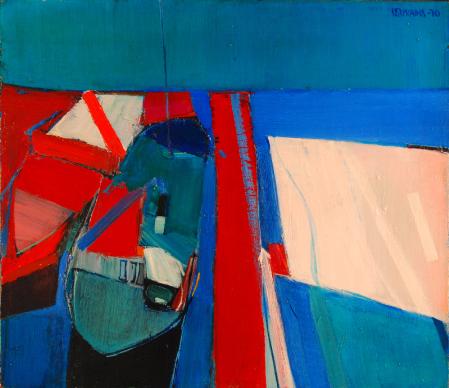
Staprans is an abstract painter whose compositions are minimalist in both concept and execution. Though grouped with the Bay Area Figurative painters, Staprans' style is more akin to the geometric abstractions of de Staël and Piet Mondrian. Nonetheless, the tension between representation and abstraction is the key to understanding Staprans' work. This tension arises from Staprans' need to impose order on a chaotic world, while acknowledging the disorder of personal experience. His oeuvre is comprised predominantly of landscapes and still lives. The figure almost never appears in his paintings; rather, narrative and temporal reality are left to the page.
In addition to being a painter, Staprans is an active teacher whose colleagues include Richard Diebenkorn and Wayne Thiebaud. An accomplished playwright, his most famous play, The Freezing, earned him Latvia's highest civilian honor in 2003: the Three Star Medal. Set in 20th century Latvia, The Freezing explores the nature of human relationships under Latvia's totalitarian regime. Correspondingly, his nudes reflect the existential despair that permeates his written work. They are - in essence - a form of self-representation that synthesize the defining characteristics of Staprans' oeuvre: Latvian nationalism, figuratively-based abstraction, and psychological expression.
His work can be found in the collections of many prominent institutions, including the Museum of Fine Arts, Houston; Phoenix Art Museum, AZ; Portland Art Museum, OR; Los Angeles County Art Museum, CA; Fine Art Museums of San Francisco, CA; and the State Museum of Art, Riga, Latvia. In 2006, the Pasadena Museum of California Art held a traveling retrospective.Biography from Hackett-Freedman Gallery
Raimonds Staprans (b. 1926 -)
He is a painter whose still life and landscape compositions explore color and form by examining the geometry or 'architecture' of everyday objects—chairs, tables, fruit, anonymous buildings—and subverting their inherent naturalism via color and flattened compositions. Rigorous geometry and a strong line are hallmarks of Staprans's painting. Though superficially associated with the paintings of Wayne Thiebaud, due to similar subject matter and a high-keyed "California" palette, Staprans' work is more akin to the formal abstractions of painters Josef Albers and Piet Mondrian.(1) Staprans himself has stated that he is "an abstract painter whose objects are recognizable and sometimes quite realistic, but [in reality] they are all … constructed from the ground up in absolutely abstract terms."(2)
An accomplished playwright, Staprans' writing explores the tension between fact and fiction, totalitarian 'reality' and human truth, set against his Latvian homeland's 20th-century history. His play Cetras dienas junija (Four Days in June), about the last days in office of pre-Soviet occupation President Karlis Ulmanis was a cultural and political watershed in Latvia in the late 1980s and played an important role in the country's democratic revolution in the early 1990s. In 2003, Staprans was awarded Latvia's highest civilian honor, the Three Star Medal, the equivalent of the United States's Presidential Medal of Freedom.
Raimonds Staprans immigrated with his family to America in 1947 after fleeing the Soviet invasion of Latvia. He studied art at the University of Washington under Alexander Archipenko and Mark Tobey, he obtained his master's degree at UC Berkeley where he studied with Hans Hofmann. His work is held in the permanent collections of the Museum of Fine Arts, Houston; the Fine Arts Museums of San Francisco; the Los Angeles County Museum of Art; and the San Jose Museum of Art, among others. The University of Washington Press published a full-color monograph on Staprans' career in 2005, which was followed by a retrospective exhibition at the Pasadena Museum of California Art in early 2006.
1. Michael Duncan, "Raimonds Staprans: The Philosophy of On, Under, Nearby, and Through" in Raimonds Staprans (San Francisco: Hackett-Freedman Gallery, 2003) 2. Interview with art historian Paul J. Karlstrom for the Smithsonian Archives of American Art.