Page loaded successfully. Showing biography for Ralph Balson.
Ralph Balson BIOGRAPHY
1890 - 1964. Known for: Painting.
Until the end of his life, Ralph Balson remained a highly ambitious painter. Throughout his career Balson was not satisfied in working exclusively towards producing a commercially popular style of... Read full biography
Until the end of his life, Ralph Balson remained a highly ambitious painter. Throughout his career Balson was not satisfied in working exclusively towards producing a commercially popular style of painting. Instead he restlessly strove to interpret the experience of modernity. In 1963 and 1964 he... Read full biography
Until the end of his life, Ralph Balson remained a highly ambitious painter. Throughout his career Balson was not satisfied in working exclusively towards producing a commercially popular style of painting. Instead he restlessly strove to interpret the experience of modernity. In 1963 and 1964 he re-examined several of his earlier painting styles including his Non-Objective series. In 1955 when Balson turned 65 years of age he left his home in suburban Pagewood and relocated his studio to a... Read full biography
Until the end of his life, Ralph Balson remained a highly ambitious painter. Throughout his career Balson was not satisfied in working exclusively towards producing a commercially popular style of painting. Instead he restlessly strove to interpret the experience of modernity. In 1963 and 1964 he re-examined several of his earlier painting styles including his Non-Objective series. In 1955 when Balson turned 65 years of age he left his home in suburban Pagewood and relocated his studio to a converted double garage located on the property of fellow artist, Grace Crowley. For the previous twenty years Balson's works were almost exclusively geometric in style and belong to what art historians refer to as his Constructive paintings. Balson's... Read full biography
Until the end of his life, Ralph Balson remained a highly ambitious painter. Throughout his career Balson was not satisfied in working exclusively towards producing a commercially popular style of painting. Instead he restlessly strove to interpret the experience of modernity. In 1963 and 1964 he re-examined several of his earlier painting styles including his Non-Objective series. In 1955 when Balson turned 65 years of age he left his home in suburban Pagewood and relocated his studio to a converted double garage located on the property of fellow artist, Grace Crowley. For the previous twenty years Balson's works were almost exclusively geometric in style and belong to what art historians refer to as his Constructive paintings. Balson's dramatic break with his earlier geometric style allowed him to embrace... Read full biography
Artist Biography
Biography page for Ralph Balson ((1890 - 1964)), known for Painting. Showing 1 biographical entries and 0 sample artworks.
Ralph Balson - Artist Info
About Ralph Balson
Biography from Bonhams Australia
Until the end of his life, Ralph Balson remained a highly ambitious painter. Throughout his career Balson was not satisfied in working exclusively towards producing a commercially popular style of painting. Instead he restlessly strove to interpret the experience of modernity. In 1963 and 1964 he re-examined several of his earlier painting styles including his Non-Objective series.
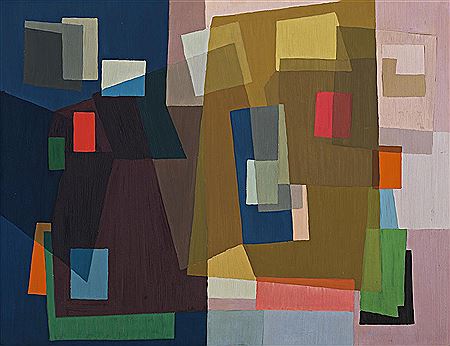
In 1955 when Balson turned 65 years of age he left his home in suburban Pagewood and relocated his studio to a converted double garage located on the property of fellow artist, Grace Crowley. For the previous twenty years Balson's works were almost exclusively geometric in style and belong to what art historians refer to as his Constructive paintings. Balson's dramatic break with his earlier geometric style allowed him to embrace a new found freedom of expression through the exploration of a loose gestural style of abstraction mirroring the increasingly liberated atmosphere of the post-war world. Balson viewed the soft dappled light and shadows of Crowley's garden as a visual template for his philosophical interests that included notions of impermanence, change and relativity. For Balson and his fellow non-objective painters, the critical limitation of figurative painting was something he aimed to avoid. By analyzing the formal structure of abstract painting Balson invented a new type of visual language that could engage the physical world in a non-literal way. Superficially the fields of bright spotted color forming vertical striations in the painting might resemble the patterns of nature found in Crowley's garden, but for Balson the significance of these forms exist in their ability to represent the invisible laws that govern nature.
From the mid-1950s until the end of his life Balson developed a fascination with the underlying existential stream of consciousness found in the writings of James Joyce. This literary influence combined with an interest in Einstein's theory of relativity is what directed Balson to produce his Non-Objective works. For Balson an awareness of the contingency of life enabled him to develop a painting style that portrayed the rhythms of flux and change. By combining artists' oil paints and domestic enamels, Balson explored a medium enabling him to produce works containing an overwhelming sense of fluidity and freedom.
Until the early 1990s, Balson's paintings were only known among a small group of curators and intellectuals to whom he remained an important figure. After Balson's death in 1964, many of his works were packed up into cardboard boxes and taken to a storage shed at Gallery A, in Sydney. Over the next five years these paintings formed the basis of three Memorial Exhibitions, the last of which was held in 1969, when and where the collector and gallerist Ann Lewis purchased this work. In 1989 Bruce Adams curated the influential touring exhibition Ralph Balson: a retrospective, which included this work; and as a result of this exhibition, the significance of Balson's work has become widely acknowledged in Australian art.
Dr Christine Dean