Page loaded successfully. Showing biography for Ralph Rosenborg.
Ralph Rosenborg BIOGRAPHY
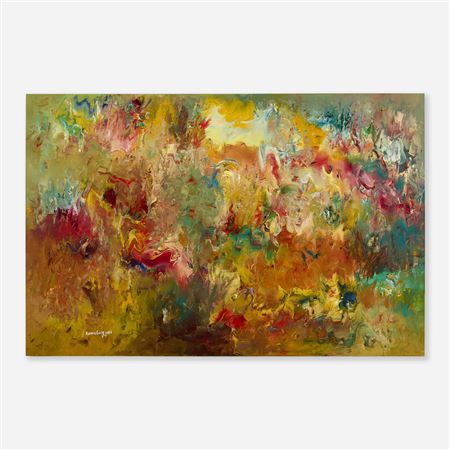
1913 New York, New York - 1992. Known for: Mod views-figure-face, non ob, mural.
The following biography was written by Virginia M. Mecklenburg for the Patricia and Phillip Frost Collection: "American Abstraction, 1930-1945" (Washington, DC: National Museum of American Art and... Read full biography
The following biography was written by Virginia M. Mecklenburg for the Patricia and Phillip Frost Collection: "American Abstraction, 1930-1945" (Washington, DC: National Museum of American Art and Smithsonian Institution Press, 1989), pp. 151-153. It was submitted by Peter Karol. ALTHOUGH RALPH... Read full biography
The following biography was written by Virginia M. Mecklenburg for the Patricia and Phillip Frost Collection: "American Abstraction, 1930-1945" (Washington, DC: National Museum of American Art and Smithsonian Institution Press, 1989), pp. 151-153. It was submitted by Peter Karol. ALTHOUGH RALPH ROSENBORG HAS PAINTED ABSTRACT WORK THROUGHOUT his life, nature has served as his perennial motif. He won a scholarship while still in high school to Saturday art classes at the American Museum of... Read full biography
The following biography was written by Virginia M. Mecklenburg for the Patricia and Phillip Frost Collection: "American Abstraction, 1930-1945" (Washington, DC: National Museum of American Art and Smithsonian Institution Press, 1989), pp. 151-153. It was submitted by Peter Karol. ALTHOUGH RALPH ROSENBORG HAS PAINTED ABSTRACT WORK THROUGHOUT his life, nature has served as his perennial motif. He won a scholarship while still in high school to Saturday art classes at the American Museum of Natural History in New York City. After classes ended, he continued to study privately with his teacher there, Henriette Reiss, who provided not only exacting technical training, but broad-based instruction in music, literature, and art history. More... Read full biography
The following biography was written by Virginia M. Mecklenburg for the Patricia and Phillip Frost Collection: "American Abstraction, 1930-1945" (Washington, DC: National Museum of American Art and Smithsonian Institution Press, 1989), pp. 151-153. It was submitted by Peter Karol. ALTHOUGH RALPH ROSENBORG HAS PAINTED ABSTRACT WORK THROUGHOUT his life, nature has served as his perennial motif. He won a scholarship while still in high school to Saturday art classes at the American Museum of Natural History in New York City. After classes ended, he continued to study privately with his teacher there, Henriette Reiss, who provided not only exacting technical training, but broad-based instruction in music, literature, and art history. More significantly, Reiss had worked with Kandinsky earlier in her career and introduced her young protégé to the vast arena of vanguard... Read full biography
Artist Biography
Biography page for Ralph Rosenborg ((1913 - 1992)), known for Mod views-figure-face, non ob, mural. Showing 2 biographical entries and 0 sample artworks.
Ralph Rosenborg - Artist Info
About Ralph Rosenborg
Name variants
Ralph Rosenberg
Biography from the Archives of askART
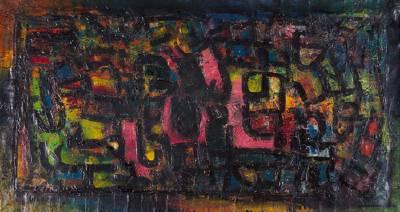 The following biography was written by Virginia M. Mecklenburg for the Patricia and Phillip Frost Collection: "American Abstraction, 1930-1945" (Washington, DC: National Museum of American Art and Smithsonian Institution Press, 1989), pp. 151-153. It was submitted by Peter Karol.
ALTHOUGH RALPH ROSENBORG HAS PAINTED ABSTRACT WORK THROUGHOUT his life, nature has served as his perennial motif. He won a scholarship while still in high school to Saturday art classes at the American Museum of Natural History in New York City. After classes ended, he continued to study privately with his teacher there, Henriette Reiss, who provided not only exacting technical training, but broad-based instruction in music, literature, and art history. More significantly, Reiss had worked with Kandinsky earlier in her career and introduced her young protégé to the vast arena of vanguard European ideas.
After four years, Rosenborg was ready to exhibit. He showed frequently during the 1930s---initially in group exhibitions at ACA Galleries and later in Mayor La Guardia's 1934 "Mile of Art" at Radio City. His first solo exhibition, at the Eighth Street Theater in 1935, was followed by shows at various galleries almost annually throughout the 1940s.
A highly personal artist, inclined toward interpreting nature rather than the geometric form pursued by many of his fellow members of the American Abstract Artists, Rosenborg wrote in 1955:
"Painting will always remain a super-real world to me, devoid of all modern forms of blasphemy. It is a world in which the immensity of creation moves me to a personal form of prayer and contemplation. It is also a world in which its laws demand a personal integrity of purpose, a simple humbleness, and a sufficient set of experiences as the basic requirement for admission to it.
During the 1930s and 1940s, Rosenborg moved freely between expressionist watercolors evocative of the rhythms and colors of nature (such as the Untitled watercolor of about 1938) and more consciously structured oils, such as The Far-away City in which deep-toned, dream world landscapes take on the color and architecture of expressive stained glass. He paid little heed to modernist theories of surface and structure that fascinated many of his contemporaries. Later during the 1950s, Rosenborg's paintings increasingly reflected the energies, as well as the appearances, of the natural world. Tumultuous seascapes, serene landscapes, and brightly colored floral still lifes, were all executed with an attention to richly textured, heavily painted surfaces.
Although New York City has remained home for Rosenborg throughout his career, he has traveled widely. In 1966, an award from the National Council on the Arts and Humanities enabled him to tour Europe. He continually strives upward in his work, and frequently draws an arrow in a rectangular box on the back of his paintings. Originally a Mayan motif, the arrow, for Rosenborg, "signifies that I will strive to always go up, aesthetically, spiritually, and from all practical points of view. It's very important because I try to stay on earth, but actually, the painting is another world."
Peter Karol writes: "Finally, the best article on him that I've come across is the following: Martica Sawin, "The Achievement of Ralph Rosenborg," Arts Magazine 35, no. 2 (November 1960): 44--47.
Additional information provided by Ronald Wells:
Awards, References and Publications Include:
Award-Grant - The Milton and Sally Avery Foundation, New York, NY
1938-1992 inclusive Who's Who in American Art
1942 Abstract and Surrealist Art in America by Sidney Janis
1952 Modern Artists in America by Bernard and Ad Reinhardt
1955 The Achievement of Ralph Rosenborg, by Bele Krasne - Arts and Architecture
1960 Childe Hassem Award - American Academy of Arts and Letters
1966 Arts and Humanities Award, $5000 - Roger L. Stevens, Director, Lyndon B. Johnson administration - National Council of the Arts
1966 Award-Grant - 1st year - National Endowment for the Arts
1980-1990 Who's Who in America
1981 Award-Grant - Hereward Lester Cooke Foundation
1982 Award-Grant - Esther and Adolph Gottlieb Foundation
Public and Private Collections Include:
Albert A. Gallatin; Albert A. List; Albert Landry; Alexander Bing; Andrew Weiss; Arline Snyder; Arthur J. Steel; Arthur Lipper, 3rd; Belle Krasne Ribicoff; Carl Nierendorf; Cedars of Lebanon Hospital; Columbia ; Curt Valentin; Darlene R. Valencia; Duncan Phillips; Finch College; Galerie Jeanne Boucher, Paris; Gallery of Living Art, New York University; Georgette Passedoit; Harry N. Abrams; Henry S. Caufield; J.B. Newmann; Jeanne Boucher; John Hopkins University; Joseph H. Hirschhorn; Josephine and Phillip Bruno; Junior College of Albany; Katherine S. Drier; List Art Center; Malcolm Delacorte; Marian Willard; Mark Toby; Meyer Schapiro; Mrs. Albert A. List; Mrs. Mary Barrier; New School for Social Research; Robert Woods Bliss; Rose Fried; Russell R. Blackburn; Sam A Lewisohn; Samuel Heller; Samuel Robert; Seymour Hacker; Smith College; Southampton Hospital; United Cerebral Palsy Foundation, Los Angeles Chapter; University of Illinois; University of Maryland; University of North Carolina; University of Oregon Art Gallery.
Selected Museum Collections Include:
Art Museum, Princeton University;Butler Institute of American Art, Youngstown, OH; City Art Museum, St. Lewis, MO; Colby College Art Gallery, Waterville, ME; Gray Art Gallery, New York University, New York, NY; Guggenheim Museum of Art, New York, NY; Herbert F. Johnson Art Museum, Cornell University, Ithaca, NY; Hirschhorn Museum and Sculpture Garden, Washington, DC; Hudson River Museum of Art, Montclair, NJ; Krannert Art Museum, University of Illinois, Urbana, IL; Lowe Art Gallery, Syracuse University, Syracuse, NY; Metropolitan Museum of Art, New York, NY; Montclair Museum of Art, Montclair, NJ; New Britain Museum of American Art, CT; Newark Museum of Art, Newark, NJ; Oklahoma Museum of Art, Oklahoma City, OK; Philips Memorial Gallery, Washington, DC; Rose Art Museum, Brandeis University, Waltham, MA; Seattle Art Museum, Seattle, Washington; Snite Museum, University of Notre Dame, Notre Dame, IN; University of Georgia Art Gallery, Athens, GA; University of Maryland Art Gallery, College Park, MD; University of Oregon Art Gallery, Eugene, OR; Wadsworth Atheneum Museum of Art, Hartford, CT; Whitney Museum of American Art, New York, NY; Yale University Art Gallery, Societe AnonyneBiography from Butler Institute of American Art
Born: New York City 1913
Exhibits : First solo was in June 1935; over 60 solo exhibits and over 300 group exhibits.