Page loaded successfully. Showing biography for Ravinder Reddy.
Ravinder Reddy BIOGRAPHY
Born 1956 Suryapet, Andhra Pradesh. Known for: Human head sculpture linked to classical themes.
Lots Sold: 78%, High Price: Subscribe.
Reddy is unambiguously devoted to his craft. Born in Suryapet, India, he lives and works in the same southeastern state where he was born, in a quiet port city called Visakhapatnam, where he has said... Read full biography
Reddy is unambiguously devoted to his craft. Born in Suryapet, India, he lives and works in the same southeastern state where he was born, in a quiet port city called Visakhapatnam, where he has said he intends to remain He first began showing in the United States in the late 1990s, notably at a... Read full biography
Reddy is unambiguously devoted to his craft. Born in Suryapet, India, he lives and works in the same southeastern state where he was born, in a quiet port city called Visakhapatnam, where he has said he intends to remain He first began showing in the United States in the late 1990s, notably at a 1998 South Asian survey exhibition at the Queens Museum of Art, in New York. But his New York exhibition with Deitch Projects put him on the map in 2001, making him one of the first among a new wave of... Read full biography
Reddy is unambiguously devoted to his craft. Born in Suryapet, India, he lives and works in the same southeastern state where he was born, in a quiet port city called Visakhapatnam, where he has said he intends to remain He first began showing in the United States in the late 1990s, notably at a 1998 South Asian survey exhibition at the Queens Museum of Art, in New York. But his New York exhibition with Deitch Projects put him on the map in 2001, making him one of the first among a new wave of contemporary Indian artists to draw critical attention in the United States around the turn of the Millennium. More recently, his works have been shown at the Arken Museum of Modern Art, Copenhagen (2012) and the Smart Museum of Art, Chicago... Read full biography
Reddy is unambiguously devoted to his craft. Born in Suryapet, India, he lives and works in the same southeastern state where he was born, in a quiet port city called Visakhapatnam, where he has said he intends to remain He first began showing in the United States in the late 1990s, notably at a 1998 South Asian survey exhibition at the Queens Museum of Art, in New York. But his New York exhibition with Deitch Projects put him on the map in 2001, making him one of the first among a new wave of contemporary Indian artists to draw critical attention in the United States around the turn of the Millennium. More recently, his works have been shown at the Arken Museum of Modern Art, Copenhagen (2012) and the Smart Museum of Art, Chicago (2011).Christie's, Mumbai... Read full biography
Artist Biography
Biography page for Ravinder Reddy ((Born 1956)), known for Human head sculpture linked to classical themes. Showing 3 biographical entries and 0 sample artworks.
Ravinder Reddy - Artist Info
About Ravinder Reddy
Biography from the Archives of askART
 Reddy is unambiguously devoted to his craft. Born in Suryapet, India, he lives and works in the same southeastern state where he was born, in a quiet port city called Visakhapatnam, where he has said he intends to remain He first began showing in the United States in the late 1990s, notably at a 1998 South Asian survey exhibition at the Queens Museum of Art, in New York.
But his New York exhibition with Deitch Projects put him on the map in 2001, making him one of the first among a new wave of contemporary Indian artists to draw critical attention in the United States around the turn of the Millennium. More recently, his works have been shown at the Arken Museum of Modern Art, Copenhagen (2012) and the Smart Museum of Art, Chicago (2011).Biography from Saffronart
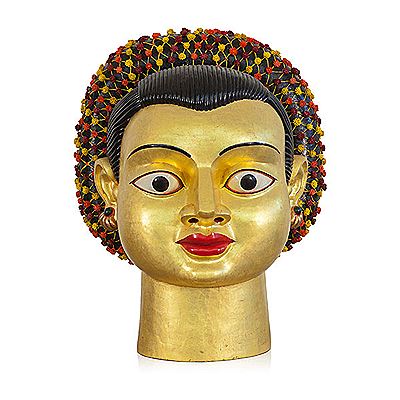
Ravinder Reddy's sculpture is heraldic. Many of his sculptures are larger than life heads. Invariably, they look frontally through wide-open eyes, the characteristic attitude of one who proclaims. None of the sculptures looks sideways, or over the shoulder. The one who predicts may draw material from the past, but he has only the future to address. And the message, or prediction, that is about to be announced can be read from sculpture to sculpture in the gold emblazoning, or the searing red which covers the head, or in the complex hair-dos on the female heads, all of which are emblematic designs.
In his search for forms that could satisfy his sculptor's instincts, Reddy goes back to earlier periods of civilization - the Egyptian, and the early Greek - where conventions of extreme simplification and frontality prevailed. This bold backward step is to me a kind of confirmation of the authenticity of the herald role. A convention is a given, a predictable way of doing something. When it becomes an end in itself it is arid. When married to deeper needs, like the projection of a shared philosophy, it can enable a work of art.
The conventionalizing impulse in Reddy is vigorous, though for other needs. I will hazard a wild interpretation. It is the silenced voice of Indian sculpture, which was one of the greatest the world has seen, trying to address a possible, future renewal. However, there is a further element in Reddy's sculpture that keeps the convention from becoming arid. It is the repeated outbreak of sensuality. Even where the subject may not be overtly sexual, the sensuality colours and modifies the convention, infusing it with irregularity, mischief, and all such-like good things.
The sensuality is serene, in most instances the sexual impulse does not speak of excitement, but of fulfillment. Sculpture is a welling upward of a world of images from the flat and even surface in which they were earlier concealed. The sculptor merely unveils them, or so it would seem. This sense of apparent effortlessness goes hand in hand with the emotional and structural informality of Reddy's latest works.Biography from Christie's New York, Rockefeller Center
Born in Suryapet, in the Andhra Pradesh region of India, artist Ravinder Reddy references ancient Indian sculptural traditions in his massive polyester-resin heads. Contemporizing images of traditional Indian goddesses, Reddy plays on the American concept of "super-sizing", inflating these distinctly South Asian busts to gargantuan proportions.
In spite of their imposing size and saturated colors, the artist cunningly imbues his sculptures with a sense of serenity and the brash faces remain docile and oddly domestic. In his transformation or re-appropriation of temple sculpture, Reddy is perhaps commenting on how India's religion and cultural history are affected by the racing bandwidth and relentless bombardment of internet and other mass media.