Page loaded successfully. Showing biography for Ray Stanford Strong.
Ray Stanford Strong BIOGRAPHY

1905 Corvalis, Oregon - 2006 Three Rivers, California. Known for: Plein air western landscape painting, dioramas, teaching.
"Ray Strong: Remembering a Master" by Mark Humpal, Southwest Art magazine, January 12, 2018:. In a career spanning the last three-quarters of the 20th century, painter Ray Strong (1905-2006) strove... Read full biography
"Ray Strong: Remembering a Master" by Mark Humpal, Southwest Art magazine, January 12, 2018:. In a career spanning the last three-quarters of the 20th century, painter Ray Strong (1905-2006) strove to capture the essence of the western landscape. California’s voluptuous, sunbaked foothills, dotted... Read full biography
"Ray Strong: Remembering a Master" by Mark Humpal, Southwest Art magazine, January 12, 2018:. In a career spanning the last three-quarters of the 20th century, painter Ray Strong (1905-2006) strove to capture the essence of the western landscape. California’s voluptuous, sunbaked foothills, dotted with clusters of live oaks, are his best-known subjects, but his oeuvre also includes depictions of Oregon, New York, Arizona, Utah, Canada, and Europe. Fresh from training in New York, he arrived in... Read full biography
"Ray Strong: Remembering a Master" by Mark Humpal, Southwest Art magazine, January 12, 2018:. In a career spanning the last three-quarters of the 20th century, painter Ray Strong (1905-2006) strove to capture the essence of the western landscape. California’s voluptuous, sunbaked foothills, dotted with clusters of live oaks, are his best-known subjects, but his oeuvre also includes depictions of Oregon, New York, Arizona, Utah, Canada, and Europe. Fresh from training in New York, he arrived in San Francisco during the early years of the Great Depression and soon became a major player in that city’s vibrant art community. A variety of accomplishments during the New Deal art programs of the 1930s brought him national fame and opened doors of... Read full biography
"Ray Strong: Remembering a Master" by Mark Humpal, Southwest Art magazine, January 12, 2018:. In a career spanning the last three-quarters of the 20th century, painter Ray Strong (1905-2006) strove to capture the essence of the western landscape. California’s voluptuous, sunbaked foothills, dotted with clusters of live oaks, are his best-known subjects, but his oeuvre also includes depictions of Oregon, New York, Arizona, Utah, Canada, and Europe. Fresh from training in New York, he arrived in San Francisco during the early years of the Great Depression and soon became a major player in that city’s vibrant art community. A variety of accomplishments during the New Deal art programs of the 1930s brought him national fame and opened doors of opportunity. He hit his stride a decade later in Marin County, where he refined his signature style. But the important first... Read full biography
Artist Biography
Biography page for Ray Stanford Strong ((1905 - 2006)), known for Plein air western landscape painting, dioramas, teaching. Showing 4 biographical entries and 0 sample artworks.
Ray Stanford Strong - Artist Info
About Ray Stanford Strong
Biography from the Archives of askART
 "Ray Strong: Remembering a Master" by Mark Humpal, Southwest Art magazine, January 12, 2018:
In a career spanning the last three-quarters of the 20th century, painter Ray Strong (1905-2006) strove to capture the essence of the western landscape. California’s voluptuous, sunbaked foothills, dotted with clusters of live oaks, are his best-known subjects, but his oeuvre also includes depictions of Oregon, New York, Arizona, Utah, Canada, and Europe. Fresh from training in New York, he arrived in San Francisco during the early years of the Great Depression and soon became a major player in that city’s vibrant art community. A variety of accomplishments during the New Deal art programs of the 1930s brought him national fame and opened doors of opportunity. He hit his stride a decade later in Marin County, where he refined his signature style.
But the important first steps in Strong’s odyssey as a landscape painter were taken years earlier in his home state. Growing up on a large berry farm in Oregon instilled a profound regard for the regenerative, life-giving qualities of the land. Besides helping his family cultivate farmland, he explored, hunted, fished, and chased butterflies at every opportunity, deepening his understanding of and respect for nature. Living close to the picturesque, rugged terrain of Mount Hood and surrounding territory provided ready access to inspirational subjects just as he began to investigate the medium of oil paint. Strong’s early experiences certainly set the tone and gave direction, but key aspects of character fueled forward momentum: a steadfast determination to master his craft, a hunger to intellectually grasp the processes that shape the natural world, and an insatiable desire to express direct responses in paint.
Strong discovered a predilection for landscape painting by studying landscapes created by his maternal grandmother, an amateur oil painter whose Hudson River School works adorned the walls of the family home in Portland. From the moment he could hold a brush, Strong industriously copied her work, revealing evidence of his promising talent. He continued to hone his skills under the guidance of a progression of teachers at least a generation older who preferred a representational approach to art. Strong particularly sought those who made the great outdoors their main classroom.
The rise of impressionism in the late 1800s opened the floodgates to experimentation and innovation in the world of art. By the end of the first decade of the 1900s, impressionism had achieved widespread acceptance among American artists. At the same time, avant-garde artists overseas were pushing perceptual barriers even further, devising radical new theories of expression. Cubism, futurism, fauvism, expressionism, Dadaism, and a host of other “isms” appeared to varying extents in the years leading up to World War I. As a budding young artist on the threshold of a career, Strong witnessed these developments as they gained traction.
In one respect, Strong was born a generation too late, since most artists in his cohort—that is, those born circa 1900 to 1915—aspired to the tenets of modernism. Art schools, museums, and other art organizations increasingly promoted these emergent trends as the new century progressed. An artist of Strong’s generation who excitedly pursued modernism was Louis Demott Bunce (1907-1983). Bunce, whose training and career provide parallels and counterpoints to Strong’s, came of age as a young artist in Portland and, unlike Strong, explored virtually every new idea in modern art-making. Similarities between Strong and Bunce include studies at the Art Students League in New York in the late 1920s, work on various New Deal art projects of the 1930s, resourceful navigation through the turmoil of World War II, and careers as respected art educators. Contrasts between the two provide a context for the successes and struggles particular to Strong, and other artists like him, determined to stay focused on realism and risk marginalization. Indeed, Strong’s reluctance to follow the drumbeat of the avant-garde instigated numerous career challenges over time, not all of which resolved painlessly. This is not to say that the modernists had smooth sailing either; the general public often ridiculed, rejected, and misunderstood abstract art (and still does).
Early 20th-century Swiss psychiatrist Carl G. Jung’s theory of psychological types offers one explanation for Strong’s lifelong inclination as a landscape painter and, notably, for his resistance to deep involvement in the world of nonobjective art. Jung outlined eight pairs of opposite attitudes and functions that characterize an individual’s preferred mode of thinking about and interacting in the world. Jung referred to the first dynamic pair of opposites as “extraversion” and “introversion.”?Essentially, introverts are most concerned with the inner world of thoughts and feelings, of processing experiences carefully and reflectively. Extraverts are most comfortable engaging the people, places, and things of the world outside themselves. Each attitude also entails shortcomings. Introverts may tend to overthink and procrastinate, whereas extraverts tend to jump headlong into action without considering all sides of the question. This distinction is not typically one of black and white but of degrees. Most people embody both but prefer one orientation.
Strong, virtually a pure extravert, viewed the natural world—and his connection to it—as the essential ingredient for art-making. He had little desire to plumb the depths of the psyche for artistic inspiration, choosing instead to respond experientially to the tangible world around him. Midcentury American art critic Clement Greenberg’s insistence on the primacy of the artist’s inner experience, expressed directly through art materials with few external references, held little attraction to Strong. He was simply wired differently.
Underlying vast changes in the art world, great social, economic, and political upheaval raged across the globe during the 20th century. In particular, the Great Depression significantly affected Strong, galvanizing ideals of social justice, peace, and cooperation to a degree rivaling his love of landscape painting. He was not alone in this regard as radical politics proliferated among artists during the 1930s, most notably in the urban population centers of the East. Strong occasionally used art as a vehicle to express his political beliefs and staunch social activism. More often, he channeled opinions regarding conservation and environmental issues through his landscape work.
Numerous public and private murals stand as a testament to Strong’s proficiency at handling large-scale, complex projects. He achieved national recognition as a major innovator in the field of diorama background painting from numerous institutional commissions. Collaboration with earth scientists and paleontologists deepened his understanding of geological processes that sculpt the earth over millions of years and of the ongoing action of wind, waves, and weather, which actively shapes it. He vigorously applied these principles whenever he painted, endeavoring to portray the fundamental characteristics of the earth beyond mere surface details.
As an art educator, Strong taught hundreds of students over nearly six decades and considered sharing his extensive knowledge and philosophy to be one of his highest callings. Along the way, he helped establish several art schools, organizations, and galleries. A broad resurgence of interest in landscape painting during the last quarter of the 20th century revitalized his career in his twilight years. A new generation of artists flocked to his studio, eager to learn from an acknowledged master and a living link to the once-flourishing plein-air tradition. Over his last 20 years, he spearheaded the fight for preservation of lands endangered by encroaching development—and helped win important victories—by organizing artists as environmental activists.
Though he created the bulk of his work in California and spent most of his life there, Ray Strong invariably exclaimed, “I’m a third-generation Oregonian!” An examination of Strong family heritage in the West reveals an intriguing narrative of connectedness to the land and its vital importance to livelihood. His father, Harold William (H.W.) Strong, worked first as a timber cruiser, then as a lawyer, and finally as a farmer who operated the largest berry farm in the Northwest in the 1920s and 1930s. His grandfather, Edward Webster (E.W.) Strong, owned a succession of lumber mills during the time when timber was king in the Pacific Northwest. Strong’s great-grandparents, William Riley and Harriet Strong, were Oregon pioneers from Indiana who staked their future on the remote settlement of Rainier, 50 miles north of Portland on the Columbia River, in 1852. Riley, as he was known, juggled numerous professions, including teacher, lawyer, and political activist, culminating in his election to the territorial legislature in 1858, where he helped facilitate Oregon’s arduous transition to statehood.
Ray Strong settled permanently in California in his late 20s but continually returned to Oregon to visit family and, of course, to paint. For decades, these lengthy trips were taken annually, producing a significant body of Oregon subjects, which stand as a counterpoint to the California paintings for which he is best known. Though he painted elsewhere during his long career, California, Oregon, and the American West were the subjects that inspired him most and form the majority of his?artistic output.
Submitted by Mark HumpalBiography from the Archives of askART
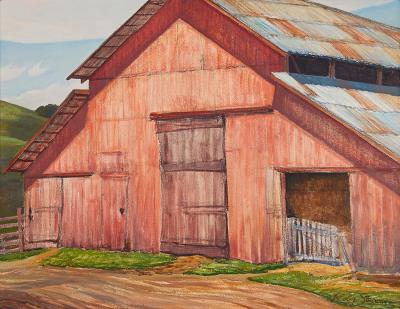 Ray Strong (1905-2006) (San Francisco / Santa Barbara)
Artist who created a view of Lion Rock near Morro Bay at an unknown date.
Source: Nancy Dustin Wall Moure, MORRO BAY (including LOS OSOS, BAYWOOD PARK and CAYUCOS) ART AND PHOTOGRAPHY BEFORE 1960 (Publications in [Southern] California Art, vol. 13, no. I), Los Angeles: Dustin Publications, 2016.Biography from Archer Jordan
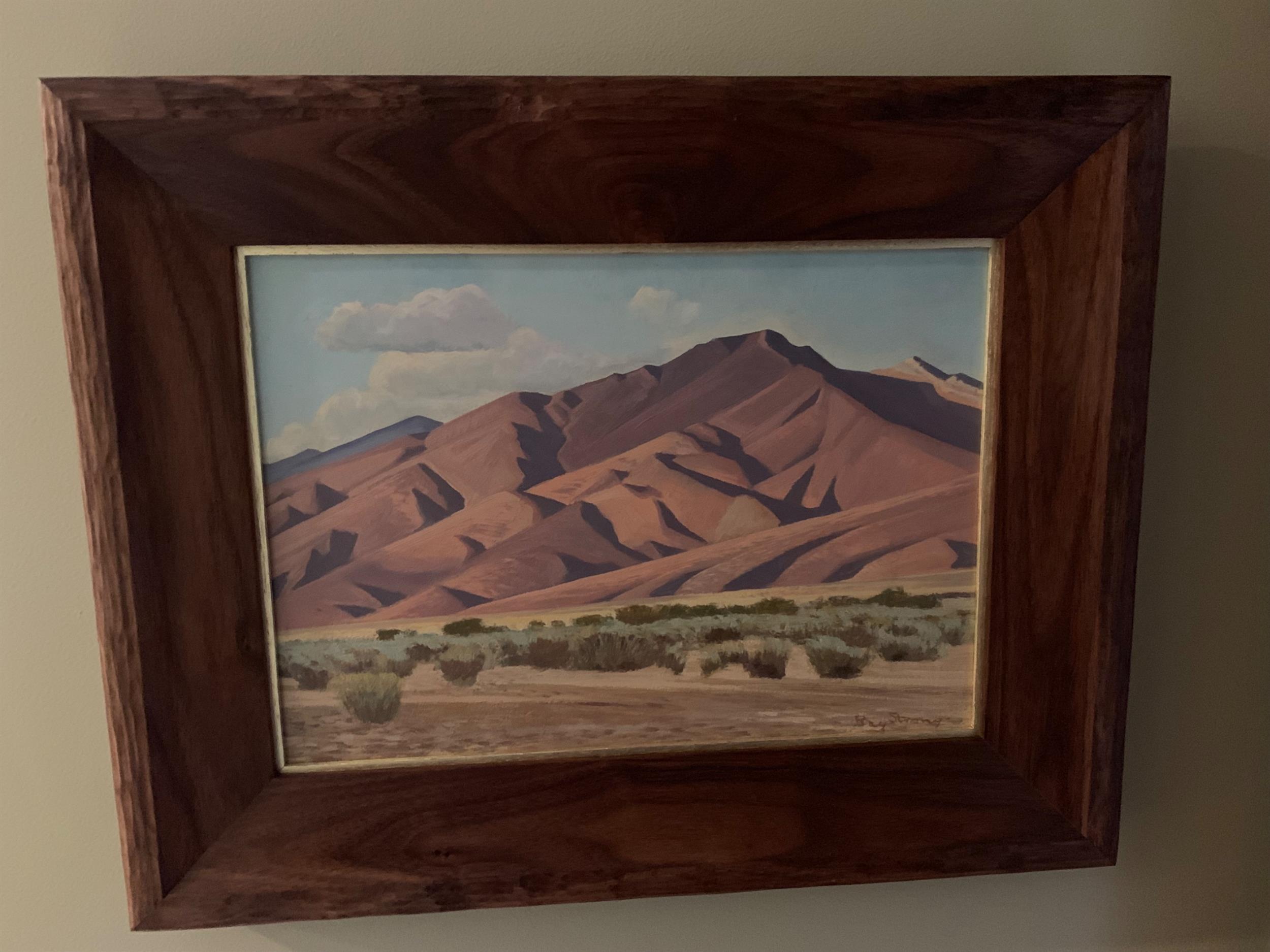 Born in 1905, Ray Strong was a leading American landscape painter known for his refined technique and deep connection to California and Western landscapes. A longtime Santa Barbara resident, his work is held in major museum and private collections and is widely respected for its balance, light, and sense of place.
Biography from Crocker Art Museum Store
Landscape painter and muralist, Ray Strong was born in Corvallis, Oregon on January 2, 1905. He began painting at age eight, and during his highschool years, spent Sundays with painter Clyde Keller working from the Columbia slough to Mt Hood.
Upon moving to San Francisco in 1924, he enrolled at the California School of Fine Art, and from there went to New York City where he continued his studies at the Art Students League under Frank DuMond.
Returning to San Francisco in 1931, Strong taught at the local Art Students League with Maynard Dixon, Frank Van Sloun, and George Post. Taking over the old Beaux Arts Galleries on Maiden Lane, they formed an Artists Cooperative Gallery from 1934-39.
He did dioramas for both the San Diego Expo of 1935 and the Golden Gate International Exposition of 1939. Strong was a diorama painter for the U.S. Forest Service from 1935-38 and did similar work for the National Park Service during 1940-41.
Still active as an artist in his later years, from 1960, he has been a resident of Santa Barbara. He was artist-in-residence at the Santa Barbara Museum of Natural History (1960-63) and co-founder of the Santa Barbara Art Institute. Ray Strong died on July 3, 2006
ASSOCIATIONS:
Oregon Society of Artists
Society of Western Artists
Palo Alto Art Club
California Society of Mural Painters
Santa Barbara Art Association
Mann Society of Artists
COLLECTIONS:
National Museum of American Art
Lassen, Rainier, and White Sands National Parks
Daly City High School
College of Mann
Society of California Pioneers
Murals: Santa Barbara Museum
Morro Bay State Park Museum
Keene Valley (NY) Congregational Church
Post Offices in San Gabriel, CA and Decatur, TX
Bacon Hall, UC Berkeley
Academy of Sciences (SF); Roosevelt Jr. High School (San Jose)
Santa Fe Railway Station in LA (done with Edith Hamlin and Buck Weaver)
Sources include:
American Art Annual, 1933; Who Was Who in American Art 1936-41; Interview