Page loaded successfully. Showing biography for Richard Peter Stankiewicz.
Richard Peter Stankiewicz BIOGRAPHY
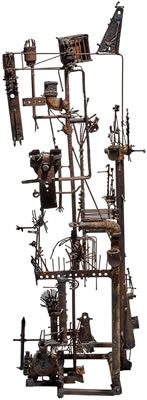
1922 Philadelphia, Pennsylvania - 1983 Worthington, Massachusetts. Known for: Whimsical junk assemblages sculpture, industrial elements.
Richard Stankiewicz Dies, Pioneer of 'Junk' Sculpture, by Michae Brenson, Obituary, The New York Times, March 29, 1983. Richard Stankiewicz, the American sculptor whose whimsical scrap-iron... Read full biography
Richard Stankiewicz Dies, Pioneer of 'Junk' Sculpture, by Michae Brenson, Obituary, The New York Times, March 29, 1983. Richard Stankiewicz, the American sculptor whose whimsical scrap-iron constructions made him one of the pioneers of ''junk art'' and assemblage, died of cancer Sunday in... Read full biography
Richard Stankiewicz Dies, Pioneer of 'Junk' Sculpture, by Michae Brenson, Obituary, The New York Times, March 29, 1983. Richard Stankiewicz, the American sculptor whose whimsical scrap-iron constructions made him one of the pioneers of ''junk art'' and assemblage, died of cancer Sunday in Worthington, Mass. He was 60 years old. Mr. Stankiewicz established his reputation by taking pipes, nuts, bolts, screws, clockworks and other scrap from junkyards and welding them into carefully ordered... Read full biography
Richard Stankiewicz Dies, Pioneer of 'Junk' Sculpture, by Michae Brenson, Obituary, The New York Times, March 29, 1983. Richard Stankiewicz, the American sculptor whose whimsical scrap-iron constructions made him one of the pioneers of ''junk art'' and assemblage, died of cancer Sunday in Worthington, Mass. He was 60 years old. Mr. Stankiewicz established his reputation by taking pipes, nuts, bolts, screws, clockworks and other scrap from junkyards and welding them into carefully ordered sculptural compositions that both respected the fragmentary, arbitrary character of the materials and transformed them. ''I take material that is already degenerating, flaking and rusting, and then try to make something beautiful of it,'' Mr. Stankiewicz... Read full biography
Richard Stankiewicz Dies, Pioneer of 'Junk' Sculpture, by Michae Brenson, Obituary, The New York Times, March 29, 1983. Richard Stankiewicz, the American sculptor whose whimsical scrap-iron constructions made him one of the pioneers of ''junk art'' and assemblage, died of cancer Sunday in Worthington, Mass. He was 60 years old. Mr. Stankiewicz established his reputation by taking pipes, nuts, bolts, screws, clockworks and other scrap from junkyards and welding them into carefully ordered sculptural compositions that both respected the fragmentary, arbitrary character of the materials and transformed them. ''I take material that is already degenerating, flaking and rusting, and then try to make something beautiful of it,'' Mr. Stankiewicz said in 1958. ''It should hit people over the head and make them ask, 'What is beauty?' ''. Mr. Stankiewicz's sculptures ha... Read full biography
Artist Biography
Biography page for Richard Peter Stankiewicz ((1922 - 1983)), known for Whimsical junk assemblages sculpture, industrial elements. Showing 2 biographical entries and 0 sample artworks.
Richard Peter Stankiewicz - Artist Info
About Richard Peter Stankiewicz
Biography from the Archives of askART
 Richard Stankiewicz Dies, Pioneer of 'Junk' Sculpture, by Michae Brenson, Obituary, The New York Times, March 29, 1983
Richard Stankiewicz, the American sculptor whose whimsical scrap-iron constructions made him one of the pioneers of ''junk art'' and assemblage, died of cancer Sunday in Worthington, Mass. He was 60 years old.
Mr. Stankiewicz established his reputation by taking pipes, nuts, bolts, screws, clockworks and other scrap from junkyards and welding them into carefully ordered sculptural compositions that both respected the fragmentary, arbitrary character of the materials and transformed them.
''I take material that is already degenerating, flaking and rusting, and then try to make something beautiful of it,'' Mr. Stankiewicz said in 1958. ''It should hit people over the head and make them ask, 'What is beauty?' ''
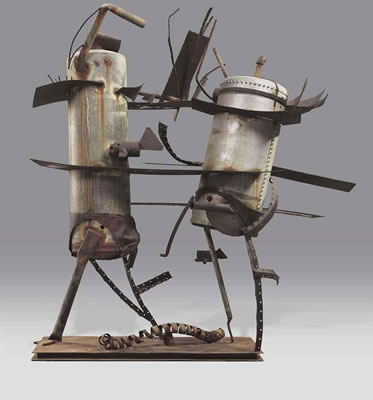
Mr. Stankiewicz's sculptures have a special kind of humanity and wit. Particularly during the 1950's, when his work had some of the brashness and irreverence identified with the New York School, he used incongruity and the judicious placement of ''ready-made'' objects to call attention to some aspect or character trait of the human figure. In the sculpture The Bride,' for example, the veil is made up of bed springs. In The Warrior,' the spindly legs seem unable to hold up the boiler that is the warrior's ponderous, inflated armor. Later Works More Formal
Between 1965 and 1972 Mr. Stankiewicz decided not to show in New York. When he began exhibiting again in New York, at the Zabriskie Gallery, the humor and choice of materials were less conspicuous in his work, and it was easier to recognize the formal intelligence and high purpose that had guided him all along.
Mr. Stankiewicz's sculptures were still made up of metal parts, but not scraps; the humor was still present, but it was more discreet. The forms were often larger, bulkier; the compositions had an unmistakable rigor and weight.
''I love his work,'' William Rubin, director of painting and sculpture at the Museum of Modern Art, said. ''He has never achieved in the popular mind the stature I think he deserves.''
''Basically I think he was somebody who came out of David Smith,'' Mr. Rubin added. ''Despite the whimsical character of his work, he shared with Smith a very strong feeling for the purely esthetic structure.''
Richard Stankiewicz was born of Polish parents in Philadelphia in 1922. In 1928, after his father died, he moved with his mother to Detroit, settling in an apartment alongside a foundry dump. Without money to buy toys, he made his own playthings from the scraps he came upon in the junkyard.
Before he joined the Navy in 1941 and toured the Pacific, his work was primarily in painting. While in the Aleutians he carved images out of caribou bone; in Hawaii he made his first abstract sculptures, in wood. His work would always retain a totemic quality.
In 1947 he went to New York and studied art for the first time, with the noted teacher and Abstract Expressionist painter Hans Hofmann. In 1950 he went to Paris and studied first with the painter Fernand Leger, then with the sculptor Ossip Zadkine. Other artists whose influence Mr. Stankiewicz acknowledged are Dubuffet, Franz Kline, David Smith, Giacometti and Mondrian.
When he returned to the United States, he began to produce the work he is known for, taking found objects and welding them together with techniques established in America by Smith.
Mr. Stankiewicz has had one-man shows throughout the United States and Europe. His work is in the collections of the Museum of Modern Art, the Whitney Museum of American Art, the Solomon R. Guggenheim Museum, the Walker Art Center in Minneapolis, the Moderna Museet in Stockholm and the Centre Georges Pompidou in Paris.
He is survived by two sons, Anthony Leslie and Peter Alex; two sisters, Florence Wagner and Jeanine Krogulecki, and three brothers, Edward Stankiewicz, Theodore Stone and John Zytell.
His marriage to Patricia Doyle ended in divorce.Biography from the Archives of askART
 Sculptor Richard Stankiewicz, born in Philadelphia in 1922, was most closely associated with the Assemblage movement. He studied with Hans Hofmann at the Hoffman School between 1945 and 1949, and, in Europe, with Fernand Leger in 1950 and Ossip Zadkine in 1950-51.
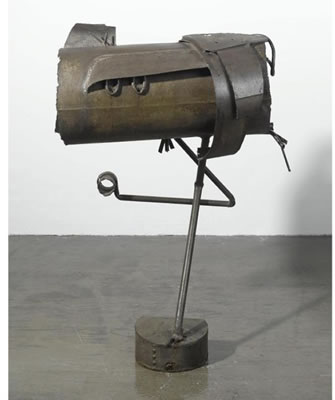
After his return to the United States, he began to create works from scrap metal and discarded mechanical and household equipment, integrating their forms into compositions that could be both formally elegant and witty (Kabuki Dancer, 1956, Whitney Museum of American Art, New York City).
Unlike some assemblage-makers, Stankiewicz did not transform the objects he used. Despite the limitations imposed by the materials, he developed a body of work noted for its intricate spatial relations and technical innovation.
Stankiewicz was also an art educator and held positions at the State University, New York, Albany, 1967-and at Amherst College from 1970-71.
He died in 1983 in Worthington, Massachusetts.
Sources:
Matthew Baigell, Dictionary of American Artists
Peter Hastings Falk, Editor, Who Was Who in American Art