Page loaded successfully. Showing biography for Richmond Barthe.
Richmond Barthe BIOGRAPHY
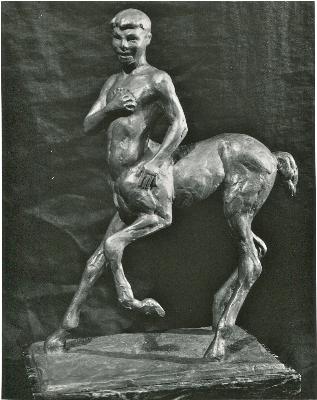
1901 Bay St. Louis, Mississippi - 1989 Pasadena, California. Known for: Expresssionist monument and figure sculpture.
Richmond Barthe (Barthé) is known for his many public works. He received acclaim for his realistic sculptural depictions of African-Americans during the 1930s-40s, and produced numerous portraits, as... Read full biography
Richmond Barthe (Barthé) is known for his many public works. He received acclaim for his realistic sculptural depictions of African-Americans during the 1930s-40s, and produced numerous portraits, as well as allegorical* and genre* figures, and became especially known for his dancers (Falk). Barthe... Read full biography
Richmond Barthe (Barthé) is known for his many public works. He received acclaim for his realistic sculptural depictions of African-Americans during the 1930s-40s, and produced numerous portraits, as well as allegorical* and genre* figures, and became especially known for his dancers (Falk). Barthe was born in Bay St. Louis, Mississippi of French Creole ancestry. His mother was a Robeteau, of New Orleans French Creole ancestry; the Barthé family came from the South West region of France, where... Read full biography
Richmond Barthe (Barthé) is known for his many public works. He received acclaim for his realistic sculptural depictions of African-Americans during the 1930s-40s, and produced numerous portraits, as well as allegorical* and genre* figures, and became especially known for his dancers (Falk). Barthe was born in Bay St. Louis, Mississippi of French Creole ancestry. His mother was a Robeteau, of New Orleans French Creole ancestry; the Barthé family came from the South West region of France, where descendants today still operate an active vineyard among other enterprises. At the age of eighteen, Barthe, then residing in New Orleans, won his first prize -- a blue ribbon for a drawing he sent to the County Fair. In 1924, with the aid of the... Read full biography
Richmond Barthe (Barthé) is known for his many public works. He received acclaim for his realistic sculptural depictions of African-Americans during the 1930s-40s, and produced numerous portraits, as well as allegorical* and genre* figures, and became especially known for his dancers (Falk). Barthe was born in Bay St. Louis, Mississippi of French Creole ancestry. His mother was a Robeteau, of New Orleans French Creole ancestry; the Barthé family came from the South West region of France, where descendants today still operate an active vineyard among other enterprises. At the age of eighteen, Barthe, then residing in New Orleans, won his first prize -- a blue ribbon for a drawing he sent to the County Fair. In 1924, with the aid of the Reverend Harry Kane S.S.I, Barthe, with less than a high school education and no formal training in art, was admitted to... Read full biography
Artist Biography
Biography page for Richmond Barthe ((1901 - 1989)), known for Expresssionist monument and figure sculpture. Showing 2 biographical entries and 0 sample artworks.
Richmond Barthe - Artist Info
About Richmond Barthe
Biography from the Archives of askART
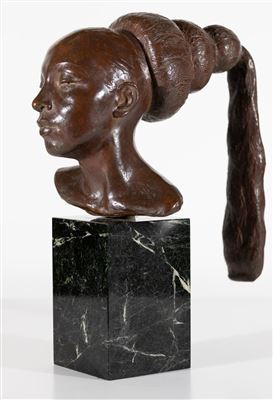 Richmond Barthe (Barthé) is known for his many public works. He received acclaim for his realistic sculptural depictions of African-Americans during the 1930s-40s, and produced numerous portraits, as well as allegorical* and genre* figures, and became especially known for his dancers (Falk).
Barthe was born in Bay St. Louis, Mississippi of French Creole ancestry. His mother was a Robeteau, of New Orleans French Creole ancestry; the Barthé family came from the South West region of France, where descendants today still operate an active vineyard among other enterprises.
At the age of eighteen, Barthe, then residing in New Orleans, won his first prize -- a blue ribbon for a drawing he sent to the County Fair. In 1924, with the aid of the Reverend Harry Kane S.S.I, Barthe, with less than a high school education and no formal training in art, was admitted to the school of the Art Institute of Chicago*. During this time he pursued a career in painting, until in his fourth year, Barthe began modeling in clay to gain a better understanding of the third dimension in his painting. This transition proved to be a turning point in his career. He exhibited two busts in the Negro History Week Exhibition and in the April 1928 annual exhibition of the Chicago Art League. He received much admiration from the critics and numerous commissions.
Following his graduation from The Art Institute of Chicago in 1929, Barthe moved to New York and established his first studio in Harlem. During the next two decades, he built his reputation as a sculptor. By 1934, his reputation was so well established that he was awarded his first solo show at the Caz Delbo Galleries, New York City.
Barthe experienced success after success and was considered by writers and critics as one of the leading "moderns" of his time. Eventually, the tense environment and violence of the city began to take its toll, and he decided to abandon his life of fame and move to Jamaica, West Indies. His career flourished in Jamaica, and he remained there until the mid-1960's.
The ever-growing violence forced yet another move. For the next five years he lived in Switzerland, Spain, and Italy before eventually settling in Pasadena, California, where he worked on his memoirs until his death in 1989, and most importantly, made editions of many of his works with the financial assistance of the actor, James Garner.
Notable public works that Barthe created include his Toussaint L'Ouverture Monument and General Dessalines Monument, both in front of the Palace, Port-au-Prince, Haiti; Green Pastures: Walls of Jericho for the Harlem River Housing Project; and Rose McClendon for Frank Lloyd Wright's Fallingwater House.
Richmond Barthe received many honors during his career, including the Rosenwald Fellowship*, Guggenheim Fellowship*, and membership in the National Academy of Arts and Letters. His work is also in public collections, including the Metropolitan Museum, New York; Whitney Museum of Art, New York; and The Art Institute of Chicago, Illinois.
Sources:
www.childsgallery.com
Peter Hastings Falk (ed.)Who Was Who in American Art
Information about the artist's ancestry courtesy of Elizabeth Simmons, who is a relative on his mother's side.
* For more in-depth information about these terms and others, see AskART.com Glossary http://www.askart.com/AskART/lists/Art_Definition.aspxBiography from The Johnson Collection
RICHMOND BARTHÉ (1901–1989)
Harlem Renaissance sculptor Richmond Barthé approached art-making as a spiritual endeavor. He believed that if an artist considered how an object felt—rather than how it looked—then his hands could execute the sculpture with little interference from his conscious mind. During his sixty-year career, Barthé received numerous prestigious awards for his art, including Rosenwald and Guggenheim fellowships. Considered by critics to be one of the leading “moderns” of his time, Barthé’s sculpture bridges the gap between realism and abstraction.
Growing up along the Mississippi Gulf Coast, Barthé was frequently sick and enjoyed art as a diversion. As his talent became more evident, supporters raised money to fund his enrollment at the Art Institute of Chicago, one of only two art academies that accepted African American students at that time. In Chicago, Barthé attended classes with his friend and classmate Ellis Wilson and also undertook private instruction with notable independent teachers, including Archibald Motley, Jr., all the while working multiple jobs to make ends meet. Following his graduation from the institute in 1929, Barthé relocated to New York, where he established a studio in Harlem. Immersing himself in the cultural renaissance flourishing there, Barthé developed a reputation among scholars of the New Negro Movement, including Alain Locke, who became a passionate collector and promoter of his work, as well as poet Langston Hughes.
Barthé was open to studying and depicting people of all races, creeds, and demographics. Eager to understand the nature of societies and the individuals who function within them, Barthé sought to capture the spiritual essence of his subjects. “For me,” he said, “there is no Negro art—only art. I have not limited myself to Negro subjects. It makes no difference in my approach to the subject matter whether I am to model a Scandinavian or an African dancer.” However, he is best known for the allegorical and genre figures of African Americans executed during the 1930s and 1940s, works inspired by his Christian faith, interest in African lore, and fascination with theater and dance.
Barthé left New York City at the height of his career in the late 1940s and moved to Jamaica in the late 1940s. Though soon forgotten by New York art critics, Barthé’s career flourished in Jamaica. Two decades later, he went on hiatus to Europe, living in Switzerland, Spain, and Italy over a five-year period. Impoverished, aging, and unwell, Barthé returned to the United States in 1977. He settled in Pasadena, California, where he befriended the actor James Garner. Garner became a faithful benefactor, supporting Barthé financially, assisting him with copyright issues, and establishing the Richmond Barthé Trust.
The Johnson Collection, Spartanburg, South Carolina
thejohnsoncollection.org