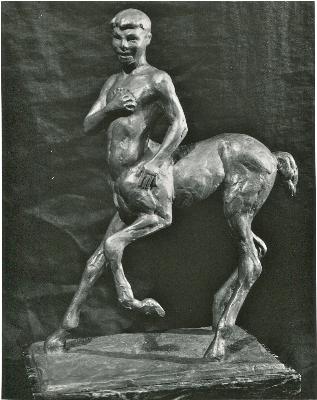
Richmond Barthe (Barthé) is known for his many public works. He received acclaim for his realistic sculptural depictions of African-Americans during the 1930s-40s, and produced numerous portraits, as... Read full biography
Richmond Barthe (Barthé) is known for his many public works. He received acclaim for his realistic sculptural depictions of African-Americans during the 1930s-40s, and produced numerous portraits, as well as allegorical* and genre* figures, and became especially known for his dancers (Falk). Barthe... Read full biography
Richmond Barthe (Barthé) is known for his many public works. He received acclaim for his realistic sculptural depictions of African-Americans during the 1930s-40s, and produced numerous portraits, as well as allegorical* and genre* figures, and became especially known for his dancers (Falk). Barthe was born in Bay St. Louis, Mississippi of French Creole ancestry. His mother was a Robeteau, of New Orleans French Creole ancestry; the Barthé family came from the South West region of France, where... Read full biography
Richmond Barthe (Barthé) is known for his many public works. He received acclaim for his realistic sculptural depictions of African-Americans during the 1930s-40s, and produced numerous portraits, as well as allegorical* and genre* figures, and became especially known for his dancers (Falk). Barthe was born in Bay St. Louis, Mississippi of French Creole ancestry. His mother was a Robeteau, of New Orleans French Creole ancestry; the Barthé family came from the South West region of France, where descendants today still operate an active vineyard among other enterprises. At the age of eighteen, Barthe, then residing in New Orleans, won his first prize -- a blue ribbon for a drawing he sent to the County Fair. In 1924, with the aid of the... Read full biography
Richmond Barthe (Barthé) is known for his many public works. He received acclaim for his realistic sculptural depictions of African-Americans during the 1930s-40s, and produced numerous portraits, as well as allegorical* and genre* figures, and became especially known for his dancers (Falk). Barthe was born in Bay St. Louis, Mississippi of French Creole ancestry. His mother was a Robeteau, of New Orleans French Creole ancestry; the Barthé family came from the South West region of France, where descendants today still operate an active vineyard among other enterprises. At the age of eighteen, Barthe, then residing in New Orleans, won his first prize -- a blue ribbon for a drawing he sent to the County Fair. In 1924, with the aid of the Reverend Harry Kane S.S.I, Barthe, with less than a high school education and no formal training in art, was admitted to... Read full biography
Richmond Barthe - Artist Info
About Richmond Barthe: Books
Books & Publications (32)
Publications based on askART research. List may not be comprehensive.
American Masters of the Mississippi Gulf Coast: George Ohr, Dusti Bonge, Walter Anderson, Richmond Barthe
2009
Black, Patti Carr
99 pages (color)
The Artists Bluebook 34,000 North American Artists to March 2005
2005
AskART.com Inc. - Dunbier, Lonnie Pierson (Editor)
479 pages
Davenport's Art Reference: The Gold Edition
2005
Davenport, Ray
2,421 pages
With an Eye and a Passion: Selections from The Marion Collection
2003
Sherman, Charlotte (Essay)
38 pages (color)
Who Was Who in American Art, 1564-1975: Three Volumes
1999
Falk, Peter Hastings (Editor)
3,724 pages
Black Art and Culture in the 20th Century
1997
Powell, Richard J
256 pages (color)
St. James Guide to Black Artists: Published in Association with Schomburg Center for Research in Black Culture
1997
Riggs, Thomas (Editor); Howard Dobson (Preface)
625 pages
American Art History and Culture
1994
Craven, Wayne
687 pages (color)
A History-African-American Artists From 1792 to the Present
1993
Bearden, Romare/Harry Henderson
542 pages (color)
The Annual Exhibition Record of the Art Institute of Chicago (Exhibition catalog)
1990
Falk, Peter Hastings (Editor)
1,117 pages
Sport in Art From American Museums (Exhibition catalog)
1990
Plimpton, George; J. Carter Brown
128 pages (color)
Black Art/Ancestral Legacy (Exhibition catalog)
1989
Dallas Museum of Fine Art
305 pages (color)
Annual Exhibition Record, 1914-68, Pennsylvania Academy of the Fine Arts (Exhibition catalog)
1989
Falk, Peter Hastings (Editor)
538 pages
African American Artists 1880-1987 Selections from the Evans-Tibbs Collection
1989
McElroy, Guy C (others)
125 pages (color)
Harlem Renaissance Art of Black America (Exhibition catalog)
1987
Studio Museum in Harlem
200 pages (color)
Who's Who in American Art-1986 1986
1986
Jaques Cattell Press
1,292 pages
Who Was Who in American Art: Artists Active Between 1898-1947
1985
Falk, Peter Hastings (Editor)
707 pages
National Portrait Gallery Collection Illustrated Checklist
1985
Smithsonian Institution
461 pages
Dictionary of American Sculptors: 18th Century to Present
1984
Opitz, Glenn B (editor)
656 pages
The American Eagle in Art & Design 321 Examples
1978
Hornung, Clarence Pearson
113 pages (color)
Art: African American
1978
Lewis, Samella
246 pages (color)
Two Centuries of Black American Art (Exhibition catalog)
1976
Driskell, David C
221 pages (color)
Amistad II Afro-American Art (Exhibition catalog)
1975
Driskell, David C
92 pages
Afro-American Artists: A Bio-Bibliographical Directory
1973
Cederholm, Theresa Dickason
348 pages
The Afro-American Artist A Search for Identity
1973
Fine, Elsa Honig
310 pages (color)
The Artist and the Sportsman (The National Art Museum of Sport) (Exhibition catalog)
1968
Scott, Martha B.
95 pages (color)
Art and Life in America Revised and Enlarged Edition
1966
Larkin, Oliver W
559 pages (color)
American Negro Art
1960
Dover, Cedric
186 pages (color)
Modern Negro Art
1943
Porter, James A
272 pages
20th Century Portraits (Exhibition catalog)
1942
Wheeler, Monroe
148 pages (color)
Negro Artists: An Illustrated Review of Their Achievements (Exhibition catalog)
1935
Harmon Foundation
60 pages
Mallet's Index of Artists: International-Biographical Two Volumes: Includes 1940 Index