Page loaded successfully. Showing biography for Rita Ackermann.
Rita Ackermann BIOGRAPHY

Born 1968 Budapest, Hungary. Known for: Semi-abstract conceptual painting, feminist themes.
Rita Ackermann is a Hungarian-American artist. She is currently living and working in New York City. She was born in Budapest (Hungary) in 1968. Ackermann trained at the University of Fine Arts... Read full biography
Rita Ackermann is a Hungarian-American artist. She is currently living and working in New York City. She was born in Budapest (Hungary) in 1968. Ackermann trained at the University of Fine Arts Budapest from 1989 until 1992. She moved to New York City to study at The New York Studio School of... Read full biography
Rita Ackermann is a Hungarian-American artist. She is currently living and working in New York City. She was born in Budapest (Hungary) in 1968. Ackermann trained at the University of Fine Arts Budapest from 1989 until 1992. She moved to New York City to study at The New York Studio School of Drawing, Painting and Sculpture*. In an interview Ackermann was asked about her choice to move to New York and how it has influenced her work to which her response was, "It gave me possibilities that I had... Read full biography
Rita Ackermann is a Hungarian-American artist. She is currently living and working in New York City. She was born in Budapest (Hungary) in 1968. Ackermann trained at the University of Fine Arts Budapest from 1989 until 1992. She moved to New York City to study at The New York Studio School of Drawing, Painting and Sculpture*. In an interview Ackermann was asked about her choice to move to New York and how it has influenced her work to which her response was, "It gave me possibilities that I had to choose from and then learn to narrow… narrow things down to their bare existences to find out the reason to make something where everything is already made or readymade. I am an optimist always full of hope that I find my way that is only my way... Read full biography
Rita Ackermann is a Hungarian-American artist. She is currently living and working in New York City. She was born in Budapest (Hungary) in 1968. Ackermann trained at the University of Fine Arts Budapest from 1989 until 1992. She moved to New York City to study at The New York Studio School of Drawing, Painting and Sculpture*. In an interview Ackermann was asked about her choice to move to New York and how it has influenced her work to which her response was, "It gave me possibilities that I had to choose from and then learn to narrow… narrow things down to their bare existences to find out the reason to make something where everything is already made or readymade. I am an optimist always full of hope that I find my way that is only my way that is my work.". Ackermann has been featured in numerous museum and gallery exhibitions in the United States, Japan and Europe. Si... Read full biography
Artist Biography
Biography page for Rita Ackermann ((Born 1968)), known for Semi-abstract conceptual painting, feminist themes. Showing 3 biographical entries and 0 sample artworks.
Rita Ackermann - Artist Info
About Rita Ackermann
Biography from the Archives of askART
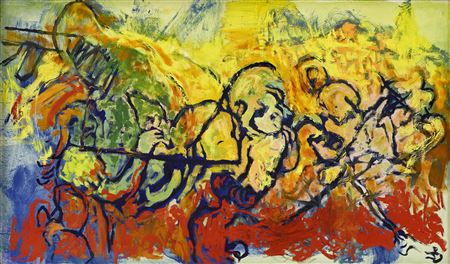 Rita Ackermann is a Hungarian-American artist. She is currently living and working in New York City. She was born in Budapest (Hungary) in 1968.
Ackermann trained at the University of Fine Arts Budapest from 1989 until 1992. She moved to New York City to study at The New York Studio School of Drawing, Painting and Sculpture*. In an interview Ackermann was asked about her choice to move to New York and how it has influenced her work to which her response was, "It gave me possibilities that I had to choose from and then learn to narrow… narrow things down to their bare existences to find out the reason to make something where everything is already made or readymade. I am an optimist always full of hope that I find my way that is only my way that is my work."
Ackermann has been featured in numerous museum and gallery exhibitions in the United States, Japan and Europe. Since the mid-1990s Ackermann has been adding to her knowledge of painting and her social comment. "from stained glass to the red ballpoint pen she’s applied to runway models’ faces in lieu of makeup. She has realized multiform shadow puppet theaters like The Deer Slayer (1997), performed as a band member of the art collaborative Angelblood, and curated exhibitions including The Perfect Man (2007) and The Kate Moss Show (2006, with Olivier Zahm)."
"In both her drawings and collages Ackermann juxtaposes characters and narratives, as in Scorpionun (Man on My Breast/Man, Man between My Legs) (2006), which draws on the semiotics of fertility charms and pornography to create an Anthropomorphism like womanman- child. The superimposed images composing this life-size freestanding collage on plexiglass come from the artist’s own sketches—a row of her lithe women, wearing bowler hats and holding tennis rackets — as well as other sources, such as an illustration of the Madonna and Child positioned over the figure’s heart.
As Scorpionun’s content suggests, Ackermann’s interest in constructions of gender and the fantasies that subtend and are sustained by them has survived her transformation of scale and material. Indeed, the oversize cruciform Nun/Skeleton/Cross (2006) and comparably large-scale Nun/Mother/Whore (2006) revolve around the bifurcated, simultaneously present identities of these objects of desire.
The aggregation in these collages’ list-like titles is mirrored in the conspicuous overlay of their images: Ackermann does not negate tropes of womanhood but stages them as acts and processes of becoming to be set into dizzying and conflicting relief with and within one another. Few clear plots emerge despite her utilizations of fairy-tale themes, and irrespective of the ingratiatingly beautiful protagonists who inhabit them, neither are there storybook endings."
Her work includes paintings, drawings, T-shirts, a line of underwear, and skateboard design. Her paintings in the early and mid 1990s featured nymphetish girls.
In 2008 she participated in the Whitney Biennial.*
Solo exhibitions
• 2016: "JEZEBELS", FARAGO, Los Angeles, March 12 - April 16
• 2005: “Jump On Me”, Bonner Kunstverein, April 29 to July 3
• 2005: “Collage: 1993-2005”, Andrea Rosen Gallery, September 9-October 8
• 2004: “The Dreamland Artist Club”, public project with Creative Time for Coney Island redevelopment, June 12 to September 6
• 2003: Galerie Almine Rech, Paris, France, “Ördögök” (Devils) January 11 to February 22
• 2003: Galerie Peter Kilchmann, Zurich, Switzerland, “Memoires d’Une Jeune Fille Rouge”, May 23 to July 26
• 2003: Andrea Rosen Gallery, New York, “Listen to the Fool’s Reproach”, December 13, 2003 to January 17, 2004
• 2002: Museum Het Domein, Sittard, Holland, “Snowfall in August”, June 2 – August 18
• 2001: The Deep Gallery, Paris, France, “Style Show for the Levitation of the Strong American Women”, June 28 – July 28
• 2001: Peter Kilchmann Galerie, Zurich, Switzerland, “the only way to get to my vagina is through Jesus!”, March 10 – April 12
• 2000: Annet Gelink Gallery, The Netherlands, “Lost and Found Notes”, September 2 – October 15
• 2000: Galerie Krobath Wimmer, Vienna, Austria, “God’s Little Helpers”, May 17 – July 1
• 2000: Andrea Rosen Gallery, New York, “corvette”, March 10 – April 15
• 1999: Parco Gallery, Tokyo, Japan, “Revelation”, September 3 – October 11
• 1999: Swiss Institute, New York, January 21 – March 6, with Ana Axpe
• 1998: Rebecca Camhi Gallery, Athens, Greece, June - September
• 1998: Bartok 32 Galeria, Budapest, Hungary, “Just Do Whatever You Want”, March 13 – April 5
• 1998: Andrea Rosen Gallery, NYC, “Songs of Sirens”, January 9 – February 7
• 1997: Peter Kilchmann Galerie, Zurich, Switzerland, “The Good, The Bad and The Evil”, May/June
• 1996: Andrea Rosen Gallery, New York, “If Anyone Hurts My Brother, I’ll Kill That...”, January 19 - February 24
• 1995: Peter Kilchmann Galerie, Zurich, Switzerland, “The Birth of Tragedy”, September 1–30
• 1995: Interim Art, London, England, “out of the blue into the black”, June 1 - July 15
• 1995: Rebecca Camhi Gallery, Athens, Greece, “It Doesn’t Matter if You Love Me or Not....I’ll Be Always There For You...”, February 11 - March 25
• 1995: Museum of Contemporary Art, “Options 48: Dan Peterman”, November 12 – January 8
• 1994: Andrea Rosen Gallery, New York, “After Dinner I’m Gonna Shoot You But Before I’ll Take A Shower”, July 8 - August 12, 1994
Source:
"Rita Ackerman," Wikipedia, Nov. 2016
* For more in-depth information about these terms and others, see AskART.com. Glossary http://www.askart.com/AskART/lists/Art_Definition.aspxBiography from the Archives of askART
 Rita Ackermann
‘Kline Rape’
Hauser & Wirth?548 West 22nd Street?Chelsea?Through Jan. 14
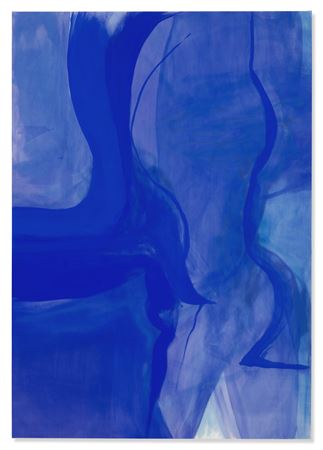
Rita Ackermann paints with skill, attitude and a highly effective command of pink, that girlie color. Her latest semi-abstract paintings, at Hauser & Wirth, seem deliberately unresolved but still quite tasteful. They are among her best, if still not original enough.
But visual originality may interest Ms. Ackermann less than a skeptical conceptual* framework. In some works, big intersecting bars of black and transparent washes evoke the Abstract Expressionist* and the Color Field* painters. The black forms in particular conjure Franz Kline, whose name figures in “Kline Rape,” the show’s suggestive title. If you know a little German, Kline evokes both “kleine” (“little”) rape and “kein” (“no”) rape, and thus male denial of criminality and, more generally, macho unconsciousness — at which the Abstract Expressionists surely excelled.
Ms. Ackermann’s signature line drawings of women idling alone or in one another’s company — as they have tended to do across the history of painting — frequently hover in these abstractions. Several may be self-portraits, like the subject of the show’s first work, a Warholesque black on white drawing on canvas whose jaded subject stares out at us, a champagne glass at her side. Occasionally a more fully painted female figure appears, as in the small Strip Nurse 1, whose smears conjure de Kooning, while its title recalls the artist Richard Prince, known both for paintings of nurses and for his own riffs on de Kooning.
In contrast to the historical commentary of the “Kline Rape” and “Strip Nurse” paintings, the “Stretcher Bar Paintings” are more locally self-referential, alluding to the way stretcher bars can enter the picture by pressing through from the back. Ms. Ackerman’s waiting women inhabit these works too, some of which, like “Stretcher Bar Painting 3,” are among the show’s strongest.
Source:
"Rita Ackermann: What to See in New Your Galleries This Month," The New York Times, by Roberta Smith, November 24, 2016
* For more in-depth information about these terms and others, see AskART.com. Glossary http://www.askart.com/AskART/lists/Art_Definition.aspxBiography from Sotheby's New York
Rita Ackermann’s evocative drawings and paintings range from expressionist renderings of the human figure to highly gestural abstractions. Her chalkboard paintings, for which she is best known, progress through states of deconstruction and disappearance. Their surfaces are primed with chalkboard paint, and preliminary sketches are made in chalk, which Ackermann later smears and washes away with sweeping gestures in high-saturation hues.
Simultaneously erasing and painting through this process, Ackermann leaves very little evidence of her original mark making, instead favoring the forms and marks that self-develop. Sealed with a spray paint fixative, these dynamic and often forceful works are resolved by being held in a permanent state of flux.
Exhibitions of Ackermann’s work have been held at the Ludwig Museum, Budapest; the Chinati Foundation, Marfa; and the Museum of Modern Art, New York, among many others.