Page loaded successfully. Showing biography for Robert Carston Arneson.
Robert Carston Arneson BIOGRAPHY
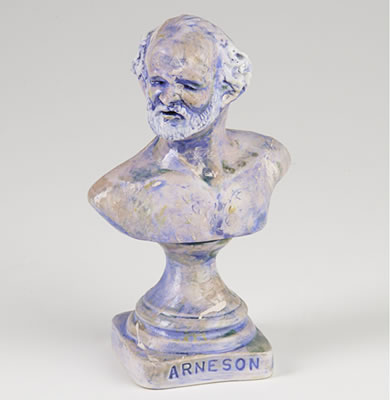
1930 Benicia, California - 1992 Benica, California. Known for: Funk ceramic pop image ceramics, mixed media.
Born in Benicia, California, Robert Arneson almost singlehandedly transformed ceramics into a major contemporary medium. In the early 1960s, he became a member of the Funk Art movement, a California... Read full biography
Born in Benicia, California, Robert Arneson almost singlehandedly transformed ceramics into a major contemporary medium. In the early 1960s, he became a member of the Funk Art movement, a California style of Pop-Art focusing on absurd images of everyday objects. In the 1970s, he began using... Read full biography
Born in Benicia, California, Robert Arneson almost singlehandedly transformed ceramics into a major contemporary medium. In the early 1960s, he became a member of the Funk Art movement, a California style of Pop-Art focusing on absurd images of everyday objects. In the 1970s, he began using humorous portraits as subjects, and his memorial portrait of San Francisco's assassinated Mayor George Moscone was very controversial because it included references to the assassin. As a young man, he was a... Read full biography
Born in Benicia, California, Robert Arneson almost singlehandedly transformed ceramics into a major contemporary medium. In the early 1960s, he became a member of the Funk Art movement, a California style of Pop-Art focusing on absurd images of everyday objects. In the 1970s, he began using humorous portraits as subjects, and his memorial portrait of San Francisco's assassinated Mayor George Moscone was very controversial because it included references to the assassin. As a young man, he was a high school art teacher, who was assigned the teaching of pottery making and, becoming intrigued by its possibilities, he stayed just a step ahead of his students. Within a few years, he realized that clay was his medium, but he did not view it in... Read full biography
Born in Benicia, California, Robert Arneson almost singlehandedly transformed ceramics into a major contemporary medium. In the early 1960s, he became a member of the Funk Art movement, a California style of Pop-Art focusing on absurd images of everyday objects. In the 1970s, he began using humorous portraits as subjects, and his memorial portrait of San Francisco's assassinated Mayor George Moscone was very controversial because it included references to the assassin. As a young man, he was a high school art teacher, who was assigned the teaching of pottery making and, becoming intrigued by its possibilities, he stayed just a step ahead of his students. Within a few years, he realized that clay was his medium, but he did not view it in the conventional way of making pots. He wanted to explore the organic and functional qualities of the material... Read full biography
Artist Biography
Biography page for Robert Carston Arneson ((1930 - 1992)), known for Funk ceramic pop image ceramics, mixed media. Showing 3 biographical entries and 0 sample artworks.
Robert Carston Arneson - Artist Info
About Robert Carston Arneson
Biography from the Archives of askART
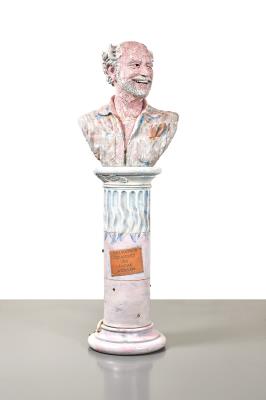 Born in Benicia, California, Robert Arneson almost singlehandedly transformed ceramics into a major contemporary medium. In the early 1960s, he became a member of the Funk Art movement, a California style of Pop-Art focusing on absurd images of everyday objects. In the 1970s, he began using humorous portraits as subjects, and his memorial portrait of San Francisco's assassinated Mayor George Moscone was very controversial because it included references to the assassin.
As a young man, he was a high school art teacher, who was assigned the teaching of pottery making and, becoming intrigued by its possibilities, he stayed just a step ahead of his students. Within a few years, he realized that clay was his medium, but he did not view it in the conventional way of making pots. He wanted to explore the organic and functional qualities of the material itself, and in this approach, was influenced by Peter Voulkos.
He gave his pieces ironic titles and incorporated graffiti, giving him an opportunity to play whimsical games with the work. In the 1970s, he began using humorous portraits as subject matter, sculpting his friends, heroes, and himself--all with ironic comments on the human condition. His works also became increasingly larger, making them a combination of sculpture and ceramics, and with his introduction of colored glazes, he was part of a generation that integrated painting and sculpture.
For many years, Arneson taught at the University of California-Davis, where he influenced many young artists. He died in 1992 from a long battle with cancer that had begun in 1975. This ill health darkened the tone of his clay works, and many of them took on issues such as nuclear war, assassins, and society's victims.
Source:
Thomas Albright, Art in the San Francisco Bay Area
Docent Files, Phoenix Art MuseumBiography from Modern Art Dealers
Robert Carston Arneson (1930 – 1992) was born in Benicia, California, a small coastal town located North of the Carquinez Strait in the San Francisco Bay Area. Arneson is widely-admired for his groundbreaking work in ceramics, which he believed should not be constrained by utilitarian concerns.
Robert Arneson exhibited artistic talent at a very young age.
This willingness to break boundaries and the wry sense of humor that infuses much of his art brought him notoriety as being among California’s “Funk” artists. Robert Arneson created several self-portraits in mixed media, including mirrors, photography and drawings, each of which presented the artist in a different way and, sometimes, seemed to suggest a different personality.
A studied artist, however, Robert Arneson was the recipient of a Master’s of Fine Arts from Mills College in 1958. By 1962, he was serving as the Head of the UC Davis Ceramics Department, and he became a full professor of ceramics at UC Davis in 1973.
Robert Arneson, though known for his irreverence and forever associated with the groundbreaking art of California, had a somber side that expressed itself in his later works. In the 1980’s, he suffered with liver cancer and the darkness of that time is reflected in his works of that era.
Robert Carston Arneson passed away Nov 2, 1992 at his home in Benicia, CA. He was 62 years old.
© Copyright 2018 Modern Art Dealers, Carmel CABiography from Wright
Robert Arneson’s propensity for questioning tactics and breaking rules are distinguishing characteristics in postwar American art. A central figure of the California Funk Art movement, Arneson and his peers were eager to distance themselves from the non-objectivity of Abstract Expressionism, and to embrace an unorthodox and sometimes rudimentary formalism that was both strange and refreshing. Inspired by Peter Voulkos’ unrepentant approach to clay, Arneson rejected the idea that it was a medium of only the utilitarian or decorative. Instead he chose to pioneer a new and unpracticed approach to what was a stalwart of functionality. Arneson created facetious renditions of household wares, such as his irreverently modified and sexualized teapots, anthropomorphic trophies, surrealist self-portrait-busts, and non-utilitarian pots and bricks. Arneson not only advanced the medium of clay—a hero for young and experimentally-inclined clay sculptors—he changed our system of value for what is the humblest of mediums. Arneson was responsible for generating a pivotal impact on one of art’s central roles, that of raising questions in order to change the way we view the world. Arneson was born in Benicia, California, in 1930. He studied at the California College of the Arts (then the California College of Arts and Crafts) receiving his BA in 1954 and his MFA in 1958 from Mills College. Arneson became head of the ceramics department at the University of California at Davis in 1962 and a full professor of art in 1973. He received honorary doctorates from the San Francisco Art Institute and the Rhode Island School of Design, and awards from the American Academy and Institute of Arts and Letters, and the American Craft Council. Arneson has had numerous gallery and museum exhibitions including solo-shows at the Institute of Contemporary Art, Chicago, and the San Francisco Museum of Modern Art, both in 1974, and a 1992 exhibition at the Institute of Contemporary Art, Philadelphia. Arneson's work is in the collections of many institutions, such as the Whitney Museum of American Art, the Los Angeles County Museum of Art, the Philadelphia Museum of Art and the Hirshhorn Museum and Sculpture Garden. The artist died in Benicia, California in 1992.