Page loaded successfully. Showing biography for Robert Chapman Turner.
Robert Chapman Turner BIOGRAPHY
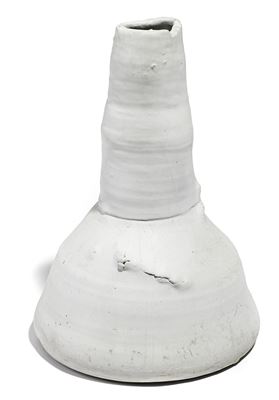
1913 Port Washington, New York - 2005 Sandy Spring, Maryland. Known for: Modernist ceramic pottery, teaching.
Lots Sold: 77%, High Price: Subscribe.
The following text, submitted by Rosalind Zuses, daughter of the artist, is from the artist's obituary, published in the Alfred, New York newspaper. Robert C. Turner, an internationally acclaimed... Read full biography
The following text, submitted by Rosalind Zuses, daughter of the artist, is from the artist's obituary, published in the Alfred, New York newspaper. Robert C. Turner, an internationally acclaimed artist and an emeritus professor of ceramic art at New York State College of Ceramics at Alfred... Read full biography
The following text, submitted by Rosalind Zuses, daughter of the artist, is from the artist's obituary, published in the Alfred, New York newspaper. Robert C. Turner, an internationally acclaimed artist and an emeritus professor of ceramic art at New York State College of Ceramics at Alfred University, died July 26, 2005, at the Friends House Retirement Community in Sandy Spring, MD, where he and his wife, Sue, had resided for the past six years. Recipient of the State University of New York... Read full biography
The following text, submitted by Rosalind Zuses, daughter of the artist, is from the artist's obituary, published in the Alfred, New York newspaper. Robert C. Turner, an internationally acclaimed artist and an emeritus professor of ceramic art at New York State College of Ceramics at Alfred University, died July 26, 2005, at the Friends House Retirement Community in Sandy Spring, MD, where he and his wife, Sue, had resided for the past six years. Recipient of the State University of New York Chancellor's Award for Excellence in Teaching in 1973, Turner was also a past president and honorary member of the National Council on Education for the Ceramic Arts (NCECA). In addition to teaching at Alfred University's School of Art & Design, Turner... Read full biography
The following text, submitted by Rosalind Zuses, daughter of the artist, is from the artist's obituary, published in the Alfred, New York newspaper. Robert C. Turner, an internationally acclaimed artist and an emeritus professor of ceramic art at New York State College of Ceramics at Alfred University, died July 26, 2005, at the Friends House Retirement Community in Sandy Spring, MD, where he and his wife, Sue, had resided for the past six years. Recipient of the State University of New York Chancellor's Award for Excellence in Teaching in 1973, Turner was also a past president and honorary member of the National Council on Education for the Ceramic Arts (NCECA). In addition to teaching at Alfred University's School of Art & Design, Turner started the ceramic program at Black Mountain College in North Carolina, and also taught as a visiting professor at the Unive... Read full biography
Artist Biography
Biography page for Robert Chapman Turner ((1913 - 2005)), known for Modernist ceramic pottery, teaching. Showing 2 biographical entries and 0 sample artworks.
Robert Chapman Turner - Artist Info
About Robert Chapman Turner
Biography from the Archives of askART
 The following text, submitted by Rosalind Zuses, daughter of the artist, is from the artist's obituary, published in the Alfred, New York newspaper.
Robert C. Turner, an internationally acclaimed artist and an emeritus professor of ceramic art at New York State College of Ceramics at Alfred University, died July 26, 2005, at the Friends House Retirement Community in Sandy Spring, MD, where he and his wife, Sue, had resided for the past six years.
Recipient of the State University of New York Chancellor's Award for Excellence in Teaching in 1973, Turner was also a past president and honorary member of the National Council on Education for the Ceramic Arts (NCECA).
In addition to teaching at Alfred University's School of Art & Design, Turner started the ceramic program at Black Mountain College in North Carolina, and also taught as a visiting professor at the University of Wisconsin. He taught summer sessions at Anderson Ranch in Aspen, CO, and the Penland School of Crafts in North Carolina, and served as chairman of the Board of Directors of the Haystack Mountain School of Crafts, Deer Isle, ME.
A Fellow of the American Craft Council and recipient of its highest honor, the Gold Medal, Turner was also a member of the International Academy of Ceramics. Throughout his 60-year career as a ceramic artist, Turner received numerous awards for his work, and participated in a number of group and solo exhibitions, both in the United States and abroad.
His work is found in the permanent collections at museums in Japan and New Zealand, as well as The Smithsonian, The Los Angeles County Museum of Art, the Philadelphia Museum of Art and numerous other private and public collections.
Robert Turner - Shaping Silence, A Life in Clay, which contains essays by Marsha Miro, an art critic at the Detroit Free Press for 21 years, and Tony Hepburn, a colleague of Turner's at Alfred University before becoming head of ceramics at the Cranbrook Academy of Art, with a forward by Janet Koplos, senior editor at Art in America, was published in 2003 by Kodansha International, Ltd. (Tokyo).
Born July 22, 1913, in Port Washington, NY, and raised in Brooklyn, Turner was the son of Henry Chandlee Turner, who owned Turner Construction Co., which was among the first to use steel-reinforced concrete as a building material, and Charlotte Haines Chapman Turner. He attended Swarthmore College, earning a B.A. degree in economics in 1936. He married the former Sue Leggett Thomas, who is also a graduate of Swarthmore College, in 1938.
Turner enrolled in the Pennsylvania Academy of Fine Arts in 1936 to study painting. He received the school's Cresson Traveling Scholarships in Painting in 1939 and 1940. He completed his studies in 1941, just as the United States was entering the war. As a Quaker and a conscientious objector, Turner was assigned to the Civilian Public Service and spent the next four years at a forestry conservation camp in Big Flats, NY, and at a school for developmentally disabled children in Pownal, ME.
With the birth of his son, John, in 1944, Turner began questioning whether he could make a living and support a family as a painter. He decided upon a career as a potter, and began searching for a program that would give him the skills he wanted, along with an advanced degree. The search led him to the Master of Fine Arts program in ceramic art at Alfred University and the place that would be his home for more than 50 years.
Entering as a special student in 1946, Turner had a footed stoneware ashtray, made during his first year, accepted in the Ceramic National Exhibition in Syracuse in 1947, and won honorable mention in the Ceramic National Exhibition the following year, foreshadowing a career filled with honors and awards. He was graduated from AU in 1949 with a Master of Fine Arts degree.
After graduation, Turner was invited to go to Black Mountain College in North Carolina to establish the first ceramic art program at the avant-garde school. He taught there until 1951, when he returned to Alfred Station to establish his own studio, making stoneware bowls, jars and candleholders. In 1953, he had a solo exhibition at the American Craft Guild's America House in New York City, and was named the "Potter of the Year" by the Philadelphia Art Alliance. Two years later, he was awarded the silver medal at the International Ceramics Exposition, Palais Miramor, Cannes, France.
In 1958, he joined the ceramic art faculty at Alfred University as a special instructor in pottery and sculpture and became full-time in 1966. He served twice as chairman of the Art Department and was awarded emeritus status upon his retirement in 1979. Alfred University awarded him the Charles Fergus Binns Medal for Excellence in Ceramic Art in 2000.
Swarthmore College awarded Robert Turner an honorary Doctor of Fine Arts degree in 1987. A lifelong member of the Religious Society of Friends (Quakers), Turner and his wife, Sue, were founding members of the Alfred Friends Meeting. He was active in the work of Friends through the New York Yearly Meeting for 50 years. Turner served on the boards of George School in Newtown, PA; Pendle Hill, a study retreat center in Philadelphia, and Oakwood Friends School in Poughkeepsie, NY.
Turner's beliefs had a profound effect on his life. In a letter to Winslow Ames, who had served with him in the Quaker camp in Indianapolis, Turner wrote, "What part, if any, can and should the art world play in revitalizing people of a perhaps degenerative culture, a culture in which people seem to be morally soft, often, and unaware of their actions, insensitive to the moral religious values in situations. Have not art and those people who know its value more to say than they have said, not only to make art a more vital and integral part of community life, but to minister to the spiritual needs in the broadest sense of the term?"
That attitude prompted Turner to make one of the most controversial decisions of his professional career. In 1968, during the Vietnam Conflict, Turner, Jeff Schlanger and Peter Voulkos were jurors for the Ceramic National Exhibition. After reviewing the slides showing a variety of functional objects, the three rejected all the entries. "I felt the absence of the power of strong conviction to match the depth of the Vietnam despair, at least in what the slides presented to us," Turner wrote at the time.
In addition to his widow, he is survived by three children: John Frederic (Brier Smith) Turner of Memphis, TN; Robert Henry (Karen Koski) Turner of Santa Fe, NM; and Rosalind Turner (Howard) Zuses of Ashton, MD; one niece who lived with them from the age of 12, Lisa Phillips Turner; and six grandchildren, Rachel Sarah Zuses; Elizabeth Rebecca Zuses; Benjamin Isaac Zuses; John Thomas Turner; Brier Cutting Turner; and Joseph Ashton Turner.
He was predeceased by three brothers and a sister: Henry Chandlee Turner Jr. of Greenwich, CT; Katherine Turner Parsons of Mattittuck, NY; Howard Haines Turner of Bloomington, IN; and James Sinclair Turner of San Antonio, TX.
A Quaker memorial service will be held at 10:30 a.m. August 27, 2005, at the Sandy Spring Friends Meeting, Sandy Spring, MD. His ashes will be buried in the graveyard at the Sandy Spring Friends Meeting.
The family has asked that memorial contributions in Turner's name be made to the Sandy Spring Friends Meeting, 17715 Meetinghouse Road, Sandy Spring, MD 20860 or to the National Council on Education for the Ceramic Arts (NCECA), 77 Erie Village Square, Suite 280, Erie, CO 80516-6996.Biography from The Johnson Collection
ROBERT CHAPMAN TURNER (1913–2005)
The perennial question of whether a craft can be art is one that Robert Chapman Turner wrestled with for many years. Should a piece of pottery be purely functional, made in a “production” shop, or can it be something else? He recalled that around 1965, “I was floundering, even though I liked some of the big pieces I was making.” As his career evolved and he became acquainted with pottery from the American Southwest and Africa, he determined that pieces made from clay can indeed be works of art.
Turner was born in Port Washington on the north shore of Long Island, New York. His father owned Turner Construction Co., which was among the first to use steel-reinforced concrete as a building material. Studying economics, he graduated from Swarthmore College in 1936. Changing gears, he enrolled at the Pennsylvania Academy of the Fine Arts to study painting, earning William Emlen Cresson Memorial Traveling Scholarships in 1939 and 1940, allowing him to study in Europe, Mexico, and the Southwest.
During World War II, Turner, as a Quaker, was a conscientious objector and non-combatant who was assigned to the Civilian Public Service, with stints at a forestry conservation camp and a hospital for developmentally disabled patients. With a family to support, and using the GI Bill, he redirected his interests again and went to the New York State College of Ceramics at Alfred University in western New York state, receiving a master of fine arts degree in 1949.
Following graduation, between 1949 and 1951 he held his first teaching position at Black Mountain College in western North Carolina, where he established the ceramics program. Even though Josef Albers believed that the study of materials was critical for artists, he did not favor the teaching of ceramics because he thought clay was too malleable and too easily abused. By 1949 Albers was no longer at the school, which Turner described as “a strange but special place to start a family. Black Mountain was a microcosm of the ‘50s with the happenings staged there and the anticipation of social unrest. All kinds of things that came with Black Mountain eventually affected my work—Abstract Expressionism, yogurt on the stove, social action.”
He further recalled how John Cage “pulled silence into his music,” and how Merce Cunningham “created dance from observing how people pass each other coming out of the subway.” After he left Black Mountain College, Karen Karnes and her husband David Weinrib became the potters-in-residence in the fall of October 1952.
After two years, Turner returned to Alfred, New York and worked as a studio potter before returning to his alma mater, teaching at Alfred University and serving twice as chairman of the School of Art and Design. He was also a visiting professor at the University of Wisconsin. Summers were often spent in Aspen, Colorado, at the Anderson Ranch, or at Penland School of Crafts in western North Carolina beginning in 1969. Upon his retirement ten years later, Turner began to spend winters in Santa Fe, New Mexico, enjoying a more temperate climate than upstate New York. His visits to the Canyon de Chelly, a National Park in Arizona, and his encounters with southwestern pottery significantly impacted his work.
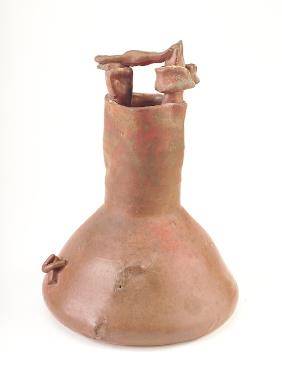
Gradually he moved away from the production of purely functional pieces, creating more inventive objects. “I do what the clay accepts. My love of material and ambiguity, of shape and form. Useful objects with an affinity for simplicity. I thought of a way to avoid handles; you could pick up my casseroles under the rim. … Often when I make something I don’t really know what it’s about; I give it a name later.” Typically, Turner preferred stoneware with semi-monochromatic surfaces, sometimes sandblasted and intentionally asymmetrical. He made a series with “domes” (lids) and late in his career he added strips of clay to the body of his pots, emulating African examples.
Turner garnered recognition for his skills as an educator and an artist; from Alfred University in 1974 he was presented with the Chancellor’s Award for Excellence in Teaching and Swarthmore College awarded him an Honorary Doctor of Fine Art in 1987. He received the Gold Medal for Artistic Excellence from the American Craft Council in 1993, and in 2000 Alfred University presented him with the Charles Fergus Binns Medal of Excellence in Ceramic Art. Turner also served his field, as president of the National Council on Education for the Ceramic Arts and as chairman of the Board of Directors of the Haystack School of Crafts in Deer Isle, Maine.
In an autobiographical article published in 2000, Turner declared: “What technology can’t do is adjust whole systems to match new truths. But we potters can. We may screw up a pot, then see another, better piece in the accident.”
The Johnson Collection, Spartanburg, South Carolina
thejohnsoncollection.org