Page loaded successfully. Showing biography for Robert Combas.
Robert Combas BIOGRAPHY
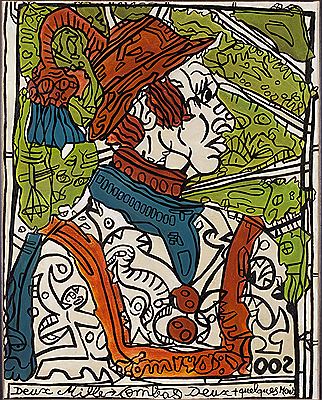
Born 1957 Lyon, France. Known for: Painting and sculpture.
Robert Combas is a French painter and sculptor, born May 25, 1957 in Lyon, France and now living and working in Paris. He is widely recognized as a progenitor of the figuration libre movement that... Read full biography
Robert Combas is a French painter and sculptor, born May 25, 1957 in Lyon, France and now living and working in Paris. He is widely recognized as a progenitor of the figuration libre movement that began in Paris around 1980 as a reaction to the art establishment in general and minimalism and... Read full biography
Robert Combas is a French painter and sculptor, born May 25, 1957 in Lyon, France and now living and working in Paris. He is widely recognized as a progenitor of the figuration libre movement that began in Paris around 1980 as a reaction to the art establishment in general and minimalism and conceptual art in particular. Figuration libre is often regarded as having roots in Fauvism and Expressionism and is linked to contemporary movements such as Bad Painting and Neo-expressionism. It draws on... Read full biography
Robert Combas is a French painter and sculptor, born May 25, 1957 in Lyon, France and now living and working in Paris. He is widely recognized as a progenitor of the figuration libre movement that began in Paris around 1980 as a reaction to the art establishment in general and minimalism and conceptual art in particular. Figuration libre is often regarded as having roots in Fauvism and Expressionism and is linked to contemporary movements such as Bad Painting and Neo-expressionism. It draws on pop cultural influences such as graffiti, cartoons and rock music in an attempt to produce a more varied, direct and honest reflection of contemporary society, often satirizing or critiquing its excesses. Combas' own work has always been strongly... Read full biography
Robert Combas is a French painter and sculptor, born May 25, 1957 in Lyon, France and now living and working in Paris. He is widely recognized as a progenitor of the figuration libre movement that began in Paris around 1980 as a reaction to the art establishment in general and minimalism and conceptual art in particular. Figuration libre is often regarded as having roots in Fauvism and Expressionism and is linked to contemporary movements such as Bad Painting and Neo-expressionism. It draws on pop cultural influences such as graffiti, cartoons and rock music in an attempt to produce a more varied, direct and honest reflection of contemporary society, often satirizing or critiquing its excesses. Combas' own work has always been strongly rooted in depictions of the human figure. The figures are often in wild, violent or orgiastic settings. Usually on large, often un-st... Read full biography
Artist Biography
Biography page for Robert Combas ((Born 1957)), known for Painting and sculpture. Showing 2 biographical entries and 0 sample artworks.
Robert Combas - Artist Info
About Robert Combas
Biography from the Archives of askART
 Robert Combas is a French painter and sculptor, born May 25, 1957 in Lyon, France and now living and working in Paris.
He is widely recognized as a progenitor of the figuration libre movement that began in Paris around 1980 as a reaction to the art establishment in general and minimalism and conceptual art in particular.
Figuration libre is often regarded as having roots in Fauvism and Expressionism and is linked to contemporary movements such as Bad Painting and Neo-expressionism. It draws on pop cultural influences such as graffiti, cartoons and rock music in an attempt to produce a more varied, direct and honest reflection of contemporary society, often satirizing or critiquing its excesses.
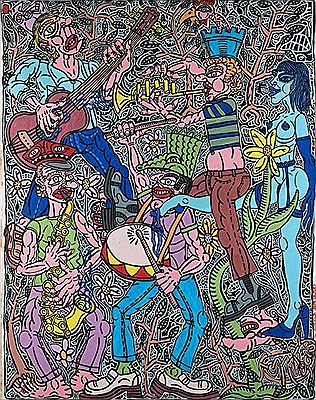
Combas' own work has always been strongly rooted in depictions of the human figure. The figures are often in wild, violent or orgiastic settings. Usually on large, often un-stretched canvases, Combas crowds his flat pictorial space with a teeming proliferation of bodies, street poetry and designs reminiscent of the compulsive patterning in much folk and outsider art. He creates hectic narratives of war, crime, sex, celebration and transgression—in short, every phase that makes up the constant flux of modern life. In recent years a strong autobiographical strain has been evident in his work, which was present only on a subliminal level, if at all, in the earlier work.
Combas often seems to be offering the work as critique—of both the art establishment and society at large. The recent painting "I am greedy man" features a densely layered jostle of bodies, with the foreground dominated by transparent line figures, the background occupied by monochromatic figures and the middle ground reserved for two more fully realized figures, one in a business suit and the other muscular and shirtless. They dance in a swirl of text which seems to have no discernible beginning or end but which may be read as: "I am greedy man/ Please shout me babe/ Soul serenade is a lot of pussy/ Pussy gone on the Eiffel Tower/ My Eiffel Tower is long and large." The lampoon of a society where all are anonymous except in the individual recognition of need and gratification is typical of Combas' work throughout his career.
While Combas' works often seem to carry an element of shock or confrontation, he insists the images are meant to engage the viewer, and their execution in vibrant color and bold, unfettered line communicate a spirit of proletarian camaraderie that offsets the tendency to overwhelm, in the larger works especially.
In a biographical note on Robert Combas' official website the artist asserts his aim is to
"provoke, that is, to trigger a reaction in the spectator only to 'invite' him, beckoning him in and whispering in his ear 'come over and talk to me, I want to tell you about the stupidity, violence, beauty, love, hatred, seriousness and fun, the logic and senselessness that pervade our day-to-day lives' ".
Source:
http://en.wikipedia.org/wiki/Robert_CombasBiography from Pierre Berge
From the autobiography, 1982 "I always painted and drew and went to Fine Arts at 9 years old. My work comes rather from the "scribbles" of school than work at the Beaux-Arts. I was a rather average student. Need to paint. These are men who led me to paint. Difficult to name names, I think we see it in my painting of times. Basically, I'm trying to be an 80s expressionist. " " I'm from a family of six, my father was a laborer, and my mom was doing housework. I went to high school until I was 17, then I went back to the Beaux Arts in Sète for a year, then to the Beaux Arts in Montpellier where I spent five years, I stayed until graduation. It's during the last three years that I I began my first work, which became what was later called "free figuration". The teachers controlled me quite often but I was free, I did what I liked. The first painting that I made I changed it several times, I repainted on it without stopping, then I separated it in 4 parts, then in 3, I cut them I burned one. It was after this painting that I started to make very free paintings, very colorful, quite violent and with many characters who were often fighting or making jokes, I was doing black humor. I was doing a lot of battles because I was scribbling school graffiti on notebooks on the school tables. My first paintings were "Battle of cowboys against Indians," I've always wanted to do something completely new, I always needed to stand out from others, I think I'm a dandy. So I passed my painting degree in St-Etienne in front of a jury, in this jury there was Bernard Ceysson director of the museum of St-Etienne, my job he liked and he offered me to participate in an exhibition at the museum "After Classicism". When I asked why he offered me this exhibition, he replied that in France there was still no one who "Trans before Italian "guard" and the German "New Fauves", while having nothing to do with them. I did this exhibition, I met Bruno Bischofberger, Daniel Templon and other people who looked at my paintings with interest, they bought some pieces. So I went to Paris to live with Di Rosa and Louis Jammes. I always thought that my work should work, I strongly defended it and that's why it worked. I'm really trying to make something new, I'm trying to get out of myself and not to look at the resemblance to someone. I try to be as honest as possible, and in art we thought it was impossible to do something that can not be explained. At Beaux Arts it was like that, I wanted to prove the opposite. I was stuck in kindergarten, at 20 I unlocked by mass work, I graduated, I had nothing intellectual but I had a huge job.