Page loaded successfully. Showing biography for Robert Lee Neal.
Robert Lee Neal BIOGRAPHY
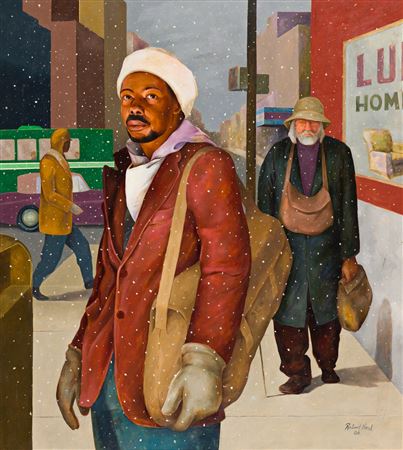
1916 Atlanta, Georgia - 1987 Dayton, Ohio. Known for: Easel and mural painting, segregation themes.
The following is quoted from a 1998 article by Virginia Burroughs in the Dayton Voice: . Another local artist who worked with one of the WPA's most famous artists and who also had ties to the DAI's... Read full biography
The following is quoted from a 1998 article by Virginia Burroughs in the Dayton Voice: . Another local artist who worked with one of the WPA's most famous artists and who also had ties to the DAI's recent exhibition is the late Robert Neal. Neal, a well-known African-American Dayton painter until... Read full biography
The following is quoted from a 1998 article by Virginia Burroughs in the Dayton Voice: . Another local artist who worked with one of the WPA's most famous artists and who also had ties to the DAI's recent exhibition is the late Robert Neal. Neal, a well-known African-American Dayton painter until his death in 1989, did not live in Dayton when he was involved with the WPA. A native of Atlanta, he started painting under the guidance of the famous African-American muralist Hale Woodruff -... Read full biography
The following is quoted from a 1998 article by Virginia Burroughs in the Dayton Voice: . Another local artist who worked with one of the WPA's most famous artists and who also had ties to the DAI's recent exhibition is the late Robert Neal. Neal, a well-known African-American Dayton painter until his death in 1989, did not live in Dayton when he was involved with the WPA. A native of Atlanta, he started painting under the guidance of the famous African-American muralist Hale Woodruff - represented in the DAI exhibition - in Atlanta in the 1930's. "He began his studies when he was 15, and his lessons cost 50 cents a day," said Neal's widow, Alberta Smith Neal. "When he was about 18, Mr. Woodruff wanted him to enter a big show, but Bob... Read full biography
The following is quoted from a 1998 article by Virginia Burroughs in the Dayton Voice: . Another local artist who worked with one of the WPA's most famous artists and who also had ties to the DAI's recent exhibition is the late Robert Neal. Neal, a well-known African-American Dayton painter until his death in 1989, did not live in Dayton when he was involved with the WPA. A native of Atlanta, he started painting under the guidance of the famous African-American muralist Hale Woodruff - represented in the DAI exhibition - in Atlanta in the 1930's. "He began his studies when he was 15, and his lessons cost 50 cents a day," said Neal's widow, Alberta Smith Neal. "When he was about 18, Mr. Woodruff wanted him to enter a big show, but Bob didn't have the right clothes and couldn't afford to attend the opening. "Mr. Woodruff rented him a limousine and a tuxedo... Read full biography
Artist Biography
Biography page for Robert Lee Neal ((1916 - 1987)), known for Easel and mural painting, segregation themes. Showing 2 biographical entries and 0 sample artworks.
Robert Lee Neal - Artist Info
About Robert Lee Neal
Biography from Foothills Fine Art
 The following is quoted from a 1998 article by Virginia Burroughs in the Dayton Voice:
Another local artist who worked with one of the WPA's most famous artists and who also had ties to the DAI's recent exhibition is the late Robert Neal. Neal, a well-known African-American Dayton painter until his death in 1989, did not live in Dayton when he was involved with the WPA. A native of Atlanta, he started painting under the guidance of the famous African-American muralist Hale Woodruff - represented in the DAI exhibition - in Atlanta in the 1930's. "He began his studies when he was 15, and his lessons cost 50 cents a day," said Neal's widow, Alberta Smith Neal. "When he was about 18, Mr. Woodruff wanted him to enter a big show, but Bob didn't have the right clothes and couldn't afford to attend the opening. "Mr. Woodruff rented him a limousine and a tuxedo so he could go, and Bob ended up taking first place in the show - his painting was judged to be better than his teacher's (Woodruff).
Neal moved to Dayton in the early 1940's, after the WPA program had ended, but many local artists recall his stories of Woodruff and his own work with the WPA murals. "Bob was Woodruff's understudy for the Amistad murals at Talladega College in Alabama," said Michael Sampson, local artist and coordinator for public communication at the National Afro-American Museum and Cultural Center at Wilberforce University. The murals were painted in 1939, just before Neal came to Dayton, and Sampson has a copy of a letter written by Woodruff to his biographers that clearly establishes that "Bob actually did the cartoons (under drawings) for the murals, and he posed for all the hand drawings and some of the figures done in the mural." Photographs of the mural series, titled The Mutiny Aboard the Amistad 1839, were on display in the DAI exhibition, and those who knew Neal could recognize his long expressive hands on the men in the paintings; in addition, many of the figures - and even some of the faces - share the same features of Neal's self-portraits.
In Dayton, Neal continued to paint, and some recall his mural that decorated the Lakeside Grill (now the Crescendo) on Germantown St. The club is still operating, but the mural has been painted over. None of the local WPA artists in this article are with us today, and, unfortunately, neither is most of their WPA work. Undoubtedly, not all of the work produced under the auspices of the WPA could be labeled as "great," but the WPA and the art that it spawned is part of America's - and Dayton's - history, and its goal to integrate art into daily life played an important role in our public art legacy. It is ironic that, in just half a century, so much work that was intended to preserve local heritage has been destroyed and forgotten by the "future generations" which it was intended to inspire. Perhaps the most important lesson to be learned from such devastation is that it is imperative to preserve and document public art. After all, it is our public art that, in part, documents and preserves our times, our history, and our heritage. Copyright 1998 Virginia Burroughs.Biography from The Johnson Collection
ROBERT LEE NEAL (1916-1987)
Robert Neal benefited greatly from his relationship with Hale Woodruff, the revered artist-educator who oversaw the art department at Atlanta University (now Clark Atlanta University). A native of Atlanta, Neal started studying under Woodruff as a teenager, presumably when he was enrolled at Atlanta University’s Laboratory School, an experimental preparatory school also attended by Martin Luther King, Jr. According to his widow, Neal “began his studies when he was fifteen, and his lessons cost fifty cents a day. When he was about eighteen, Mr. Woodruff wanted him to enter a big show, but Bob didn’t have the right clothes and couldn’t afford to attend the opening.” Recognizing the talents of his student, Woodruff stepped up, and rented him a tuxedo and limousine. The young artist took the first-place prize in the exhibition. It’s unclear if Neal pursued or received a degree from the university; in a 1977 oral interview, Neal stated that he spent six years on the Atlanta University campus and worked as a student-teacher under Woodruff as part of a scholarship package.
Neal became Woodruff’s chief assistant on a major project, the Amistad Murals at Talladega College in Alabama. Three of these large-scale colorful canvases, painted in 1938, commemorate the uprising aboard the Spanish slave ship. The other panels depict the founding of Talladega College, the construction of Savery Library on that campus, and the Underground Railroad. Neal recounted that “Mr. Woodruff did all of the figures. I did all of the background.” Woodruff would later praise Neal’s integral role in the project: “He kept my sketches and equipment in order. He transferred the cartoons to the actual canvas. He posed for all of the hands and figure gestures that appear in the mural. (His hands were expressive, by nature, artistically structural and adaptive to what I was trying to do.) I don't know what I would have done without him.” When Woodruff became ill shortly before the murals' debut at Talledega, he deputized Neal to oversee the installation of the panels in his stead.
Neal’s painting style resembles the hard-edge realism and deep chiaroscuro of his mentor’s work at the time of the murals. Several works were included in landmark exhibitions centered on the achievements of African American artists, including Contemporary Negro Art, held at the Baltimore Museum of Art in 1939, and the Exhibition of the Art of the American Negro, presented in Chicago in 1940. In his seminal volume Modern Negro Art (1943), James Porter referenced Neal as one of the “interesting personalities” of the Atlanta School who “distinctly bears the mark of Woodruff’s style and methods.”
During this same period, Neal was employed by the Works Progress Administration. In the early 1940s, he moved to Dayton, Ohio, where he executed at least one mural for a local eatery. Little is known about his subsequent life.
The Johnson Collection, Spartanburg, South Carolina
thejohnsoncollection.org