Page loaded successfully. Showing biography for Robert M Broderson.
Robert M Broderson BIOGRAPHY

1920 West Haven, Connecticut - 1992 Independence, Virginia. Known for: Abstract painting, graphics, teaching.
Robert Broderson was born in West Haven, Connecticut on July 6, 1920 and died in Independence, Virginia on March 12, 1992. He was a painter for forty-five years from the time he entered Duke... Read full biography
Robert Broderson was born in West Haven, Connecticut on July 6, 1920 and died in Independence, Virginia on March 12, 1992. He was a painter for forty-five years from the time he entered Duke University after WWII, to his last years in his studio in Independence overlooking the New River. Broderson... Read full biography
Robert Broderson was born in West Haven, Connecticut on July 6, 1920 and died in Independence, Virginia on March 12, 1992. He was a painter for forty-five years from the time he entered Duke University after WWII, to his last years in his studio in Independence overlooking the New River. Broderson served in the Air Force from 1942 to 1945, traveling to Africa, Sicily, England and France. In 1947, with the help of the G.I. Bill, Broderson enrolled as a twenty-seven-year-old freshman at Duke... Read full biography
Robert Broderson was born in West Haven, Connecticut on July 6, 1920 and died in Independence, Virginia on March 12, 1992. He was a painter for forty-five years from the time he entered Duke University after WWII, to his last years in his studio in Independence overlooking the New River. Broderson served in the Air Force from 1942 to 1945, traveling to Africa, Sicily, England and France. In 1947, with the help of the G.I. Bill, Broderson enrolled as a twenty-seven-year-old freshman at Duke University in Durham, North Carolina. In his sophomore year at Duke, Broderson began the work in painting that would be his life. After he graduated from Duke, he received an M.F.A. from State University of Iowa. He then returned to Duke where he taught... Read full biography
Robert Broderson was born in West Haven, Connecticut on July 6, 1920 and died in Independence, Virginia on March 12, 1992. He was a painter for forty-five years from the time he entered Duke University after WWII, to his last years in his studio in Independence overlooking the New River. Broderson served in the Air Force from 1942 to 1945, traveling to Africa, Sicily, England and France. In 1947, with the help of the G.I. Bill, Broderson enrolled as a twenty-seven-year-old freshman at Duke University in Durham, North Carolina. In his sophomore year at Duke, Broderson began the work in painting that would be his life. After he graduated from Duke, he received an M.F.A. from State University of Iowa. He then returned to Duke where he taught classes in drawing and painting for twelve years. He was an Associate Professor of Art when he left Duke... Read full biography
Artist Biography
Biography page for Robert M Broderson ((1920 - 1992)), known for Abstract painting, graphics, teaching. Showing 3 biographical entries and 0 sample artworks.
Robert M Broderson - Artist Info
About Robert M Broderson
Biography from Gallery C
 Robert Broderson was born in West Haven, Connecticut on July 6, 1920 and died in Independence, Virginia on March 12, 1992. He was a painter for forty-five years from the time he entered Duke University after WWII, to his last years in his studio in Independence overlooking the New River.
Broderson served in the Air Force from 1942 to 1945, traveling to Africa, Sicily, England and France. In 1947, with the help of the G.I. Bill, Broderson enrolled as a twenty-seven-year-old freshman at Duke University in Durham, North Carolina. In his sophomore year at Duke, Broderson began the work in painting that would be his life.
After he graduated from Duke, he received an M.F.A. from State University of Iowa. He then returned to Duke where he taught classes in drawing and painting for twelve years. He was an Associate Professor of Art when he left Duke after receiving a Guggenheim Fellowship in 1964. Broderson also taught at North Carolina State University in Raleigh from 1967 to 1968 and at the Skowhegan School of Painting and Sculpture in Maine during the summer of 1967. After the 1960's, Broderson gave up teaching and devoted his life to painting.
Highlights of Broderson's career include the Guggenheim and Ford Foundation Grants and the induction into the American Academy of Arts and Letters. He had shows at the Whitney, the Museum of Modern Art, the Metropolitan, and he was represented by the Catherine Viviano Gallery, which also represented the German Expressionist, Max Beckmann, and other great American Abstract Expressionists.
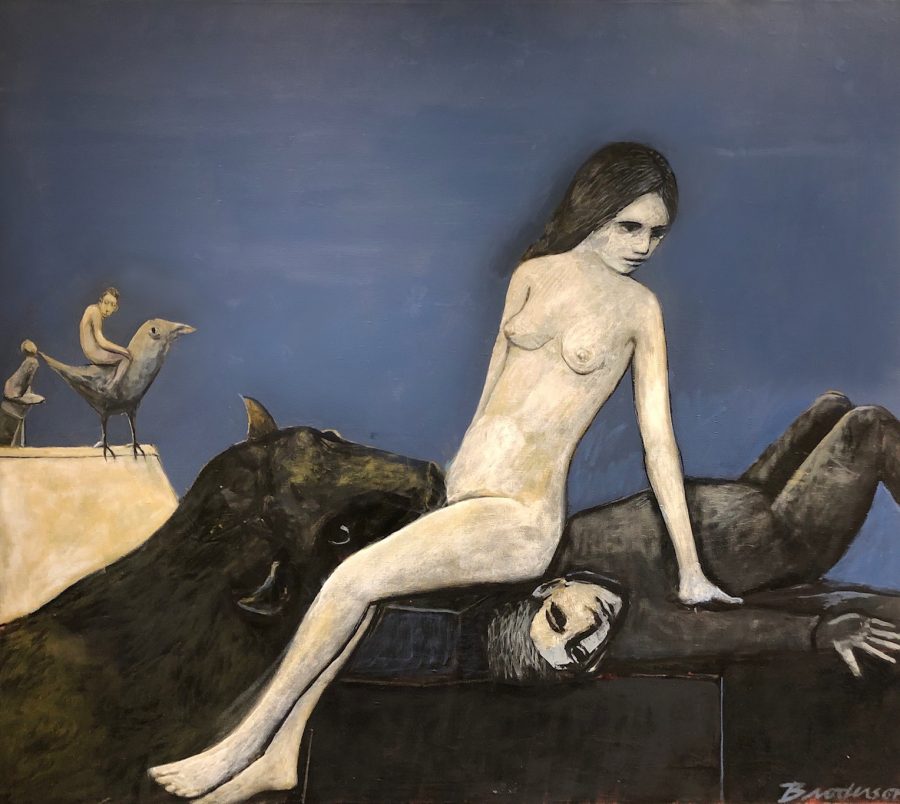
As a painter, Broderson worked mainly with oils; however, in his later years he began experimenting with acrylics. Broderson's work began in black and white. The black was oil, India ink, pastel, or pen; the white was painted, left bare, or scratched off with a penknife. Broderson studied shades of black and white, brown, and gray for decades, and off and on through experiments with color. In his later years, he moved into strikingly discordant colors of oil pastel. In between is a vast body of work, which testifies to the fertility of his creative imagination.
Broderson was a figurative painter, concerned with human and other figures. He sometimes invented new creatures in his work; often, a menagerie of people and the animals seemed to pose the perennial questions: where do we come from, where do we go? He studied all the varieties of human experience and expression. The people in his paintings, as he said, were not real people. He worked on many canvases at once and never hesitated to rework what seemed finished. He hated dating his work or titling, and often covered an entire wall with sheets randomly cut from a roll and worked on them all at once. He peopled whole worlds. He painted nearly every day for forty-five years.
2006 will be remembered as a watershed year in the rediscovery of Robert Broderson, who died in 1993. Two retrospective exhibitions were held: The City of Raleigh Arts Commission and the other at the Greenville Museum of Art in Greenville, North Carolina.
Permanent Collections
Whitney Museum of American Art, New York City
American Academy of Arts and Letters, New York City
National Collection, Smithsonian Institute, Washington, DC
Wadsworth Collection, Hardbrd,CT
Princeton University, Princeton, NJ
Carnegie Institute, Pittsburgh, PA
Colorado Springs Art Center, Colorado Springs, CO
State University of Iowa, Iowa City
Des Moines Art Center, Des Moines, Iowa
Harpur College, Binghampton, NY
North Carolina Museum of Art, Raleigh, NC
Hickory Museum of Art Hickory, NC
Winston-Salem Public Library, Winston-Salem, NC
North Carolina State University, Raleigh, NC
Duke University, Durham, NC
University of North Carolina, Chapel Hill, NC
Guilford College, Guilford, NC
Source:
Carol Broderson. Interview. Independence, Virginia. Jan. 19, 1995.Biography from The Johnson Collection
ROBERT MAURICE BRODERSON (1920–1992)
Several short statements on a website dedicated to Robert Maurice Broderson, a figurative painter, belie his inclination to depict gloomy looking individuals. For example: “And what does my work express? A little joy, a lot of pain, and many unanswered questions.” And: “Anything I say about my own work to heighten your awareness will naturally be biased and perhaps blind, since I cannot stand outside either my paintings or myself.”
Robert Maurice Broderson was born in West Haven, Connecticut. While serving in the United States Air Force between 1942 and 1945 he went to Africa, Sicily, England, and France. Using the GI Bill, in 1947, at the age of twenty-seven, Broderson enrolled as a freshman at Duke University in Durham, North Carolina. The following year he took up painting. Following graduation, he earned his Master of Fine Arts degree in 1952 at the University of Iowa in Iowa City. He studied with Mauricio Lasanky, a noted educator and printmaker.
Returning to Durham, he began a teaching career at his alma mater from 1957 to 1964. He was awarded a Guggenheim Fellowship in 1964 for painting, the same year Peter Grippe received one to work in sculpture. During the summer of 1967 Broderson taught at the Skowhegan School of Painting and Sculpture in Maine, where in the 1950s both David Driskell and Sigmund Abeles had been students. The next academic year (1967/1968) Broderson was an instructor at North Carolina State University in Raleigh, before giving up teaching to travel extensively and paint.
The subjects of Broderson paintings are typically pairs or small groups of figures placed against spare backgrounds and characterized by pale, moon-shaped faces. He admits that the reaction to them has been mixed: “My work has engendered both hostility and indifference, anger and fear. It has been described, variously, as grotesque, unhappy, depressing, prophesying doom, and impossible to live with. Seldom has it been seen as tender, compassionate, humorous or beautiful, and never, as I see it, understood.”
The Johnson Collection, Spartanburg, South Carolina
thejohnsoncollection.orgBiography from Boca Raton Museum of Art
Robert Broderson was born July 6, 1920 in West Haven, Connecticut. He died in Independence, Virginia on March 12, 1992. He began painting as an older student attending Duke University on the G.I. Bill after World War II. After he graduated from Duke in 1950, he continued painting and studied printmaking with Mauricio Lasansky at the State University of Iowa, where he received an M.F.A. in 1952.
Broderson then returned to Duke where he taught classes in drawing and painting for twelve years and became an Associate Professor of Art. He left Duke in 1964 after receiving a Guggenheim Fellowship*. Broderson also taught at North Carolina State in Raleigh in 1967-68, and at the Skowhegan School* of Painting and Sculpture in Maine during the summer of 1967.
After the 1960s, Broderson gave up teaching and devoted himself full-time to painting. Broderson was a figurative painter, concerned with human and other figures. His subjects, as he said, "always tend more toward the imaginative than the real." The people in his paintings are not real people; the landscapes do not exist in nature.
By The Boca Raton Museum of Art
Catalina Torres (Intern)
* For more in-depth information about these terms and others, see AskART.com Glossary http://www.askart.com/AskART/lists/Art_Definition.aspx