Page loaded successfully. Showing biography for Robert Seldon Duncanson.
Robert Seldon Duncanson BIOGRAPHY
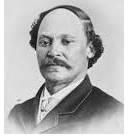
1821 Seneca County, New York - 1872 Detroit, Michigan. Known for: Hudson River landscape, portrait, floral still life and genre painting, murals.
The following information was submitted by Kate Pennington of Maine Antique Digest. On April 23, 2012, she wrote: "Our most recent issue features an article by Jeanne Schinto on Robert S. Duncanson... Read full biography
The following information was submitted by Kate Pennington of Maine Antique Digest. On April 23, 2012, she wrote: "Our most recent issue features an article by Jeanne Schinto on Robert S. Duncanson in which she reports that his middle name is actually Seldon, not Scott, and his father was not... Read full biography
The following information was submitted by Kate Pennington of Maine Antique Digest. On April 23, 2012, she wrote: "Our most recent issue features an article by Jeanne Schinto on Robert S. Duncanson in which she reports that his middle name is actually Seldon, not Scott, and his father was not Scottish-Canadian.". The article follows. Artist Robert S. Duncanson: . "What's in a Middle Name" by Jeanne Schinto. An exhibition curated by Joseph D. Ketner II, "Robert S. Duncanson: The Spiritual... Read full biography
The following information was submitted by Kate Pennington of Maine Antique Digest. On April 23, 2012, she wrote: "Our most recent issue features an article by Jeanne Schinto on Robert S. Duncanson in which she reports that his middle name is actually Seldon, not Scott, and his father was not Scottish-Canadian.". The article follows. Artist Robert S. Duncanson: . "What's in a Middle Name" by Jeanne Schinto. An exhibition curated by Joseph D. Ketner II, "Robert S. Duncanson: The Spiritual Striving of the Freedmen's Sons", was on view at the Thomas Cole National Historic Site in Catskill, New York, from May 1 through October 30, 2011. The accompanying 34-page illustrated catalog, written by Ketner, amounts to a mini-biography of the artist.... Read full biography
The following information was submitted by Kate Pennington of Maine Antique Digest. On April 23, 2012, she wrote: "Our most recent issue features an article by Jeanne Schinto on Robert S. Duncanson in which she reports that his middle name is actually Seldon, not Scott, and his father was not Scottish-Canadian.". The article follows. Artist Robert S. Duncanson: . "What's in a Middle Name" by Jeanne Schinto. An exhibition curated by Joseph D. Ketner II, "Robert S. Duncanson: The Spiritual Striving of the Freedmen's Sons", was on view at the Thomas Cole National Historic Site in Catskill, New York, from May 1 through October 30, 2011. The accompanying 34-page illustrated catalog, written by Ketner, amounts to a mini-biography of the artist. Works by the 19th-century African-American artist who signed himself "Robert S. Duncanson," "R.S. Duncanson,"... Read full biography
Artist Biography
Biography page for Robert Seldon Duncanson ((1821 - 1872)), known for Hudson River landscape, portrait, floral still life and genre painting, murals. Showing 7 biographical entries and 0 sample artworks.
Robert Seldon Duncanson - Artist Info
About Robert Seldon Duncanson
Name variants
Robert Scott Duncanson
Biography from the Archives of askART
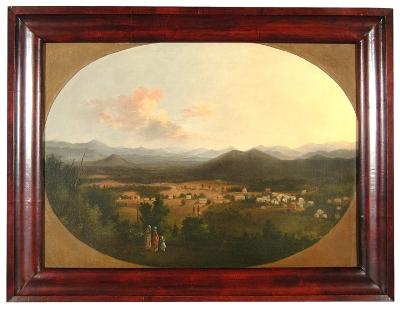 The following information was submitted by Kate Pennington of Maine Antique Digest. On April 23, 2012, she wrote: "Our most recent issue features an article by Jeanne Schinto on Robert S. Duncanson in which she reports that his middle name is actually Seldon, not Scott, and his father was not Scottish-Canadian."
The article follows.
Artist Robert S. Duncanson:
"What's in a Middle Name" by Jeanne Schinto
An exhibition curated by Joseph D. Ketner II, "Robert S. Duncanson: The Spiritual Striving of the Freedmen's Sons", was on view at the Thomas Cole National Historic Site in Catskill, New York, from May 1 through October 30, 2011. The accompanying 34-page illustrated catalog, written by Ketner, amounts to a mini-biography of the artist.
Works by the 19th-century African-American artist who signed himself "Robert S. Duncanson," "R.S. Duncanson," or simply "Duncanson" are increasingly in demand, and with that has come scrutiny of his middle initial "S" and what it stands for. Following the lead of auction house catalogs and the Internet, I have written his middle name as "Scott" in an article published in M.A.D. within the last year (see "Collectors Dominate African-American Fine Art Auction," May 2011), but in the last few months—most recently on February 3, when the National Gallery of Art in Washington, D.C., announced that it had bought a still life by Duncanson (1821-1872) in a private sale—I have noticed him being referred to as "Robert Seldon Duncanson." I knew it was time to ask the question: Is this another one of those Fitz Hugh Lane/ Fitz Henry Lane situations?
Nigel Freeman, Swann Galleries' African-American fine art specialist, said yes, adding that the dissemination of the correct information is largely due to the efforts of Joseph D. Ketner II. Ketner, I learned, has been studying Duncanson for 36 years. I reached him by phone at his office at Emerson College in Boston, where he is the Henry and Lois Foster Chair in Contemporary Art Theory and Practice and the college's Distinguished Curator-in-Residence. He said the erroneous attribution of "Scott" to the "S" in Duncanson's name is "a twentieth-century construction," the result of another error, namely that the artist's father was a white Scottish-Canadian. In fact, both of Duncanson's parents were Virginians who moved to Fayette, New York, around the turn of the 19th century, and neither was white, said Ketner, who has tracked the Duncanson family in every U.S. Census from 1820 through 1900. Rather, they were described as "mulatto" and/or "free colored persons" and were undoubtedly seeking opportunities in the North after slavery was abolished there.
According to Ketner, an oral history account by Francis Carr Wright, an amateur historian in Mount Healthy, Ohio, inaugurated the mistake about the race and nationality of Duncanson's father. A follower of Hudson River school painter Thomas Cole (1801-1848), Duncanson lived and painted landscapes in the Ohio River Valley, beginning in the 1840's. In fact, he is considered the preeminent landscape painter of the region, having had the place to himself once William L. Sonntag (1822-1900) and T. Worthington Whittredge (1820-1910) left for New York City. Wright's error was published in a 1924 article in the Cincinnati Enquirer, "Robert S. Duncanson, A Cincinnatian Who Became World Famous as an Artist."
The error was repeated in an article about Duncanson by James A. Porter, the first monographic study on the artist, published in the October 1951 issue of Art in America, and it has been reiterated ever since. As recently as September 25, 2010, there it was again, in an essay by John Wilmerding published in the Wall Street Journal.
As for the "Scott," Ketner said he presumes that the myth of the Scottish ancestry morphed into a middle name that echoed it. He doesn't know who first made that mistake, but he can cite its earliest appearance in print. It occurred in Two Centuries of Black American Art (1976) by David C. Driskell, who published it without a footnote referencing his source.
So how and when did Ketner determine that Seldon was the correct name? He credits Julie Aronson, curator of American painting, sculpture, and drawings at the Cincinnati Art Museum, who came upon it about two years ago. "I had been looking for a primary resource that listed his middle name since the seventies, and this woman found it."
Aronson made her discovery in the article "Artists and the Fine Arts Among Colored People" in the January 1860 issue of Repository of Religion and Literature. "It is the sole mention of Duncanson's middle name as 'Seldon,'" Ketner stated. "And the same book confirms all the census biographical information that I first published twenty years ago and have amplified, as I have gotten more information, in the intervening time."
How Ketner became interested in Duncanson is another story in which serendipity played a role. It was 1976, and he was studying European art history at Indiana University when a girlfriend took him to meet her grandparents in Cincinnati. "So I'm introduced to the family, and because I'm an art history student, we went into the city to see the museums." At the Taft Museum of Art, Ketner saw a number of "huge landscape paintings—really fine paintings."
There were eight of them, commissioned by the lawyer and horticulturist Nicholas Longworth (1782-1863), who owned the mansion, called Belmont, that is now the museum. More information about these imaginary landscapes and Duncanson is on the museum's Web site (www.taftmuseum.org), but on the day when Ketner was visiting, he was informed only by "a little card leaning on the wainscoting" that said "Robert S. Duncanson." So Ketner asked the security guard about him. "He told me, 'Oh, he was a slave of the landowner. He painted them.' And I thought, 'Mmmm, I don't think so.' So when I got back to Indiana, I conducted a little project to find out who this guy was."
The little project led to a larger one, and then more, and more. Said Ketner, author of The Emergence of the African-American Artist: Robert S. Duncanson, 1821-1872 (University of Missouri Press, 1993) "That's essentially how Duncanson took over my life."
Originally published in the May 2012 issue of Maine Antique Digest. © 2012 Maine Antique Digest
Online Source:
http://www.maineantiquedigest.com/stories/index.html?id=3128Biography from the Archives of askART
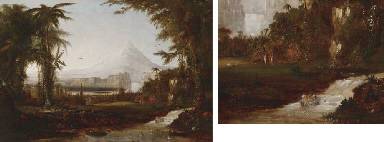 Although Hudson River style landscape painting is most associated with Robert Duncanson, his floral still lifes first brought him recognition. He is also thought to be the first black painter and muralist in America to earn his living by painting and to become internationally known.
Born in New York State to a Scottish Canadian father and mulatto mother, he likely had a birth year between 1817 and 1822, but that remains uncertain. Because of racial prejudice, his father took him to Canada to be educated in a more tolerant atmosphere. As an artist, he was largely self-taught and studied reproductions of the Hudson River School painters. In 1841, he joined his mother in Cincinnati, Ohio, and shortly after began exhibiting there.
Nicholas Longworth, a prominent citizen, supported his work and commissioned him to paint murals in his residence, now the Taft Museum. These eight murals were large-scale landscapes with elaborate frames and were covered with wall paper by subsequent owners. However, the daughter of these owners and her husband, Anna Sinton and Charles Taft, gave them to the city of Cincinnati, and Cincinnati Art Museum Director, Walter Siple had them restored.
Duncanson traveled widely from Cincinnati, doing numerous landscapes and also some daguerreotypes. In 1853, he went to Europe and then returned to paint classical motifs into his landscapes, obviously influenced by his exposure in Europe to Neo-Classicism. During the Civil War, he was in England and Scotland.
In 1872 he suffered a mental breakdown and died shortly after in Detroit, Michigan.
Source:
Michael David Zellman, 300 Years of American ArtBiography from Roger King Fine Art
Robert Scott Duncanson (1821-1872) was a major figure in the mid-19th century group of Ohio River Valley landscape painters; during his lifetime he earned a reputation as a painter in the western United States. The son of a free African-American mother and a Scottish-Canadian father, Duncanson was apprenticed in his youth to his family's housepainting and carpentry business in Canada. He was self-taught as an artist and began his career by copying popular prints. His first forays into independent works were mainly portraits.
Duncanson moved to Cincinnati in the 1840s, the city to which he would always return and with which he is most closely associated. For some years he worked as an itinerant painter; the progress of his career is an often-confusing web of locations and dates. Duncanson moved between cities like Detroit and Cincinnati, sometimes staying for as little as a year. In addition, he made frequent sketching trips that took him back and forth across the mid-West, East to New England, and north to Canada.
For a time he advertised himself as a portrait and "historical" painter in Detroit; later he was known as a "daguerreotype artist" in Cincinnati. In the early 1850s, he received a commission from Nicholas Longworth, a wealthy Cincinnati landowner, horticulturist, art patron and ardent abolitionist, to execute an elaborate series of murals for the walls of his home, "Belmont." This commission marked the largest single project of Duncanson's career and provided him with the means to undertake his first tour of Europe.
Duncanson traveled to England and Europe several times, first in the company of William Sonntag, another major landscapist of the Ohio Valley group, and John Robinson Tait. In England he was welcomed by an aristocratic group of abolitionist supporters. Duncanson also traveled to Scotland, exhibiting his work and making sketches that he later developed into landscape paintings. The influence of his travels in Italy is evident in the elements of fantasy in his mid-career works. Toward the end of his career, Duncanson spent time in Canada, where he was influenced by the extreme wilderness, and his works from that period inclined toward greater detail and observation of nature.
Duncanson made a final trip to Scotland in 1871, exhibiting a body of new landscapes on his return to America. Although his career was flourishing, he suffered increasingly from delusions, hallucinations, and anxiety. Always excitable, garrulous and somewhat obsessive, his mental stability became increasingly impaired as his career progressed. It has been theorized that Duncanson suffered from lead-paint poisoning, the cumulative effect of his years as a housepainter, exacerbated by years of grinding and mixing paints.
He was hospitalized at the Michigan State Retreat, a sanitarium, and died in December 1872.Biography from Questroyal Fine Art, LLC
Robert Seldon Duncanson was born in the Finger Lakes region of New York to a poor family of free African-American tradesmen. Soon after his birth, his parents relocated to the town of Monroe on the western coast of Lake Erie, in territory that would later become Michigan. There, he and his brothers were apprenticed in the family trades of housepainting, decorating, and carpentry. In 1841, Duncanson returned to the United States with his mother, moving to the small town of Mount Holy, Ohio. Duncanson's close proximity to Cincinnati, a home to the Hudson River School movement, instilled in him an appreciation of pastoral landscapes and realism.
Duncanson's approach of integrating the stylistic elements of the Hudson River School with his knowledge of literature continuously developed throughout his career. In 1848, Duncanson received his first important commission from Nicholas Longworth, which was a series of pastoral murals rendered in pastel tones that demonstrated his awareness of luminist landscape painting.
In 1864, Duncanson left Cincinnati and relocated to Montreal, possibly as a result of racial tensions stemming from the Civil War. The two-year stay in Canada proved advantageous for Duncanson's career, with reports stating, "…his color did not prevent his association with other artists and his entrance into good society." During his time in Montreal, Duncanson created several pieces that exercised a tonal realism that was at the time popular in Canadian landscape photography. The success of his works consequently led to Duncanson gaining representation by art dealer A.J. Pell in 1864, in addition to being invited to exhibit at both the 1864 and 1865 Conversaziones of the Art Association of Montreal.Biography from Q.M.R. Fine Art Consulting, LLC
Robert S. Duncanson achieved unprecedented renown in the art world in the 19th century despite the adversity he faced as a freeborn "person of color", earning national and international acclaim for his landscape paintings. He pursued his artistic career during a time of tremendous racial prejudice and was one the first African American artists to appropriate the landscape as part of his cultural heritage and as an expression of his cultural identity.
He was a self trained artist and started his career as a apprentice working as a house painter (murals), portraiture, and landscape art in Cincinnati, Detroit, Montreal and London. His method is attributed to Thomas Cole and William Sonntag to whom he traveled and studied with extensively. Many of his paintings were attributed to other well known caucasian artists of the time due to racial prejudice and the need for him to earn a living in his trade.
His formative years focused on portraits and murals from commissioned work. After traveling up to New York, Pennsylvania, Ohio and Cananda his focused changed more to that around the Hudson River School movement and Ohio River Valley.Biography from The Johnson Collection
ROBERT SELDON DUNCANSON (1821–1872)
Hailed as the first African American artist to achieve both national and international recognition during his lifetime, Robert Duncanson was a self-taught painter whose romantic landscapes bear comparison to works by the central figures of the Hudson River School and, as one London critic opined, with “any of the modern British school.”
Details about Duncanson’s early life and education are sparse and often conflicting. One of the chief questions surrounding the artist has been his race and lineage. Scholars now concur that Duncanson was born to free Virginians “of color.” His family, described in historical literature and official census records as “mulatto,” settled in the upstate New York town of Fayette around the turn of the century, where Robert was born in 1821. Later, the Duncansons moved west to Monroe, Michigan. As one of five sons, teen-aged Robert was trained in the family trades of carpentry and house painting. While pursuing gainful employment as a painter and glazier, Duncanson began to make art. Despite his lack of formal instruction, he started with portraiture before advancing to landscapes and genre scenes. In the early 1840s, Duncanson relocated to Cincinnati, known for its active art community and significant population of free blacks. There, he advertised his services as both a house painter (muralist) and a “fancy painter,” and established a studio adjacent to the one used by William Louis Sonntag, the area’s leading landscape painter and a member of the Hudson River School. Sonntag was both friend and mentor to Duncanson; the pair later traveled abroad together. During his first years in Cincinnati, Duncanson struggled to make ends meet and sometimes worked as an itinerant painter, often visiting Detroit. Toward the latter 1840s, abolitionists began to patronize the artist, and commissions grew in number and import.
In the summer of 1850, Duncanson made a well-documented sketching trip through Kentucky, Tennessee, and western North Carolina in search of subject matter for his brush, a common practice for artists of the day. Accompanied by Augustus O. Moore—a white artist and merchant from Georgia—the two made their way through the racially charged South without incident. Details of the visit to Asheville, North Carolina, was reported in the same August 14 edition of the local newspaper that included advertisements for the purchase of “young Negroes”: “Mr. R. S. Duncanson and Mr. A. O. Moore, of Cincinnati, Ohio, have been at our village for a fortnight or more, taking sketches of the mountain and river scenery. . . . Mr. Duncanson appears to be a fine artist . . . and we wish him abundant success.” Three years later, Duncanson departed for a year-long grand tour of Europe. In an 1854 letter to a friend, he wrote of the enlightenment and encouragement the trip provided: “Every day . . . sheds a new light over my path. . . . My trip to Europe has to some extent enabled me to judge of my own talent. Of all the landscapes I saw in Europe (and I saw thousands) I do not feel discouraged.” Regular reviews of his work in the Cincinnati press testify to his critical and commercial success throughout this decade.
Inspired by the masters of the Hudson River School and Sonntag’s sweeping Midwestern vistas, Duncanson’s landscapes are dramatic testaments to the pastoral beauty of nature—but did little to reflect the grave political climate of the mid-nineteenth century. Although he was active in abolitionist societies and donated paintings in support of the cause, he rarely addressed the national controversy in his paintings. In 1853, Duncanson executed Uncle Tom and Little Eva, a scene based on an engraved illustration in Harriet Beecher Stowe’s Uncle Tom’s Cabin, and believed to be the only example of a Duncanson work in which a black person is centrally featured. Most pictorial references, however, are quite subtle and simply document African Americans and Native Americans as active participants in the physical world, as exemplified by the Native American figures featured in the foreground of Hunting in the Woods. Duncanson’s most overt commentary on the issue of slavery was perhaps expressed in his 1861 self-described “great picture,” The Land of the Lotus Eaters. Inspired by Alfred Tennyson’s poem of a similar title (and rooted in Homer’s Odyssey), the large canvas portrays indigenous peoples greeting a group of white soldiers. When the painting went on exhibit in London, it was hailed as “a grand conception, and a composition of infinite skill . . . [that] may rank among the most delicious that Art has given us” and was promptly purchased by the king of Sweden. Extant photographs and anecdotal accounts suggest that some may have assumed that the light-skinned Duncanson was white, perhaps easing his acceptance in white art circles. In a letter to his son, Duncanson made his position plain: “I have no color on the brain; all I have on the brain is paint.”
During the Civil War, Duncanson lived in Canada before obtaining a diplomatic passport that allowed him to travel to continental Europe and Great Britain from 1865 to 1866. He paid a final visit to England and Scotland in 1870, and it was not long after his return to the United States that he experienced a serious decline in his health. As evidenced in later paintings, Duncanson suffered from mental illness now thought to have been caused by prolonged exposure to lead paint. Fellow artist and friend Henry Mosler remarked on Duncanson’s moodiness and sudden upheavals. After a breakdown in 1872, Duncanson died in a Michigan hospital at the age of fifty-one. Following his death, the artist fell into relative obscurity, and it is only in recent decades that scholars have re-examined his pioneering career. Noted professor and author Richard Powell describes Duncanson’s success as a “victory over society’s presumption of what an African American artist should create.”
The Johnson Collection, Spartanburg, South Carolina
thejohnsoncollection.orgBiography from Brunk Auctions
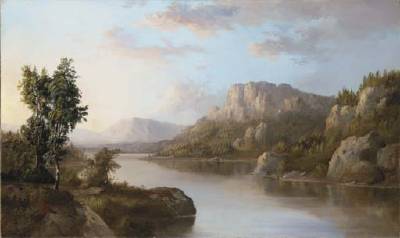 The following information was submitted February 2005 by Laura Crockett, Fine Arts Specialist of Brunk Auctions. The biography was extracted from the article 'Robert Duncanson's View of Asheville, North Carolina, 1850 by Andrew Brunk in "May We All Remember Well", Robert Brunk, 1997.
Robert Scott Duncanson was born in 1821 in upstate New York. From New York his family moved west to Monroe, a town on the western tip of Lake Erie in what is now Michigan. Duncanson apprenticed in the family trades of house painting and carpentry. In 1838, he and an associate formed a partnership and advertised as "painters and glaziers" in the "Monroe Gazette".
Through the 1840's, Duncanson taught himself the techniques of fine-art painting, concerning himself primarily with portraiture, but painting some historical subjects, estate views, genre scenes, and copies of well-known works taken from prints. The Longworth Murals represent Duncanson's largest commission. They were likely executed during 1850-1852.
By the beginning of 1850, Duncanson was residing primarily in Cincinnati in a studio adjoining that of William Sonntag.
In 1850, his painting View of Asheville, North Carolina was executed. The Asheville Messenger recorded the visit on August 14, 1850 with the following lines: "Artists.- Mr. R.S.Duncanson and Mr. A.O. Moore, of Cincinnati, Ohio, have been at our village and vicinity for a fortnight or more, taking sketches of the mountain and river scenery.- They have visited Warm Springs, French Broad, Black Mountain, Cumberland Gap and Hickory Nut Gap, and have a number of correct sketches of the most interesting objects at these places. Mr. Duncanson appears to be a fine artist...."