Page loaded successfully. Showing biography for Roland Strasser.
Roland Strasser BIOGRAPHY

1895 Vienna, Austria - 1974 Santa Monica, California. Known for: Orientalist figure and genre painting, romanticism.
Born in Austria on April 24, 1895. Strasser settled in Los Angeles in 1934. He died there on July 27, 1974. Source: Edan Hughes, "Artists in California, 1786-1940". Death record. Nearly 20,000... Read full biography
Born in Austria on April 24, 1895. Strasser settled in Los Angeles in 1934. He died there on July 27, 1974. Source: Edan Hughes, "Artists in California, 1786-1940". Death record. Nearly 20,000 biographies can be found in Artists in California 1786-1940 by Edan Hughes and is available for sale... Read full biography
Born in Austria on April 24, 1895. Strasser settled in Los Angeles in 1934. He died there on July 27, 1974. Source: Edan Hughes, "Artists in California, 1786-1940". Death record. Nearly 20,000 biographies can be found in Artists in California 1786-1940 by Edan Hughes and is available for sale ($150). For a full book description and order information please click here.... Read full biography
Born in Austria on April 24, 1895. Strasser settled in Los Angeles in 1934. He died there on July 27, 1974. Source: Edan Hughes, "Artists in California, 1786-1940". Death record. Nearly 20,000 biographies can be found in Artists in California 1786-1940 by Edan Hughes and is available for sale ($150). For a full book description and order information please click here.... Read full biography
Born in Austria on April 24, 1895. Strasser settled in Los Angeles in 1934. He died there on July 27, 1974. Source: Edan Hughes, "Artists in California, 1786-1940". Death record. Nearly 20,000 biographies can be found in Artists in California 1786-1940 by Edan Hughes and is available for sale ($150). For a full book description and order information please click here.... Read full biography
Artist Biography
Biography page for Roland Strasser ((1895 - 1974)), known for Orientalist figure and genre painting, romanticism. Showing 3 biographical entries and 0 sample artworks.
Roland Strasser - Artist Info
About Roland Strasser
Name variants
Roland Stasser
Biography from the Archives of askART
 Born in Austria on April 24, 1895. Strasser settled in Los Angeles in 1934. He died there on July 27, 1974.
Biography from Tobin Reese Fine Art
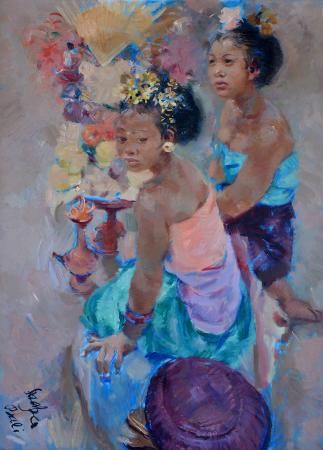 Painter, graphic artist, and worldwide traveler and writer, Roland Strasser, was born in Vienna, Austria in 1895 and died in Santa Monica, California in 1974. His father, Arthur Strasser, and brother, Benjamin Strasser, were also artists. Arthur Strasser was instrumental in developing his sons' artistic interests and talents, as well as an appreciation for travel and culture.
Roland Strasser is known for painting people and cultures regarded as mysterious and foreign to Europeans of his time. Some of the areas he visited were considered extremely isolated—even to the native peoples of those areas. To access and observe the subjects of these remote places, Strasser risked his life, traveled thousands of miles, and spent decades away from his home and family. He was an Orientalist romantic painter and recognized for his ability to beautifully capture both the physical postures and psychological states of his subjects.
Details about Strasser's early work are sparse. Between 1911 and 1915, he studied drawing, painting, and sculpture as a pupil of Rudolf Jettmar and Julius Schmidt at the Vienna Academy of Fine Arts and at the Munich Academy under Angelo Jank. He then worked for the Imperial and Royal Infantry as a war artist during World War I. One of his war posters, titled Kriegsalbum (War Album), is a full-length depiction of German soldiers, some wounded, marching towards the viewer. All of the soldiers hold rifles, while the one most in the forefront also holds an oak leaf branch, an important part of German Army regalia.
Strasser drew and made lithographs for the Society for Reproducing Art after the war. At age seventeen, Strasser made a life-changing trip to Egypt with his father. This first trip abroad ignited Strasser's adventurous spirit and unyielding desire to document exotic people and places.
Two years later Strasser embarked on a series of extensive, strenuous, thrilling, heartbreaking—and at times dangerous—study trips. He began his journey in Holland, then traveled to Siam (Thailand), Java (Indonesia), New Guinea, Japan, and North Africa. Strasser financed his trip by selling paintings he created w hile in Holland. In the early 1920s he spent a significant amount of time in Asia, observing and painting the people of China, Mongolia, and Tibet.
Strasser presented his art in Java and China, however his first successful solo exhibition of drawings and paintings was in London in the fall of 1924. The proceeds of this sale provided Strasser with the funds for his next trip, later that year, to India in preparation for yet another trip, in the spring of 1925 to Tibet via an ascent up Kula Pass in the Himalayas. After this strenuous ten-month journey and before the year's end, he again visited Mongolia, making several treks to the extremely remote and multi-cultural province of Khovd. He was arrested by Russian occupation soldiers on suspicion of espionage and later released. The Russian authorities took his maps and diaries, but allowed him to keep his artwork.
Unfortunately, Strasser encountered more trouble as he made his way through the Gobi Desert to China in the winter of 1926. Tschangsolins (rebel soldiers) attacked and robbed him near Beijing, which resulted in the destruction of all of his work created in Tibet. After this devastating event, Strasser briefly returned to Vienna via the Trans-Siberian Railway to see his ill father, then moved to London in 1927.
His next major exhibition took place at the Berheim Jeune Galley in Paris in 1928. For the majority of time between 1927 and 1952, Strasser lived and worked in London. He documented five years of travel in China and Mongolia in a book with diary entries and sketches titled The Mongolian Horde in 1930. He returned to Bali for ten years from 1934 to 1944 where he lived a very private life and painted above Lake Batur in the harsh mountains of Kintaman. He left Bali in 1944 and moved to Santa Monica, California.
Strasser's works are featured in many prominent public collections worldwide, including: Heeres Museum, Vienna; Moderne Gallerie, Innsbruck; Volksraads Gebovw, Batavia; Academie der Kunste, Berlin; Museum Urga, Academy of Art, Honolulu; ARMA, Ubud; National Gallery of New South Wales, Sydney; UCLA Art Gallery, Los Angeles; Kitchener-Waterloo Gallery, Kitchener; and the Art Gallery of Ontario, Toronto.
Two of Strasser's major works are After the Battle and The Tonalkreuz, both oil on canvas and held at the Military History Museum in Vienna. Strasser held solo exhibitions in major capital cities of Europe, Java, Hawaii, New York, Australia, and southern California.
Source:
Kristin Guess for Tobin Reese Fine ArtBiography from Geringer Art, Ltd.
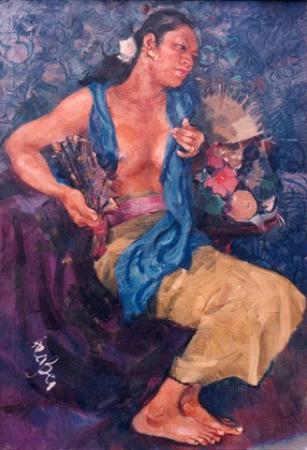 Roland Strasser, an Austrian painter of Basque descent, was born in Vienna in 1895. He was one of the great painter/adventurers of the early 20th century, and one of the last Orientalist romantics. His energetic paintings and drawings captured and portrayed the lives of subjects from regions and cultures still considered “exotic” by European viewers of the era. Once described by an admirer as “a strange, restless painter, who disappears for years…” Strasser was known for painting subjects that were difficult or even dangerous to paint.
Strasser first studied art with his father – whose family name was Quiriqez — a member of the Viennese Sucession movement who taught at the Academy of Fine Arts and was known for his small scale polychrome ceramic sculptures and also for a bronze of Marc Antony that he created for the 1900 Paris World Exhibition. Strasser’s older brother Benjamin was also a painter and graphic artist. At the age of 17, after completing his studies at a Realschule, Roland Strasser accompanied his father on a trip to Egypt.
Strasser next studied with Rudolf Jettmar and Julius Schmidt at the Vienna Academy of Fine Arts between 1911 and 1915. He was then assigned as war artist for the Imperial War Press. Roland then briefly worked as a lithographer and illustrator. In 1919 he traveled to Holland where he painted at Volendam and earned enough money selling paintings to be able to travel the following year.
In 1920 Strasser traveled first to Siam (Thailand), then Java (Indonesia) and finally New Guinea. Along with another adventurer – whose intention was to shoot exotic birds – Strasser journeyed to the remote and forbidding interior of New Guinea. After being abandoned by his companion he spent four months in a Papuan village. He eventually made his way back to Java, but all of his drawings were lost. He then spent eighteen months at Bali where he met Willem Dooyewaard, a Dutch artist, who became his student and frequent travel companion.
In the autumn of 1922 Strasser traveled to Peking, and from there to the province of Shansi, where he made studies of peasants. He then continued on to Mongolia, and by 1924 was in the province of Szetshwan and finally the mountains of Tibet. As an artist, he used his rendering skills to render activities, postures and psychological states of his subjects. The works he made during this trip – both drawings and paintings – were shown in London by a Mr. W. B. Patterson, and the proceeds from their sale provided Strasser with funds for his next trip.
Strasser traveled through Bombay, Nagpur and Calcutta, then into the foothills of the Himilayas where he planned another trek into Tibet. At Kalimpong he assembled a caravan, and in January of 1925 he crossed the Kula Pass, and 10 months later reached Urga (now Ulaanbaatar) in Mongolia. After spending a year in Urga, Soviet authorities arrested Strasser as a spy. His diary and maps were confiscated, but he was allowed to keep his paintings and drawings.
In the winter of 1926 he travelled through the Gobi desert into China. He then took a train to Peking where all of the drawings he had made in Tibet and Mongolia were pillaged and destroyed by the troops of General Chang So-ling. Strasser travelled next to Tientsin, and then to Japan where he visited Kobe and Kyoto. Eight months later he took the Trans-Siberian railway to Vienna to visit his ailing father. After his father’s death in October, 1927 he remained in Europe and was the subject of an exhibition at the Berheim Jeune Gallery in Paris in February, 1928.
In 1930 he published “The Mongolian Horde,” an account of five years of his travels in China and Mongolia, with 21 sketches included. In the foreward to his book, Strasser wrote:
“During five years of wandering in the heart of Asia, I accepted my experiences and impressions like such a child…But now that it is over, I feel the impulse to note down and retain, while they are still vivid, some at least of the strange and thrilling impressions that crowd upon me, in the shape of a few descriptive and open sketches.”
After additional travels, Strasser returned to Bali in 1934 where he stayed until 1944.
For years he had a studio in Kintamani above Lake Batur. He disliked visitors, and would leave his studio through a secret back door when not in the mood to entertain visitors.
Roland Strasser died in Santa Monica, California on July 27, 1974