Page loaded successfully. Showing biography for Ronald Langley Bloore.
Ronald Langley Bloore BIOGRAPHY
1925 Brampton, Ontario, Canada - 2009. Known for: Painting, sculpture, graphic art, murals and teaching.
Ronald Langley Bloore is a painter, sculptor, graphic artist, muralist and educator who was born in Brampton, Ontario, Canada. He's lived in St.Louis, Missouri (1953-55); London, England (1956-57);... Read full biography
Ronald Langley Bloore is a painter, sculptor, graphic artist, muralist and educator who was born in Brampton, Ontario, Canada. He's lived in St.Louis, Missouri (1953-55); London, England (1956-57); Toronto, Ontario (1957-58); and Regina, Saskatchewan (1958-66). In 1966, he returned to Toronto where... Read full biography
Ronald Langley Bloore is a painter, sculptor, graphic artist, muralist and educator who was born in Brampton, Ontario, Canada. He's lived in St.Louis, Missouri (1953-55); London, England (1956-57); Toronto, Ontario (1957-58); and Regina, Saskatchewan (1958-66). In 1966, he returned to Toronto where he lives and works today. His medium is primarily oil or stovepipe enamel on masonite applied with palette knife; however, there is a large body of important ink drawings done in the 1960's and ink... Read full biography
Ronald Langley Bloore is a painter, sculptor, graphic artist, muralist and educator who was born in Brampton, Ontario, Canada. He's lived in St.Louis, Missouri (1953-55); London, England (1956-57); Toronto, Ontario (1957-58); and Regina, Saskatchewan (1958-66). In 1966, he returned to Toronto where he lives and works today. His medium is primarily oil or stovepipe enamel on masonite applied with palette knife; however, there is a large body of important ink drawings done in the 1960's and ink paintings done in the 1980's. He has also worked in gouache, collage and mixed mediums. His sculptures are created from found items especially wooden spoons and are referred to as "Sploores". They depart from his usual subject matter because many of... Read full biography
Ronald Langley Bloore is a painter, sculptor, graphic artist, muralist and educator who was born in Brampton, Ontario, Canada. He's lived in St.Louis, Missouri (1953-55); London, England (1956-57); Toronto, Ontario (1957-58); and Regina, Saskatchewan (1958-66). In 1966, he returned to Toronto where he lives and works today. His medium is primarily oil or stovepipe enamel on masonite applied with palette knife; however, there is a large body of important ink drawings done in the 1960's and ink paintings done in the 1980's. He has also worked in gouache, collage and mixed mediums. His sculptures are created from found items especially wooden spoons and are referred to as "Sploores". They depart from his usual subject matter because many of them have eyes or other features that give them a whimsical appearance, and, though... Read full biography
Artist Biography
Biography page for Ronald Langley Bloore ((1925 - 2009)), known for Painting, sculpture, graphic art, murals and teaching. Showing 2 biographical entries and 0 sample artworks.
Ronald Langley Bloore - Artist Info
About Ronald Langley Bloore
Biography from the Archives of askART
 Ronald Langley Bloore is a painter, sculptor, graphic artist, muralist and educator who was born in Brampton, Ontario, Canada. He's lived in St.Louis, Missouri (1953-55); London, England (1956-57); Toronto, Ontario (1957-58); and Regina, Saskatchewan (1958-66). In 1966, he returned to Toronto where he lives and works today.
His medium is primarily oil or stovepipe enamel on masonite applied with palette knife; however, there is a large body of important ink drawings done in the 1960's and ink paintings done in the 1980's. He has also worked in gouache, collage and mixed mediums.
His sculptures are created from found items especially wooden spoons and are referred to as "Sploores". They depart from his usual subject matter because many of them have eyes or other features that give them a whimsical appearance, and, though quite different, remind the author of some of Picasso's work.
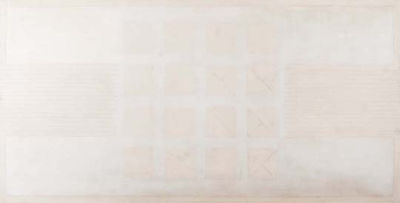
Other than the "Sploores" his subjects are pure abstraction, focusing on colour (mostly white), pattern, line and texture. His style is abstract expressionism, geometric abstraction and lyrical abstraction. It is usually recognized by monochromatic shades of white on white with highly textured impasto, patterned surfaces and large simple shapes. They also seem to exude a sort of elegance. Artist Quote: "I am not aware of any intention while painting with the exception of making a preconceived image function formally as a painting." He is a very intellectual artist.
Bloore has a B.A. degree in Art and Archaeology from the University of Toronto (1946 - 1949) and an M.A. in the same subjects from Washington University, St. Louis (1951 - 1953). He has also studied at the Institute of Fine Arts at New York University, the Belgium - American Education Foundation in Brussels and Antwerp (1955), and at the Courtauld Institute at the University of London, England (1955 - 1957).
He has taught at Washington University (while studying) (1951-1954); the Brixton Day College, London, England (1956-1957); the University of Toronto (1957-1958); the University of Saskatchewan, Regina (1958-1966) and was a Professor in the faculty of Arts at York University, Toronto from 1966 until his retirement in 1990. He has traveled extensively including to Greece, Turkey, Egypt, Spain, and France from 1962 to 1963 and in Iceland, Norway, Sweden and Denmark in 1966. He has also travelled to Germany, Holland, Portugal, Mexico, Guatemala, Honduras, Alaska and the Arctic.
During his time in Regina, he served as the director of the Norman Mackenzie Art Gallery (1958 -1960), and worked with Kenneth Campbell Lochhead (see AskART) and Arthur McKay (see AskART) in developing the Emma Lake Professional Artists' Workshops into one of the driving forces of Canadian Modernism. Interestingly, this was accomplished by inviting members of the New York School such as Barnett Newman, Kenneth Noland and Jules Olitski as well as the critic Clement Greenberg to speak and teach. He was also a member of a short lived but, influential group of painters known as the Regina Five (1959 - 1964) which along with Lochhead and Mckay included Ted Godwin (see AskART) and Douglas Morton (see AskART). They had a show at the National Gallery of Canada (Ottawa) in 1961. He has also been a member of the Federation of Canadian artists. During World War II, he served in the Canadian Army and RCAF.
His work has been exhibited continuously for over 50 years in solo and group shows in commercial and public galleryies. Some of the museum venues are Winnipeg Art Gallery (Manitoba) (1958, 63, 65, 75, 83, 92); Art Gallery of Ontario (Toronto) (1959, 74); National Gallery of Canada (Ottawa) (1961, 63, 68, 69, 93); Norman Mackenzie Art Gallery (Regina) (1962, 65, 71, 75); Montreal Museum of Fine Arts (1962); Art Gallery of Hamilton (Ontario) (1962, 94); Agnes Etherington Art Centre (Kingston, Ontario) (1963, 75, 85); Vancouver Art Gallery (B.C.) (1963, 75); Edmonton Art Gallery (Alberta) (1978, 92, 94); Glenbow Art Gallery (Calgary) (1993, 99); the Robert Mclaughlin Gallery (Oshawa) (2001); Art Gallery of Peterborough (Ontario) (2005) and many more.
Bloore's works are in many private, corporate and public collections. Some of the public collections are the Art Gallery of Greater Victoria, Victoria, British Columbia; Simon Fraser University, Burnaby, British Columbia; the Vancouver Art Gallery, Vancouver, British Columbia; the Edmonton Art Gallery, Edmonton, Alberta;the Mendel Art Gallery, Saskatoon, Saskatchewan; the Norman Mackenzie Art Gallery, Regina, Saskatchewan; the Winnipeg Art Gallery, Winnipeg, Manitoba; the Art Gallery of Windsor, Windsor, Ontario; Museum London, London, Ontario; the Art Gallery of Hamilton, Hamilton, Ontario; McMaster University Art Gallery, Hamilton, Ontario; the Art Gallery of Ontario, Toronto, Ontario; York University, Toronto, Ontario; Hart House, University of Toronto, Toronto, Ontario; the Robert McLaughlin Gallery, Oshawa, Ontario; the Art Gallery of Peterborough, Peterborough, Ontario; the Agnes Etherington Art Centre, Kingston, Ontario; the National Gallery of Canada, Ottawa, Ontario; the Montreal Museum of Modern Art; the Montreal Museum of Fine Arts; the New Brunswick Museum, Saint John, New Brunswick; the Beaverbrook Art Gallery, Fredericton, New Brunswick; and the Nova Scotia Art Gallery, Halifax, Nova Scotia.
His murals can be seen at the International Airport, Dorval, Quebec and the Confederation Centre Art Gallery and Museum, Charlottetown, Prince Edward Island.
Among his many honours and awards are the Order of Canada (CM) in 1993, one of the country's highest honours. He was also awarded the Centennial Medal in 1967. In 1993 he received an Honorary Doctor of Letters degree from York University. In 2001, he received an Honorary Doctor of Laws degree from the University of Regina.
As a very prominent artist his work is discussed in many books about Canadian art history and modern art, there are also numerous magazine and newspaper articles dated as early as March 1951 (Canadian Art magazine). He is listed in A Dictionary of Canadian Artists (1974), by Colin S. MacDonald; in The Collector's Dictionary of Canadian Artists at Auction (2001), by Anthony R. Westbridge and Diana L. Bodnar; in The Canadian Encyclopedia (1985), Hurtig Publishers; in the 1999 and 2006 versions of E. Benezit, published by Grund; and, prematurely, in Falks Who Was Who in American Art.
His work is also illustrated and discussed in Art Gallery of Ontario - The Canadian Collection (1970), by Helen Pepall Bradfield; in Contemporary Canadian Art (1983), by David Burnett and Marilyn Schiff; in Visions - Contemporary Art in Canada (1983), various authors and editors; in The History of Painting in Canada - Toward A Peoples Art (1974) by Barry Lord; in A Concise History of Canadian Painting (1973), by Dennis Reid; in Great Canadian Painting - A Century of Art (1966), by Elizabeth Kilbourn; in Four Decades (1972) by Paul Duval; in Painting in Canada: A History (1966) by J. Russell Harper; in Landmarks of Canadian Art (1978), by Peter Mellen; in Documents in Canadian Art(1987), edited by Douglas Fetherling; in Three Hundred Years of Canadian Art (1967), by R.H.Hubbard and J.R. Ostiguay; in Enjoying Canadian Painting (1976), by Patricia Godsell; in Contemporary Canadian Painting (1972), by William Withrow; in The Best Contemporary Canadian Art (1987), by Joan Murray; in Canadian Art Today (1970), by William Townsend; in Ciniplex Odeon(1989), by David Burnett; in Modern Painting in Canada (1978), by Terry Fenton and Karen Wilkin; in Agnes Etherington Art Centre (1968), by Frances K. Smith; in Canadian Art: From its Beginnings to 2000 (2000), by Anne Newlands; and in Canadian Art in the Twentieth Century (1999), by Joan Murray.
Prepared and contributed to askART by M.D. SilverbrookeBiography from Waddington's
Ron Bloore (1925-2009) steadfastly refused to give titles to his works, or even discuss the meaning or content of his art. Instead, he prefers his paintings to directly engage the viewer without any mediation, allowing their immediate perception to determine their reaction to the piece.
“The meaning of any work of art is determined entirely by the individual experiencing it,” Bloore says: what the beholder reveals is an extension of his experience in life, “not a confirmation of what he already knows.”
For Bloore, painting is given revelatory power: one that is rooted in the viewer, but demanding a dialogue between lived experience and the image. Bloore’s work from this period was characterised by an interest in experimenting with destabilising the painted surface as a two-dimensional space, seeking to play with surface and texture to create absorbing and expansive works.
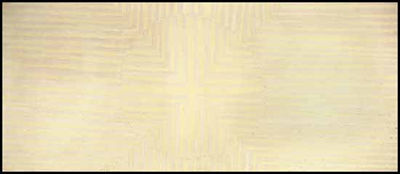
Here, the dashed static of soft greys and whites dominate the canvas, the paint deeply furrowed in a patchwork field of thin ridges. A strip of flat white runs along the edge, bounding in the heavily textured mottling with a moment of quiet. This conflict between balance and breakage is compounded by the monumental size of the work: the painting seems to oscillate between the stability of the rectangle and a buzz of restless movement that surges across the surface, threatening to break out of frame. Carefully stripped of colour and reference, Bloore invites us to expand our perception into a realm of infinite potential.