Page loaded successfully. Showing biography for Ross Bleckner.
Ross Bleckner BIOGRAPHY

Born 1949 New York City. Known for: Non objective, op imagery-stripe painting.
Ross Bleckner grew up in Hewlett, Long Island, New York; drawing all the time without being aware that other artists existed. He was the middle child between two sisters; his father manufactures... Read full biography
Ross Bleckner grew up in Hewlett, Long Island, New York; drawing all the time without being aware that other artists existed. He was the middle child between two sisters; his father manufactures electronic parts He attended New York University where Sol Lewitt, Chuck Close and others were his... Read full biography
Ross Bleckner grew up in Hewlett, Long Island, New York; drawing all the time without being aware that other artists existed. He was the middle child between two sisters; his father manufactures electronic parts He attended New York University where Sol Lewitt, Chuck Close and others were his teachers. He graduated in 1972, then spent a year at the California Institute of Arts. His contacts in the next few years were very fortuitous; Sol Lewitt and Chuck Close, Carl Andre, David Salle, Julian... Read full biography
Ross Bleckner grew up in Hewlett, Long Island, New York; drawing all the time without being aware that other artists existed. He was the middle child between two sisters; his father manufactures electronic parts He attended New York University where Sol Lewitt, Chuck Close and others were his teachers. He graduated in 1972, then spent a year at the California Institute of Arts. His contacts in the next few years were very fortuitous; Sol Lewitt and Chuck Close, Carl Andre, David Salle, Julian Schnabel, etc. Bleckner is on the nervous side, beset by self-doubt, insomnia, and gloom. He is unpretentious, although he is bluntly handsome, with olive complexion, and a compact build. He is "10 percent that is superficial and 90 percent that has... Read full biography
Ross Bleckner grew up in Hewlett, Long Island, New York; drawing all the time without being aware that other artists existed. He was the middle child between two sisters; his father manufactures electronic parts He attended New York University where Sol Lewitt, Chuck Close and others were his teachers. He graduated in 1972, then spent a year at the California Institute of Arts. His contacts in the next few years were very fortuitous; Sol Lewitt and Chuck Close, Carl Andre, David Salle, Julian Schnabel, etc. Bleckner is on the nervous side, beset by self-doubt, insomnia, and gloom. He is unpretentious, although he is bluntly handsome, with olive complexion, and a compact build. He is "10 percent that is superficial and 90 percent that has to do with the depths and that is threatened by living. He is a very complicated individual... Read full biography
Artist Biography
Biography page for Ross Bleckner ((Born 1949)), known for Non objective, op imagery-stripe painting. Showing 5 biographical entries and 0 sample artworks.
Ross Bleckner - Artist Info
About Ross Bleckner
Biography from the Archives of askART
 Ross Bleckner grew up in Hewlett, Long Island, New York; drawing all the time without being aware that other artists existed. He was the middle child between two sisters; his father manufactures electronic parts He attended New York University where Sol Lewitt, Chuck Close and others were his teachers. He graduated in 1972, then spent a year at the California Institute of Arts. His contacts in the next few years were very fortuitous; Sol Lewitt and Chuck Close, Carl Andre, David Salle, Julian Schnabel, etc.
Bleckner is on the nervous side, beset by self-doubt, insomnia, and gloom. He is unpretentious, although he is bluntly handsome, with olive complexion, and a compact build. He is "10 percent that is superficial and 90 percent that has to do with the depths and that is threatened by living. He is a very complicated individual. He is a very, very morose, deeply feeling, hardworking artist- he takes a lot from within himself - but always, no matter how successful he is, he feels he is going to fall into those depths." 1
Bleckner first exhibited his work in New York in 1974. The following year he was given his first one-man show; he was included in the 1975 Whitney Biennial.. Since about 1985 has addressed many of his paintings to the subject of AIDS- both documenting it as a historical phenomenon and commemorating specific individuals who have died.
Written and submitted by Jean Ershler Schatz, artist and researcher from Laguna Woods, California.
Sources include:
Ross Bleckner's Mood Indigo by Lisa Liebmann, in ARTnews, May 1993,
Art and Auction magazine, November 16, 1998
Art in America, November 1996
Art in America, May 1986
Footnote
(1) quote from Betty Cunningham of the Cunningham-Ward galleryBiography from the Archives of askART
 Ross Bleckner's large-format pictures utilize both graphic designs and representational images such as flowers, birds, cages, grilles, drops of water, oceans and chandeliers. These are represented in front of an abstract background and he often uses flickering light to create challenging visual experiences. For Bleckner the canvas is "a place where countless different meanings cross and enter into relationship with one another."
Bleckner was born in New York and studied at New York University until 1971 and then did graduate work, receiving his M.F.A. at the California Institute of Art. He returned to New York and in 1975, had his first solo exhibit and was part of the Whitney Biennial Exhibition. He has also had solo exhibitions at the San Francisco Museum of Art and the Milwaukee Art Museum.
Source:
Lars Larsen, Art at the Turn of the MillenniumBiography from RoGallery
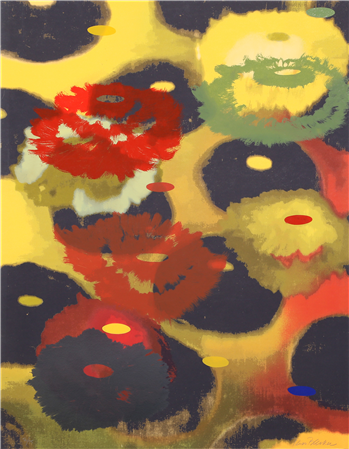 Ross Bleckner emerged as a central figure in the revival of American painting, a position he has solidified in the 1990's. Through various subjects and motifs - optically dizzying stripes, nocturnal landscapes, funerary urn, memorial imagery, chandeliers, abstract domes, birds, sunflowers and constellations - Bleckner evokes memory, desire, and irony in order to examine the uncertainty of the human condition, while simultaneously celebrating the transcendent principles of nature and the cosmos.
Bleckner's principle focus is the theme that pervades his work: light in a series of essays for the catalogue of his retrospective at the Solomon R Guggenheim Museum March 3 - May 14, 1995, written by Lisa Dennison, Curator of Collections and Exhibitions at the Solomon R Guggenheim museum; Thomas Crow, Professor of History of Art at the University of Sussex and Simon Watney, critic. Bleckner's work was placed in the context of recent art history. The text and show explore the interplay between Bleckner's painterly inventiveness and the rediscovery of themes and effects used by artists of another age.
Works by Ross Bleckner are in the principle museums of contemporary art including; the Solomon R Guggenheim Museum of Art, The Whitney Museum of American art and the San Francisco Museum of Modern Art.Biography from Rago Arts and Auction Center
Ross Bleckner was born in 1949 in New York and grew up on Long Island. Bleckner attended New York University, studying under artists such as Sol LeWitt and Chuck Close before graduating in 1971. He went on to study at the California Institute of the Arts,earning an MFA in 1973. Upon moving back to New York in 1974, Ross Bleckner purchased a building in Tribeca, where he lived and worked. He also rented three floors to the artist Julian Schnabel and the ground floor to the famed Mudd Club, a gathering place for the musicians and artists of the downtown scene.
In 1979, after several well-received shows of his early abstracted geometric paintings, Bleckner began being represented by Mary Boone Gallery, home to many of the New York City “art stars” of the coming decade. Bleckner began creating the work he is most known for in the mid-1980s, partly as a response to the AIDS crisis. A departure from his earlier nonrepresentational works, these large paintings depict urns, ornamental gates, chandeliers, flowers and fruit, floating, in a radiant glow, against dark backgrounds. These works are rooted in a sense of loss, dislocation and sentiment but also employ his earlier explorations of linear geometry, rendering the hard-edged lines of Op Art decorative and expressive.
Bleckner calls the light in these paintings “light from history,” citing Romantics such as William Blake and J.M.W. Turner among his inspirations. As a reaction to the cool detachment of the prevailing styles of the previous generation, Bleckner turned to emotional engagement, calling for artists to “reconcile the object with what we in fact do know and feel…take the emphasis off the continuous repetition of autonomous moments in the world of feeling and root these moments in a larger psychological, social and political reality.”
From this mentality came deeply moving works that confronted the turbulence of the times with vulnerability, as well as reinvigorated formalist abstraction with a personal, penetrating approach. In the late 1980s, the night sky began figuring predominantly in Bleckner’s work, both as place and non-place—enveloping atmospheric depictions of a physical phenomenon that we can often only observe and grasp through abstraction. Much like the floating objects of his earlier works, bathed in an otherworldly light, these sky paintings provoke a sense of a yearning melancholy.
Ross Bleckner’s first solo exhibition was held at the San Francisco Museum of Art in 1988 and a mid-career retrospective was presented at the Solomon R. Guggenheim Museum, New York in 1995. His paintings are widely held in collections such as The Museum of Modern Art, New York; Walker Art Center, Minneapolis; National Gallery of Art, Washington D.C.; and Museum of Fine Arts, Boston, among others. In addition to his paintings, Bleckner has also become involved in humanitarian efforts and was appointed as a United Nations Goodwill Ambassador in 2012, visiting refugee camps of abducted children in Uganda, making art with them and raising awareness and funds to support them. He continues to live and work in New York City.Biography from Phillips New York
Ross Bleckner's large-scale, almost-cosmic abstract paintings came to define a certain aesthetic era in New York in the 1980s and '90s. As much known for his celebrity friendships and Sex and the City references to his long-time relationship with gallerist Mary Boone, Bleckner is somewhat of a star, especially as the youngest artist to receive a solo retrospective at the Guggenheim at the age of 46. His circular dot paintings, which serve as both activism and tribute to the disastrous impact of the AIDS empidemic on New York's gay community, are some of his most buzzed-about and recognizable works still today. However, his heydey was hardly just the '90s—with international gallery exhibitions yearly and a steady, accessible market that has held its value; in 2016, Artnet described Bleckner as an "'80s Art World 'It' Boy Having a New York Moment" when he had six shows running concurrently.